

Welcome to the 77th investment case, 61st Resilience & Quality, 38th AI & Technology idea on Crack The Market (and the most comprehensive Alphabet investment case you will find online)! Join me as I dissect the company that sits at the exact center of the framework I published days ago in Token Economics: The Master Variable, the most valuable advertising business ever built, the fastest growing hyperscaler on the planet, and the one company that is already monetizing AI.
Twice a week, I release deep dives into stocks and sectors that fit into the 6 themes that I see winning in the coming years and decades: AI & Technology, Electrification & Energy, Reshoring & Sovereignty, Healthcare & Longevity, China & Asia, Resilience & Quality.
Take advantage of this once in a generation opportunity to build long term wealth by investing in great stocks that will deliver returns for your portfolio for years to come.
After reading this article, you will understand why Alphabet is the best illustration of my token economics thesis, why the second quarter of 2026 was one of the most important earnings of this entire AI supercycle, and why the shift from asset-light monopoly to asset-heavy full-stack AI platform is the defining risk and the defining opportunity in the story.
In this article I go through:
How Alphabet went from AI loser to the fastest re-rating in mega-cap history.
The breakdown of the company and its full-stack AI positioning.
Why Search is having an expansionary moment.
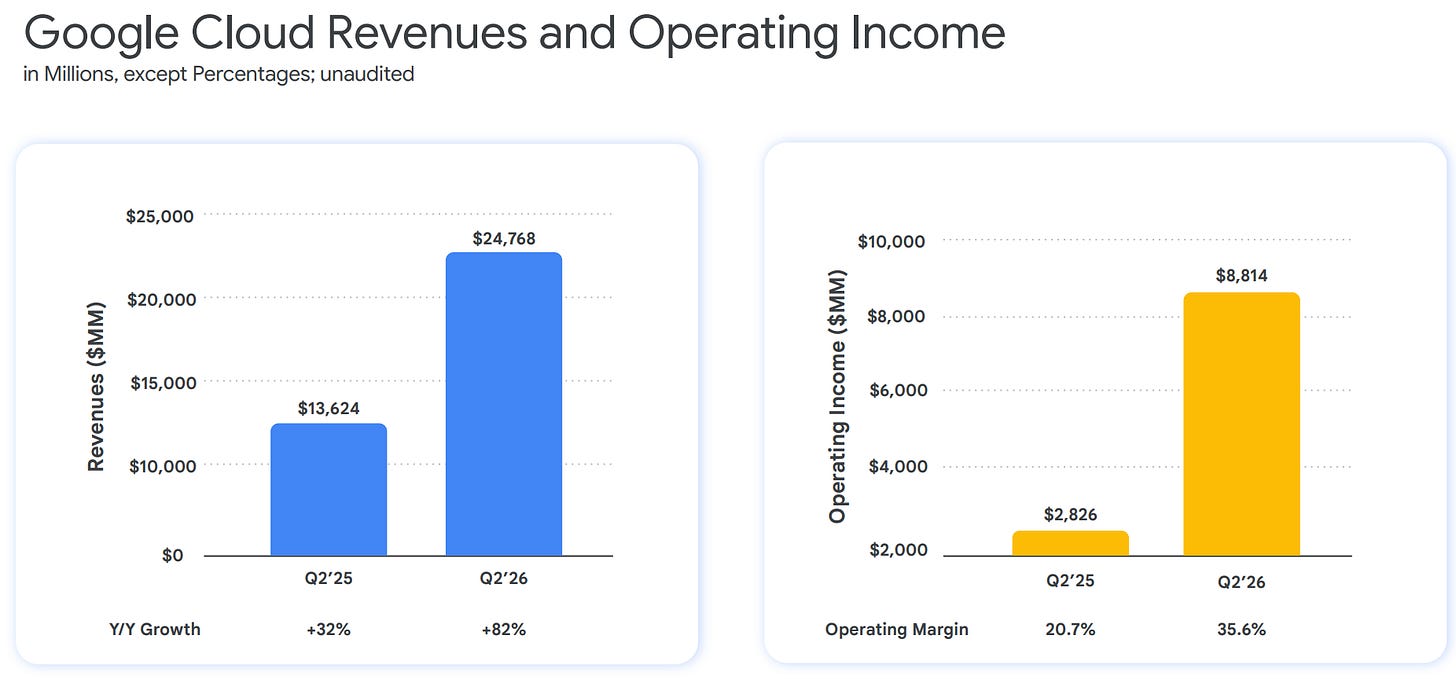
Why Cloud is now the story with its inflection, $514bn backlog, the arrival of TPU system sales, and what an 82% growth quarter at 35.6% margins tells us about AI returns on capital.
The financing question with the balance sheet transformation, the $195-205bn capex year, the first negative free cash flow quarter in the modern history of the company, and how to think about whether the buildout earns its cost of capital.
A full bear, base and bull scenario analysis, the valuation work, and what I would do with the stock after the post-earnings pullback.

Alphabet Investment Case
Table of content
Positioning - the continuation of Token Economics:
Days ago I published Token Economics: The Master Variable, and I want to be upfront that this deep dive is its direct continuation.
Here was my conclusion: The token is commoditizing and the AI trade can still pay for itself, because what services the capex is not the price of a token but the dollar pool of tokens, price times volume, and that pool is currently a race the volume side is winning.
As the price of any fixed level of intelligence collapses, value relocates away from anyone selling undifferentiated tokens and toward the two ends of the stack, the toll booths beneath that are paid on volume (notably the AI infrastructure providers like semicaps and semis), and the frontier and application layers above that are paid on differentiation.
The hyperscalers, like Alphabet, occupy the middle position, but they own the three things tokens cannot commoditize: distribution, proprietary data and the enterprise relationship. And whoever is paid on volume rather than on the spread carries the less speculative cash flow.

Alphabet is the name-level payoff of that entire thesis, which has massively strengthened in the last few days:
In the token piece I wrote that Alphabet’s cloud unit was annualizing near $80bn and growing above 60%.
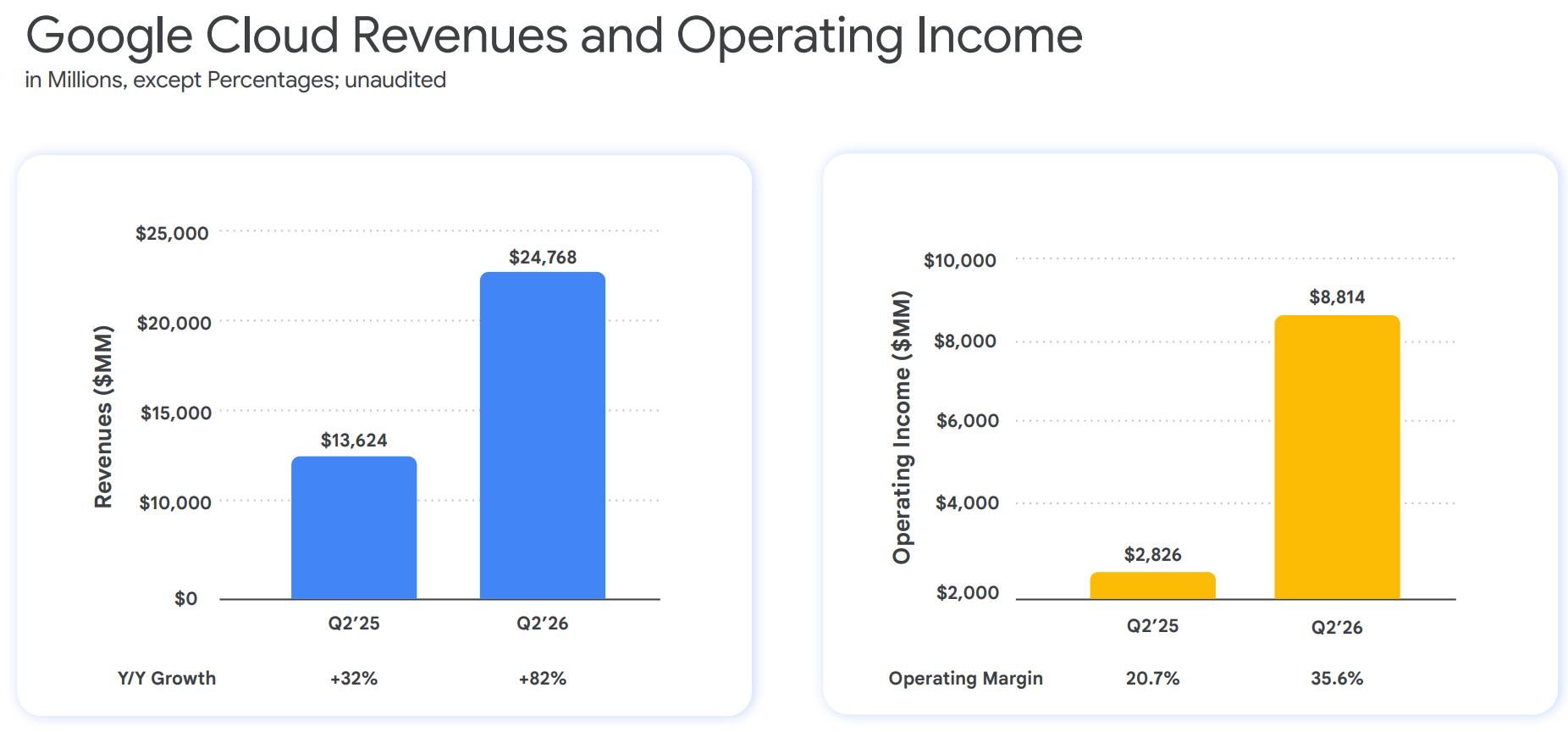
Roughly twenty-four hours later the company reported a quarter in which Google Cloud grew 82% year-on-year to $24.8bn, an annualized run-rate of $99bn, with segment operating margins of 35.6% and a backlog of $514bn.
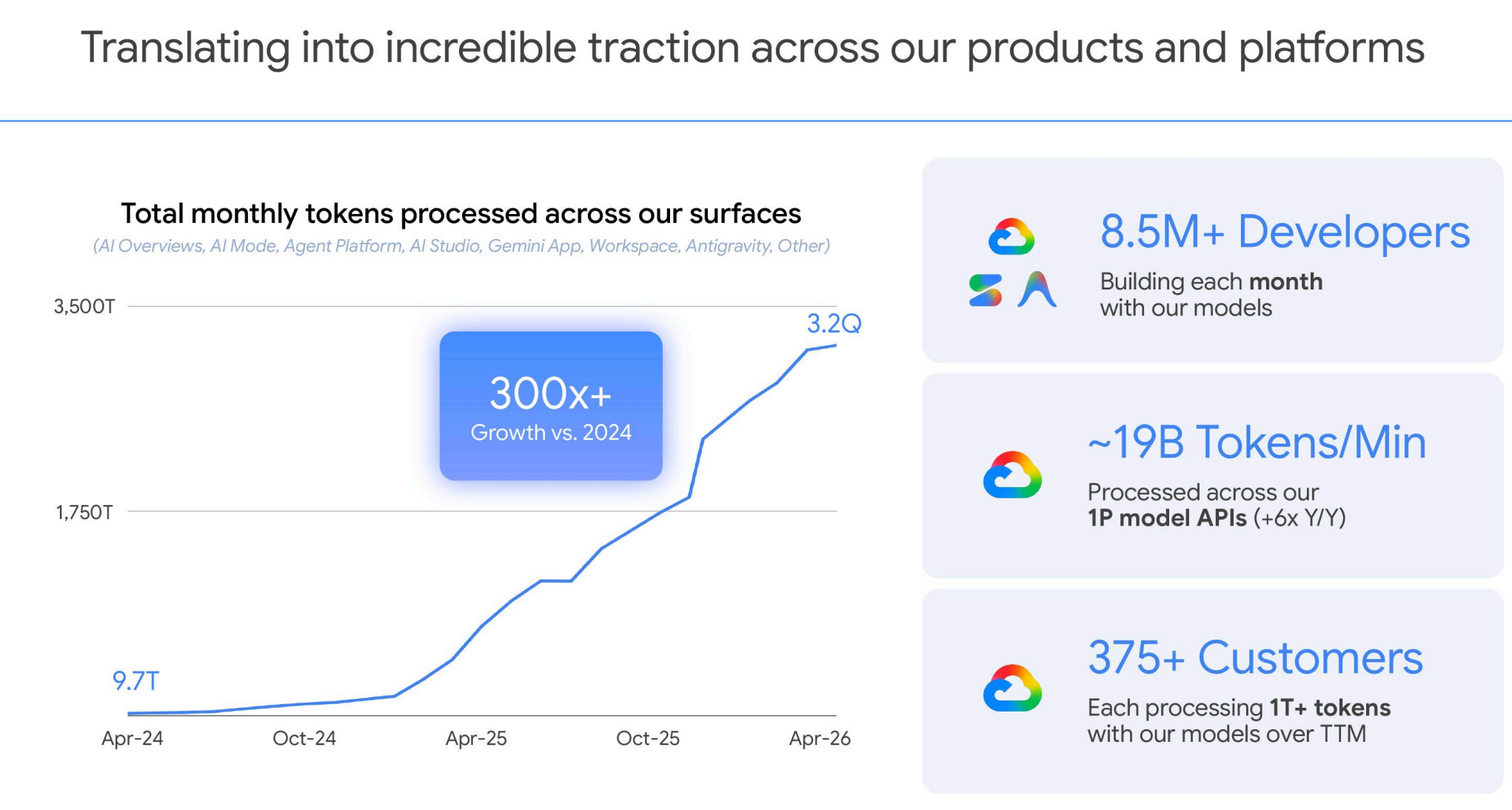
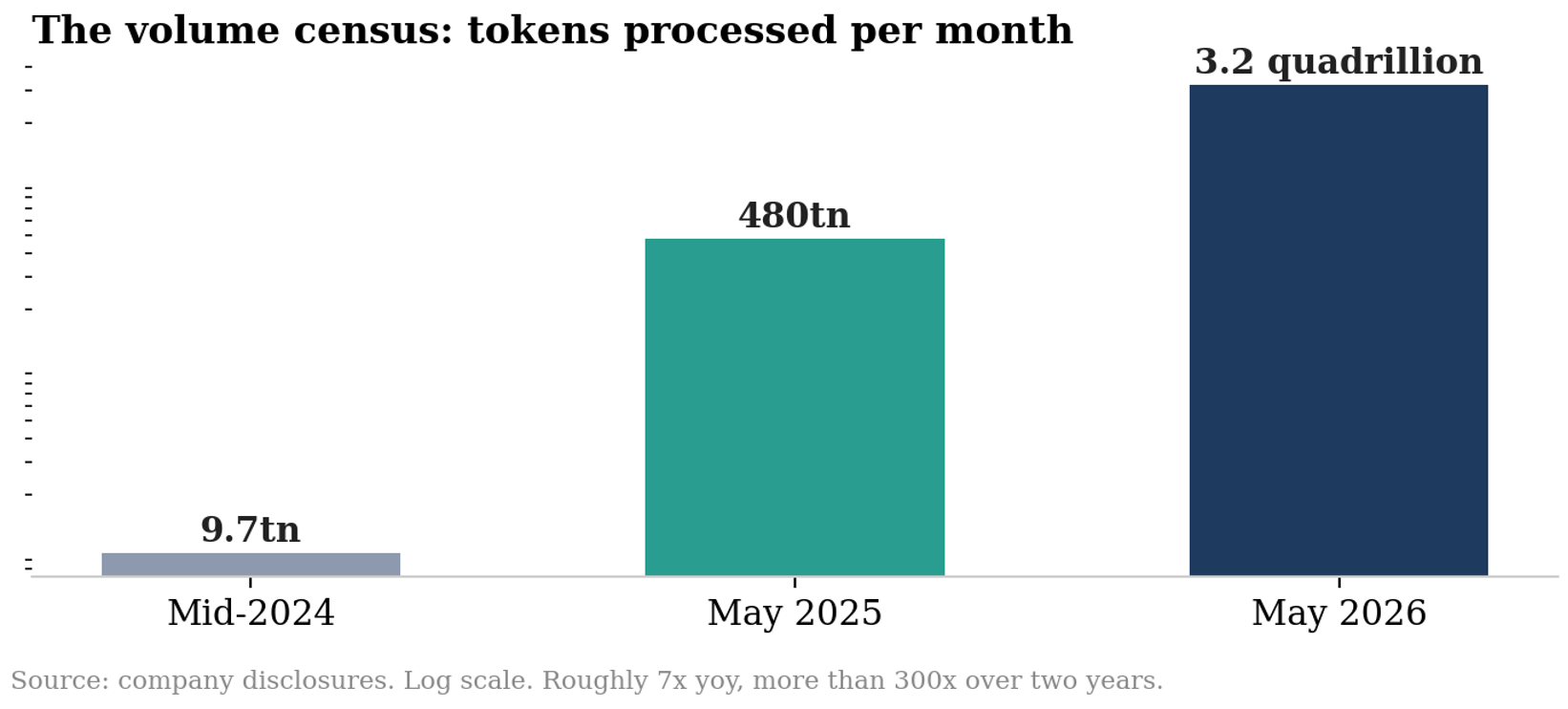
The single most important dataset in the token piece, the closest thing we have to a census of global AI volume, also comes from this company: Google processed over 3.2 quadrillion tokens in the month of May, up roughly sevenfold from 480 trillion a year earlier and more than 300 times the 9.7 trillion of two years ago.
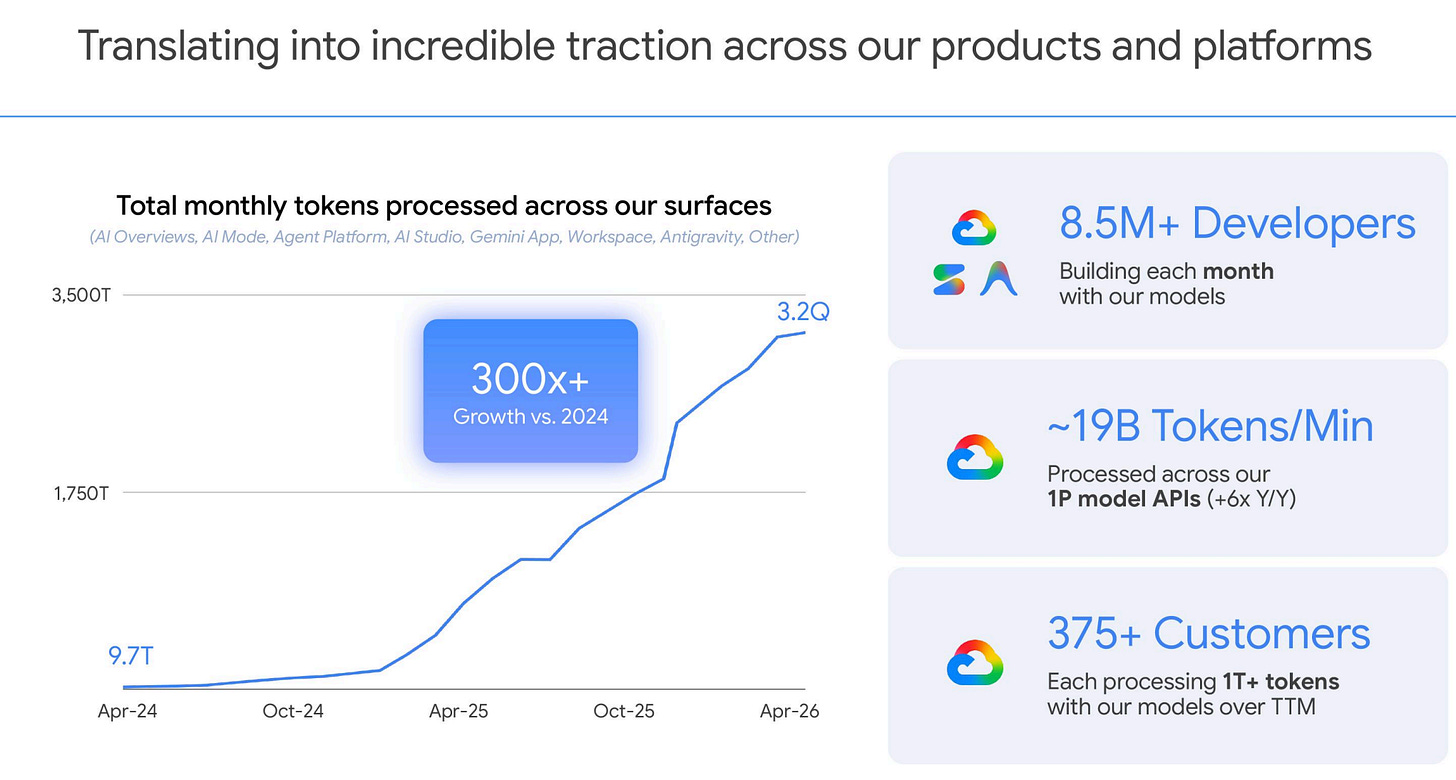
On the earnings call the company updated the flow metric: its first-party model APIs are now processing approximately 22bn tokens per minute, up from 16bn just one quarter earlier.
Nobody else on Earth can publish numbers like these, because nobody else sees this volume.
The organizing question of this deep dive is this: Is Alphabet the one hyperscaler that already resolves the AI monetization question inside its own P&L?
My answer is yes, with important caveats about what it is costing to get there.
Remember the framework: Alphabet is paid on volume at the bottom of its stack (Cloud infrastructure, and now TPU systems sold as hardware), paid on differentiation at the top (Search, YouTube, subscriptions), and it funds this from the strongest advertising cash flow machine in history, with the capital markets in a supporting rather than a load-bearing role.
When you own Alphabet, you are long the token volume curve and long the differentiated application layer at the same time, inside one name.
Business Description
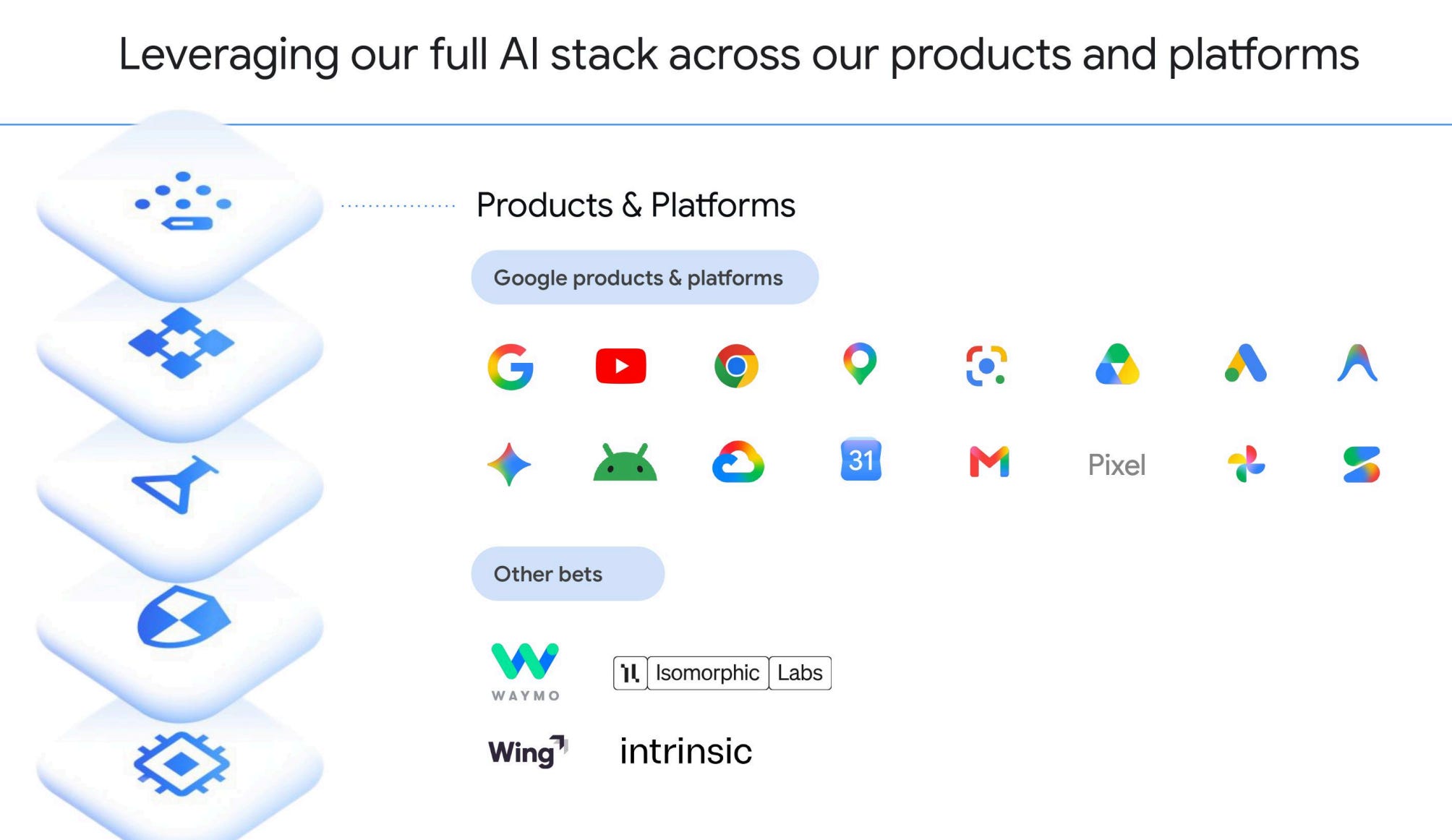
Headquartered in Mountain View, California, Google was founded in 1998 by Larry Page and Sergey Brin while they were PhD students at Stanford University. Today, Google runs the world’s largest search engine and a multitude of other internet-based services and products, including YouTube, Google Cloud, Chrome, Gmail, Google Drive, Google Maps, Google Play, and Android.
The company went public in 2004. Alphabet was launched in 2015 as the holding company for Google and other subsidiaries, a corporate restructure designed to provide some separation between Google’s core search business and its increasingly diverse side projects.
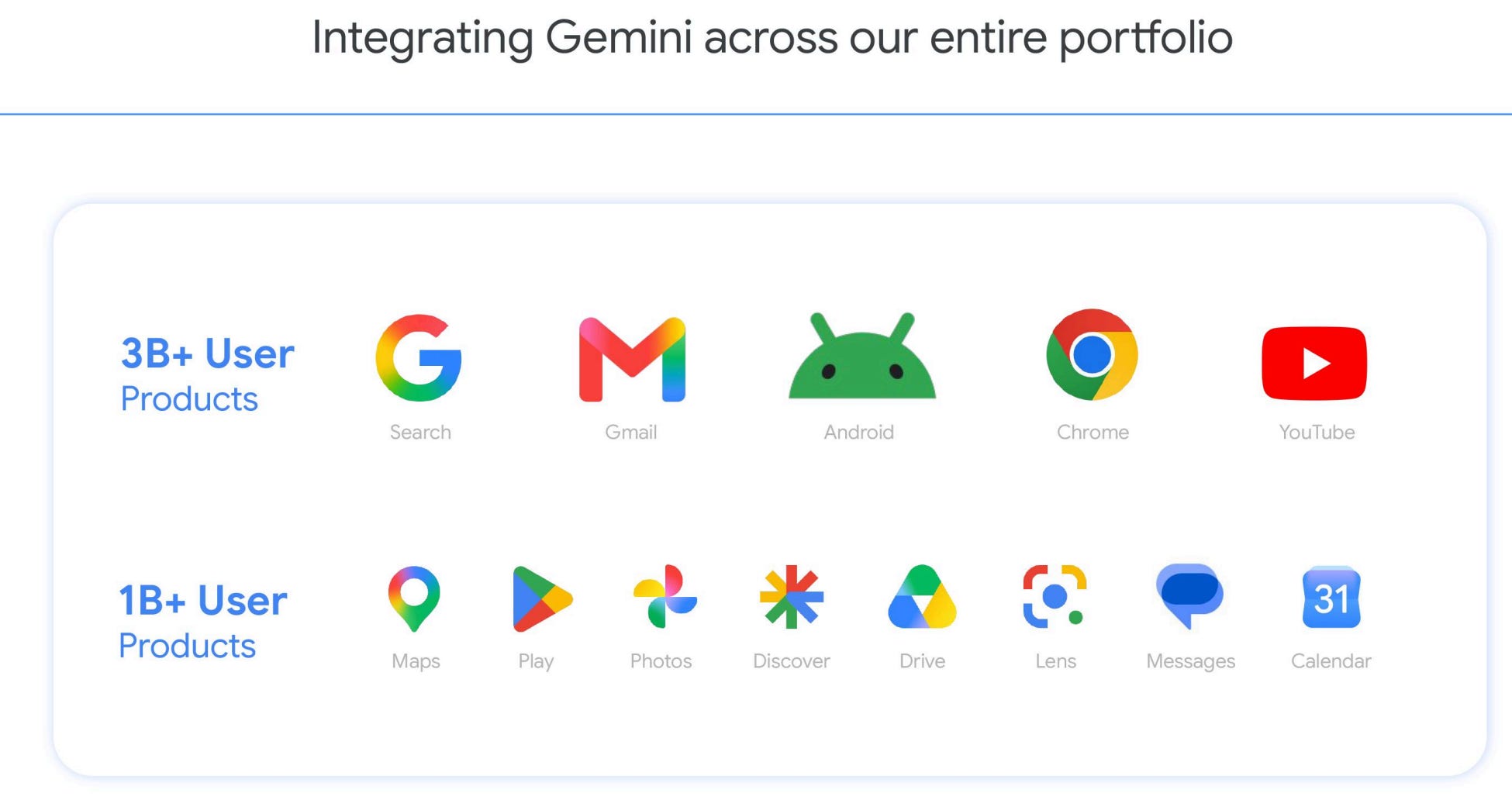
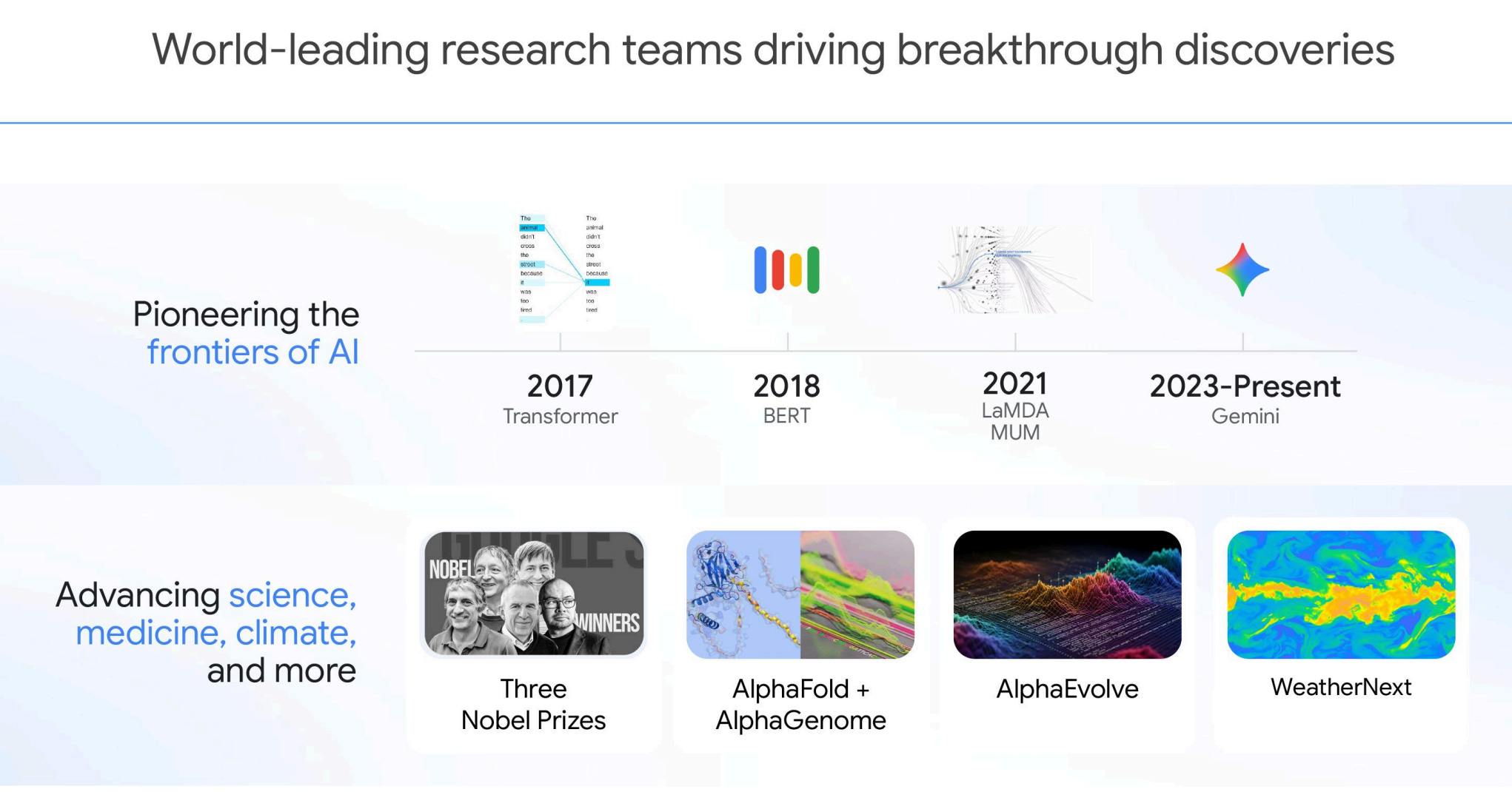
In 2023, the company launched Gemini, a natively multimodal AI model capable of understanding and integrating text, code, audio, image, and video. Gemini now powers all 13 of Alphabet’s products with more than a billion users each, five of which surpass 3 billion users.
Alphabet trades under GOOGL (Class A) and GOOG (Class C) on Nasdaq, sits in the Communication Services GICS sector, and after the second quarter of 2026 and the post-earnings selloff carries a market capitalization of roughly $3.9tn with around $11bn of average daily traded value and a free float near 99%.
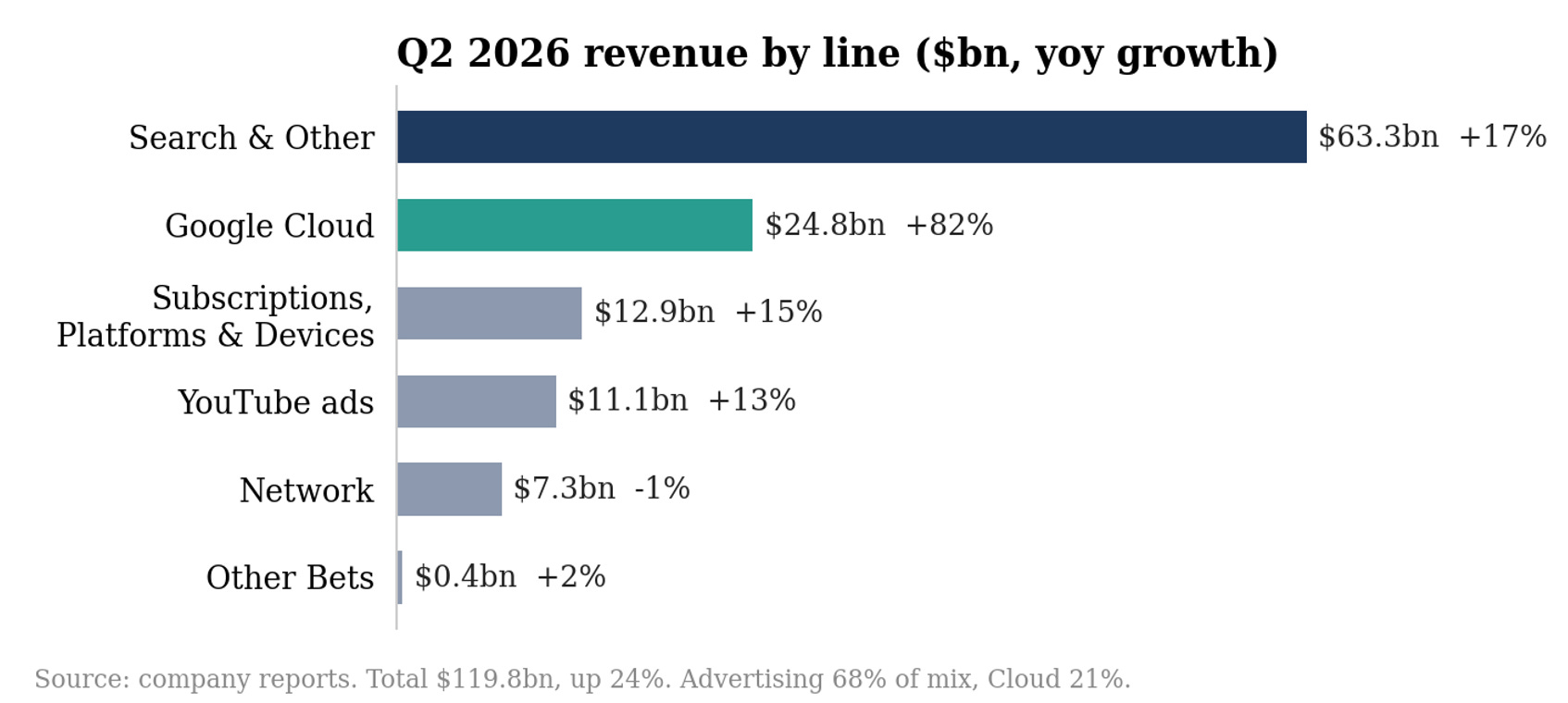
In FY2025 the company generated $402.8bn of revenue (net revenue of $342.9bn excluding traffic acquisition costs) and $129bn of GAAP operating income, a 37.6% margin on net revenue, and it has now delivered twelve consecutive quarters of double-digit revenue growth.
Alphabet reports through four buckets (three segments + a bucket of shared costs at the group level), and the mix is shifting faster than at any point in the company’s history:
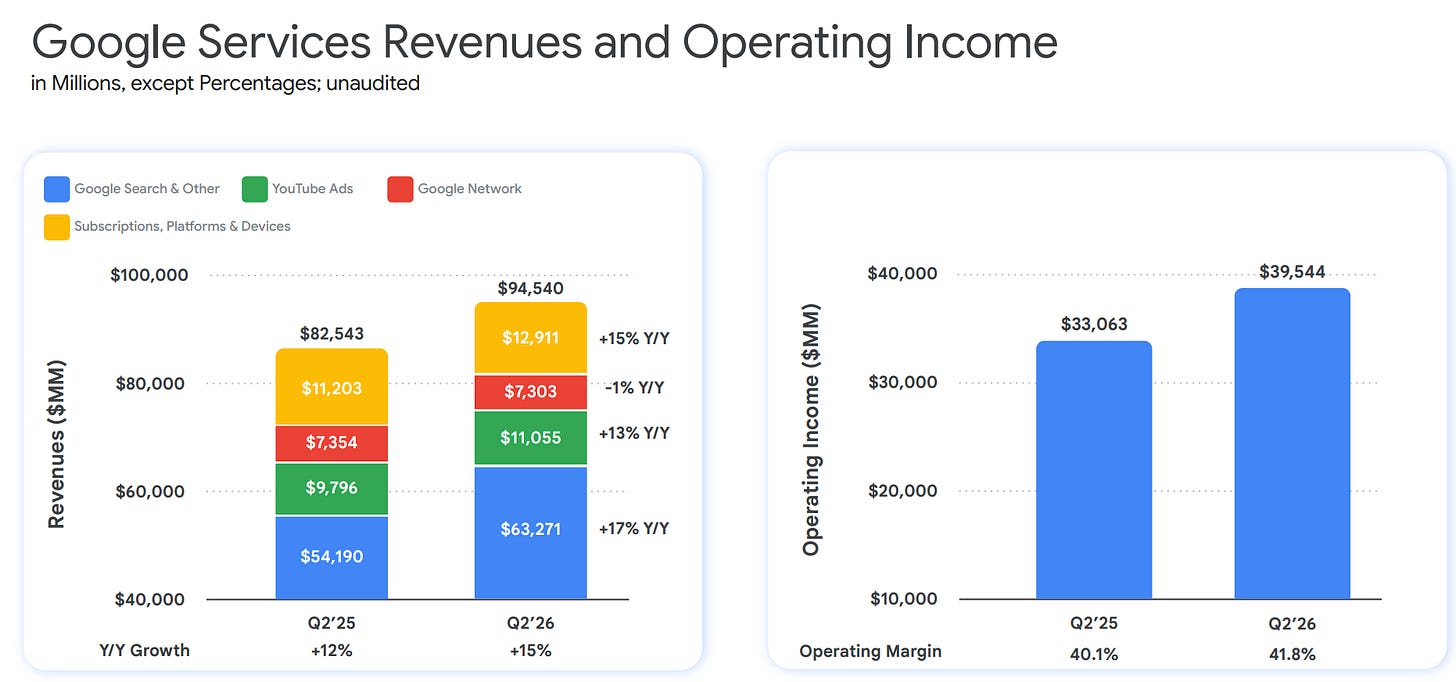
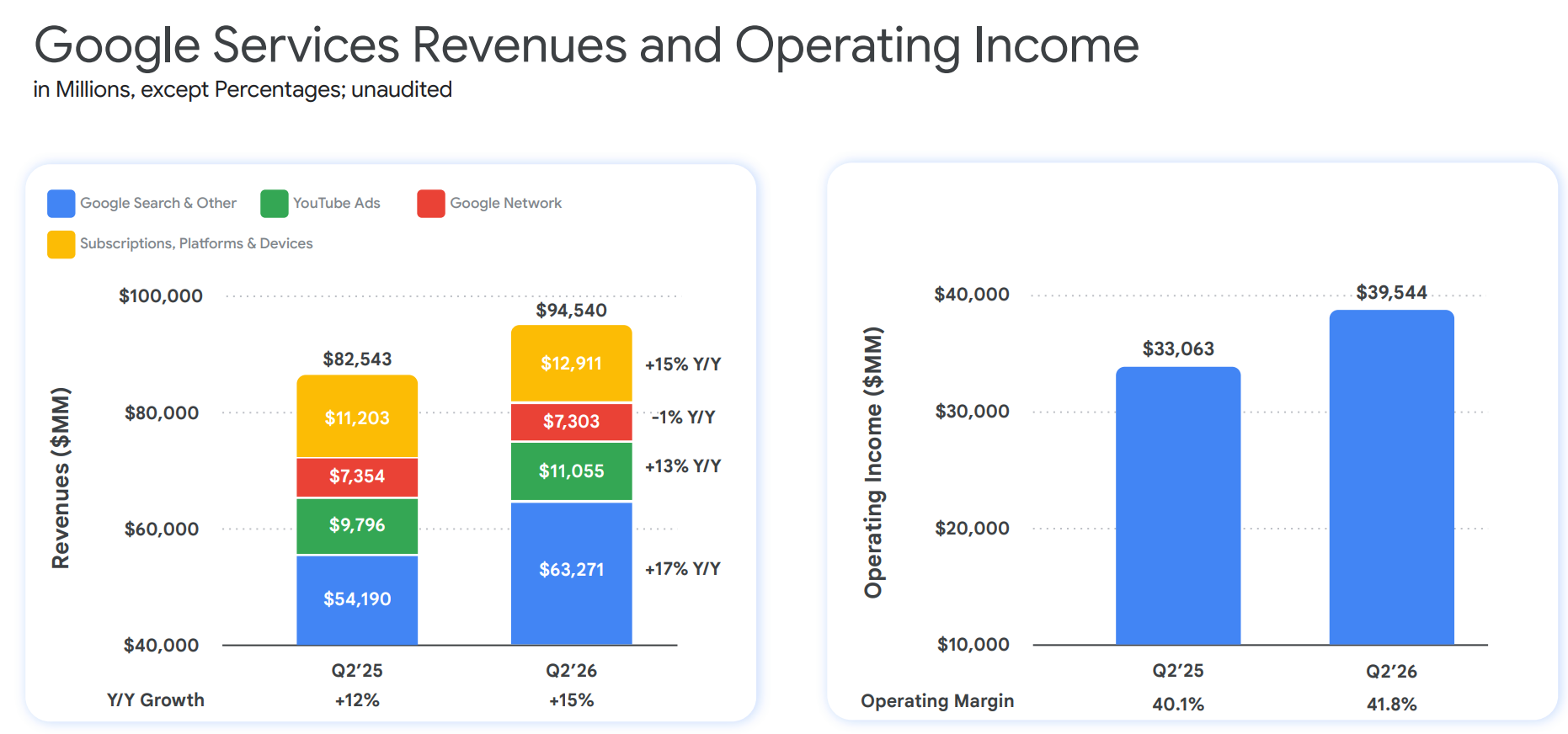
Google Services ($94.5bn in Q2 2026, 79% of revenue, up 15%, 41.8% operating margin, $39.5bn operating income) which has 4 revenue lines. This is the advertising and consumer engine.
Google Search & Other ($63.3bn, up 17%) remains the profit center of the entire enterprise, monetizing intent at a scale no other business has ever matched.
YouTube advertising ($11.1bn, up 13%) is the world’s dominant video platform across mobile and, increasingly, the living room television.
Google Network ($7.3bn, down 1%) is the structurally declining third-party ads business.
Subscriptions, Platforms & Devices ($12.9bn, up 15%) houses YouTube Premium and Music, Google One (where AI plans are the fastest growing driver), Play and the Pixel family.
Services operating margin reached 41.8% in the quarter, up from 40.1% a year ago, a remarkable statistic for a segment absorbing the inference costs of AI Overviews and AI Mode.
Google Cloud ($24.8bn in Q2 2026, 21% of revenue, up 82%, 35.6% operating margin, $8.8bn operating income).
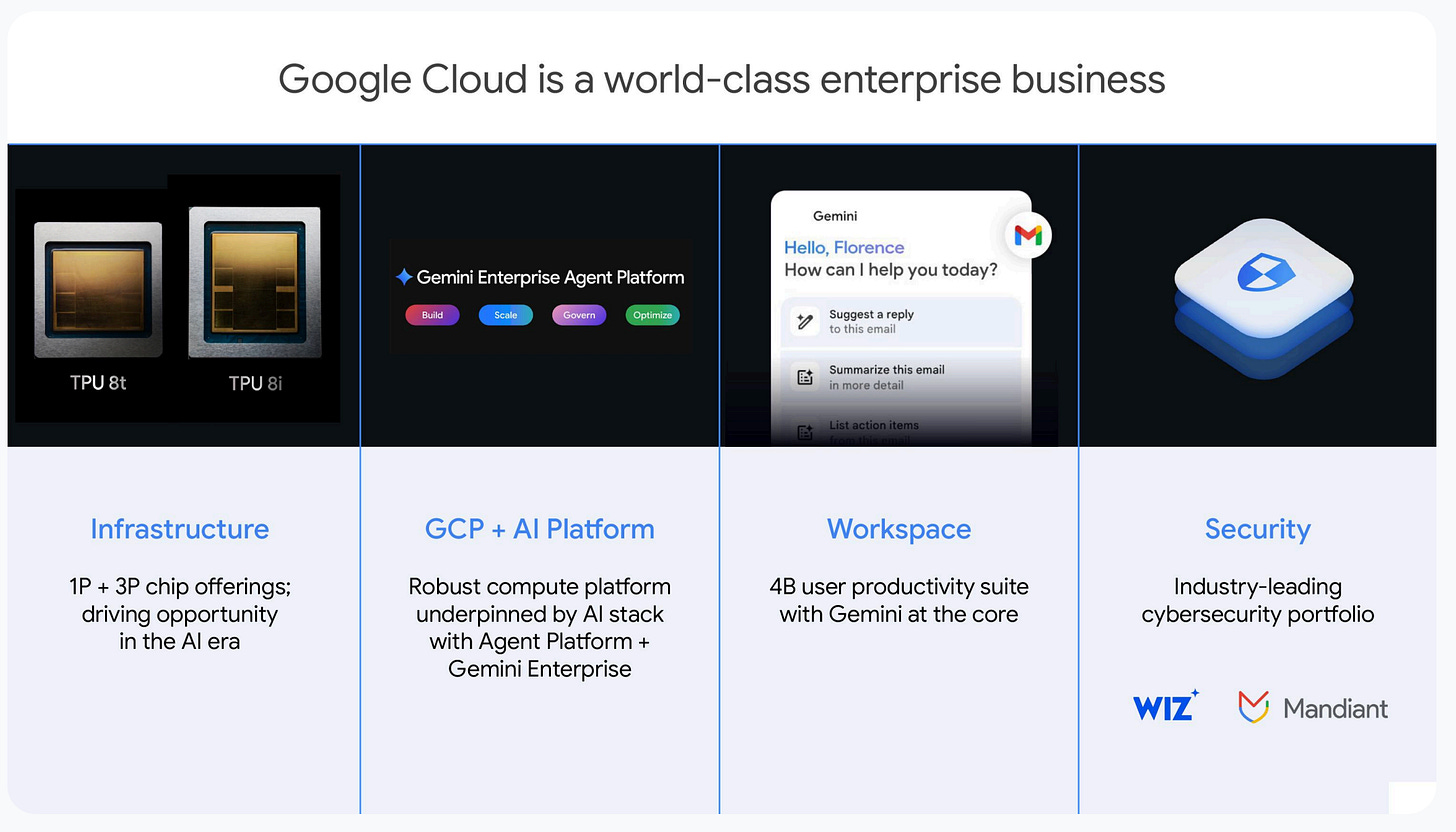
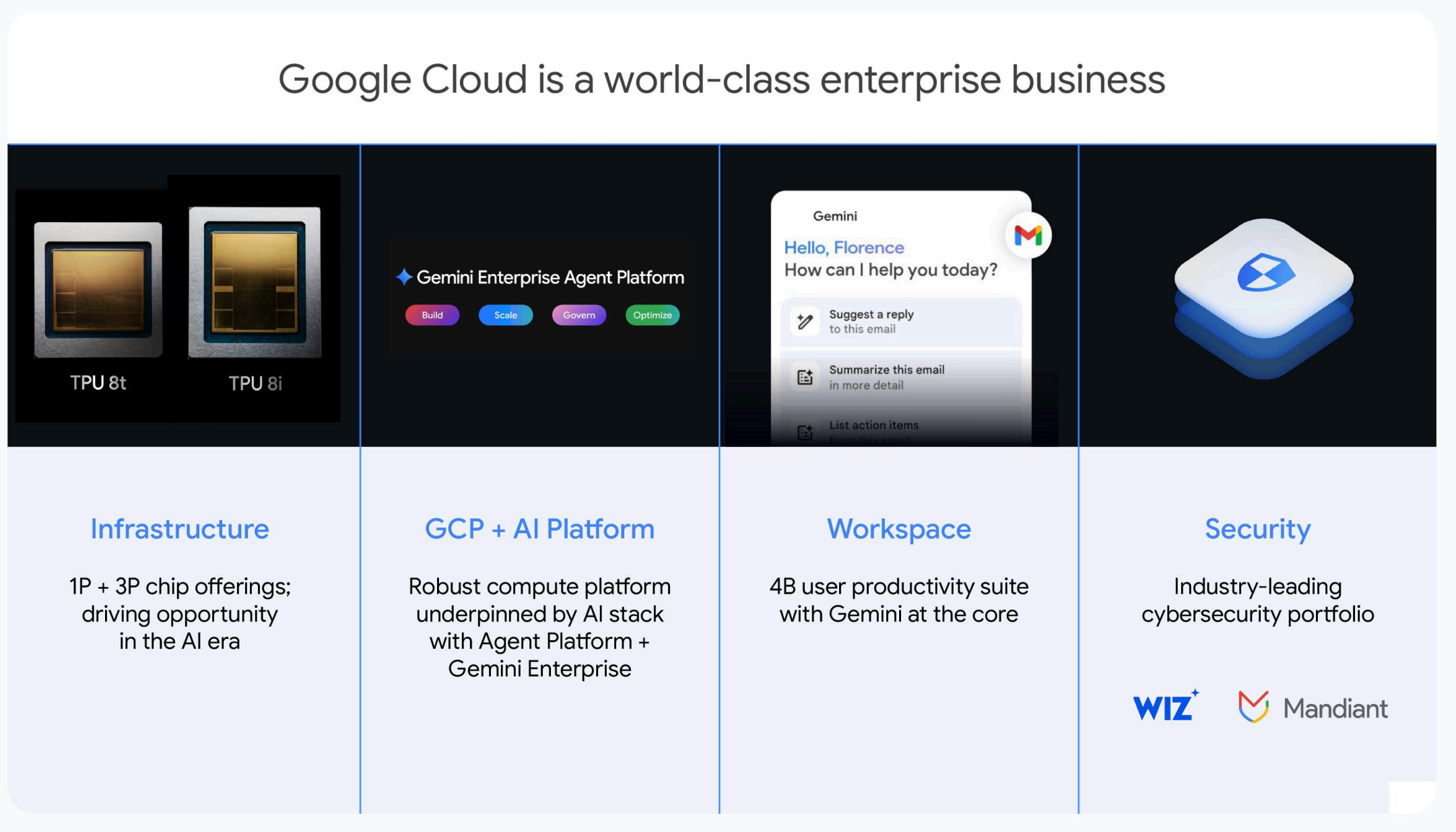
The hyperscaler business, spanning GCP infrastructure, the Vertex and Gemini Enterprise platforms, data analytics, cybersecurity (now including Wiz, acquired for $29.5bn in March 2026), and Workspace.
Cloud operating income more than tripled year-on-year to $8.8bn, a 35.6% margin against 20.7% a year ago.
Did you know Google is now an AI hardware seller? In Q2 the segment also began recognizing revenue from a completely new business line: TPU systems sold and delivered into customer data centers.
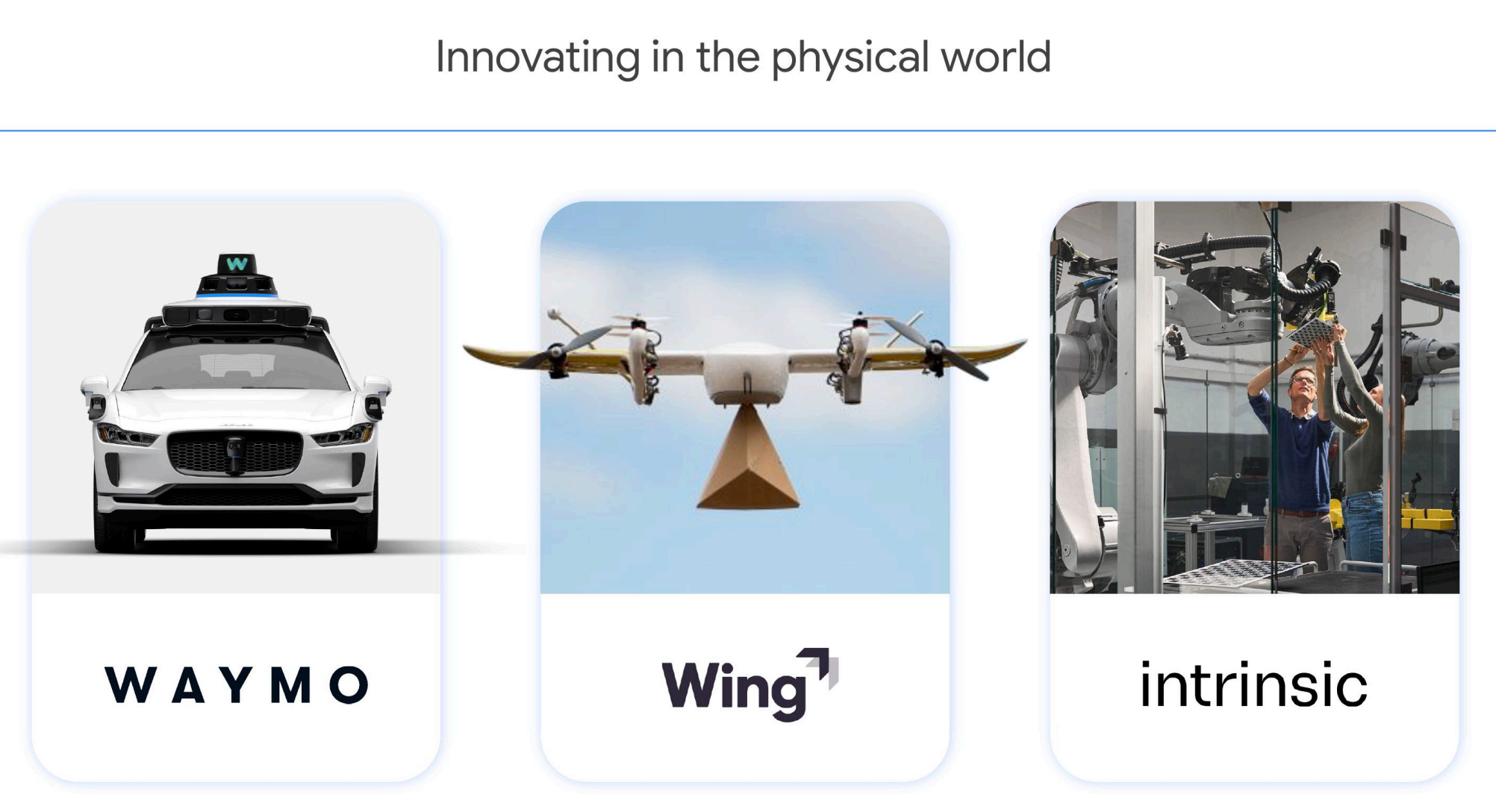
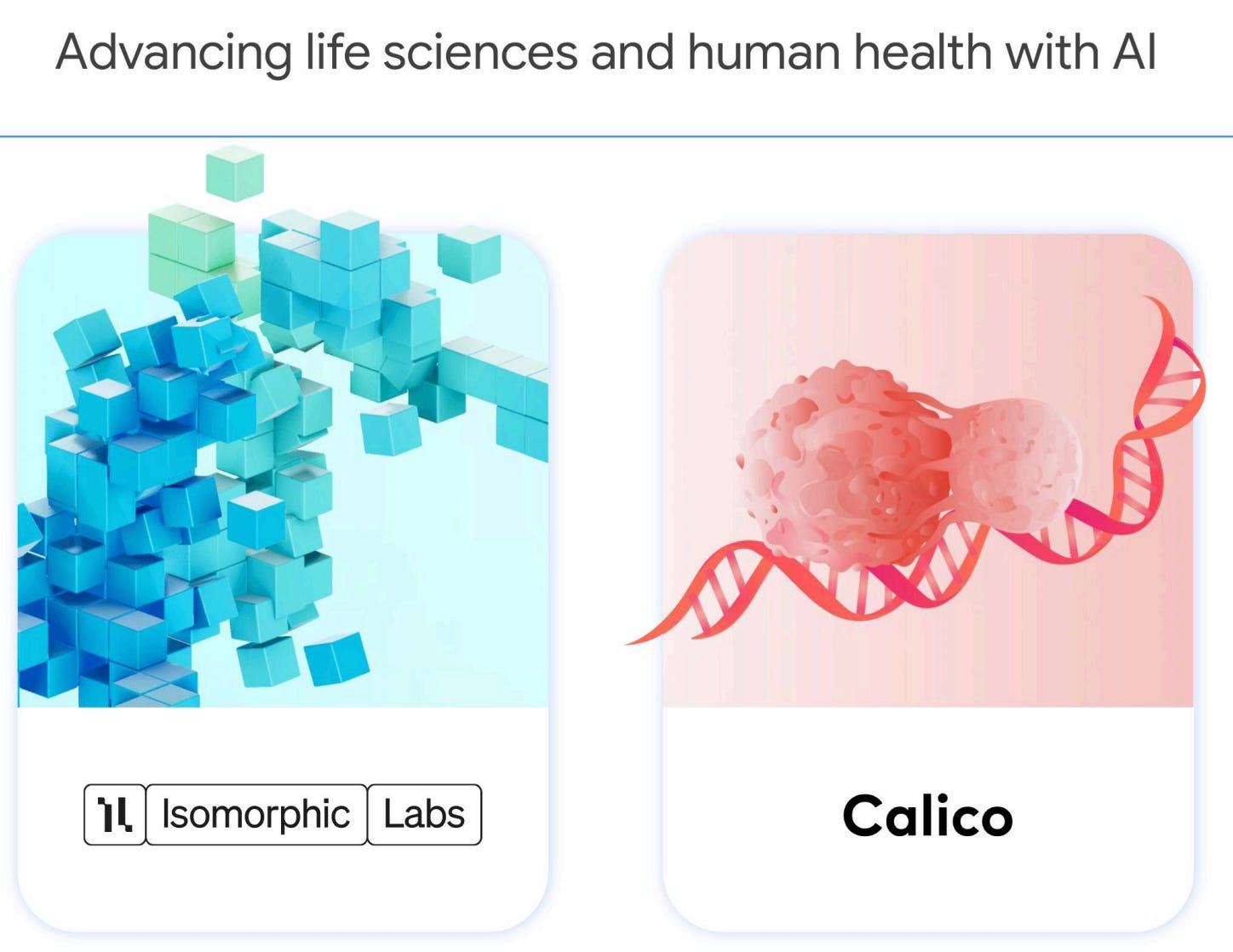
Other Bets ($382m of revenue, $1.8bn operating loss). The long-duration option portfolio, headlined by Waymo (the robotaxi company), which introduced its newest vehicle, Ojai, the first powered by the sixth-generation Waymo Driver, plus Wing (now past 1m home deliveries with Walmart, DoorDash and Papa Johns as partners) and stakes in businesses like Isomorphic Labs, which raised over $2bn this year to scale its AI drug design engine.
Alphabet-level activities ($5.8bn operating loss in Q2 vs $3.4bn last year). This is where shared AI R&D lives, including the frontier training runs for Gemini. I flag it because it is the cleanest disclosure any hyperscaler gives of what it costs to stay at the frontier, and it is growing fast.
Two important points to understand how to model the company:
First, net revenue: consolidated revenue minus traffic acquisition costs (TAX) equals net revenue.
TAC, the payments Google makes to partners such as browser providers (Apple above all), mobile carriers and hardware manufacturers to secure default search placement and distribute its services, is essentially the cost of buying traffic to display ads.
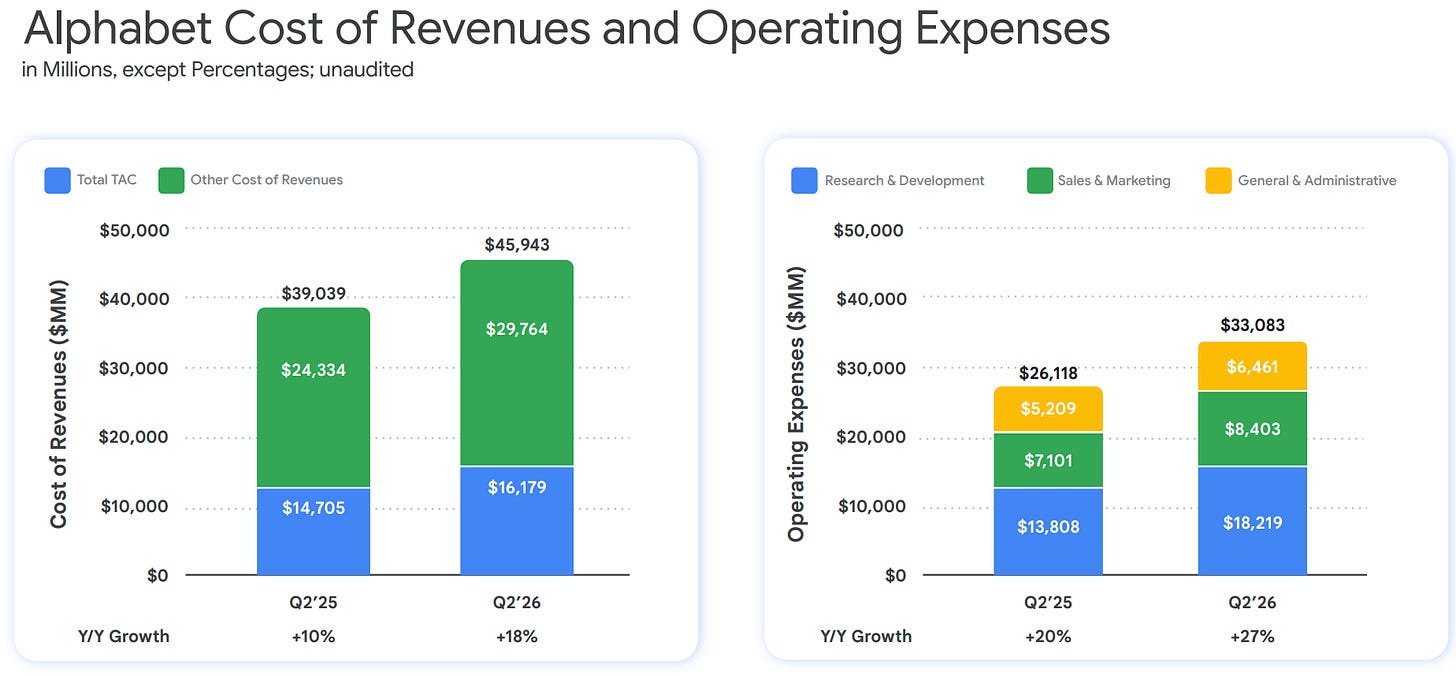
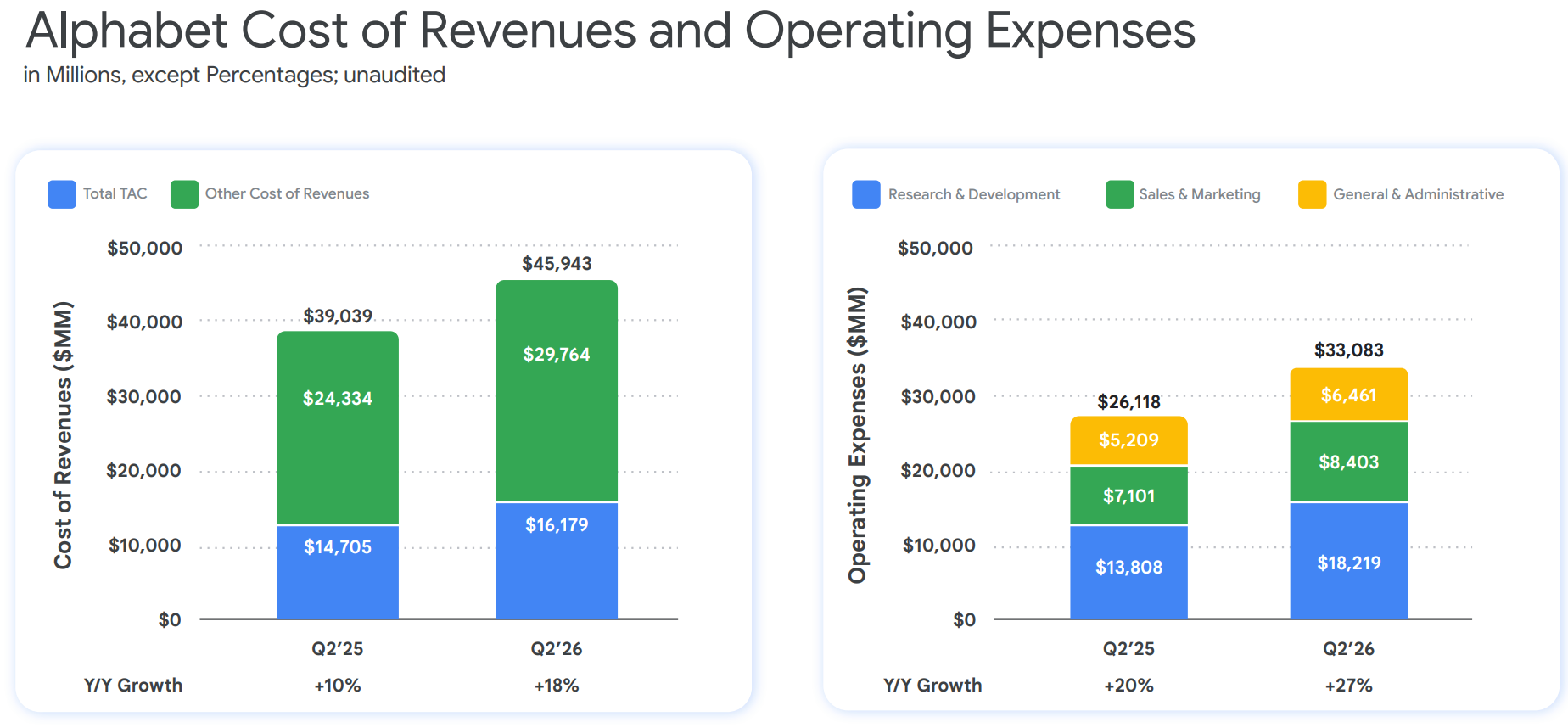
TAC ran at $16.2bn in Q2, roughly 20% of advertising revenue and a shrinking 14% of consolidated revenue, and it is growing far slower than the revenue it enables.
Second, geography: the United States is 51% of revenue, EMEA 27%, APAC 16% and Other Americas 6%, and the striking feature of Q2 was US acceleration to 32% constant-currency growth, driven by Cloud, while EMEA held steady at 12% and APAC decelerated modestly to 19%.
Underneath the reporting lines sits the assets that define the company, this is where you can see that Google truly owns the full stack:
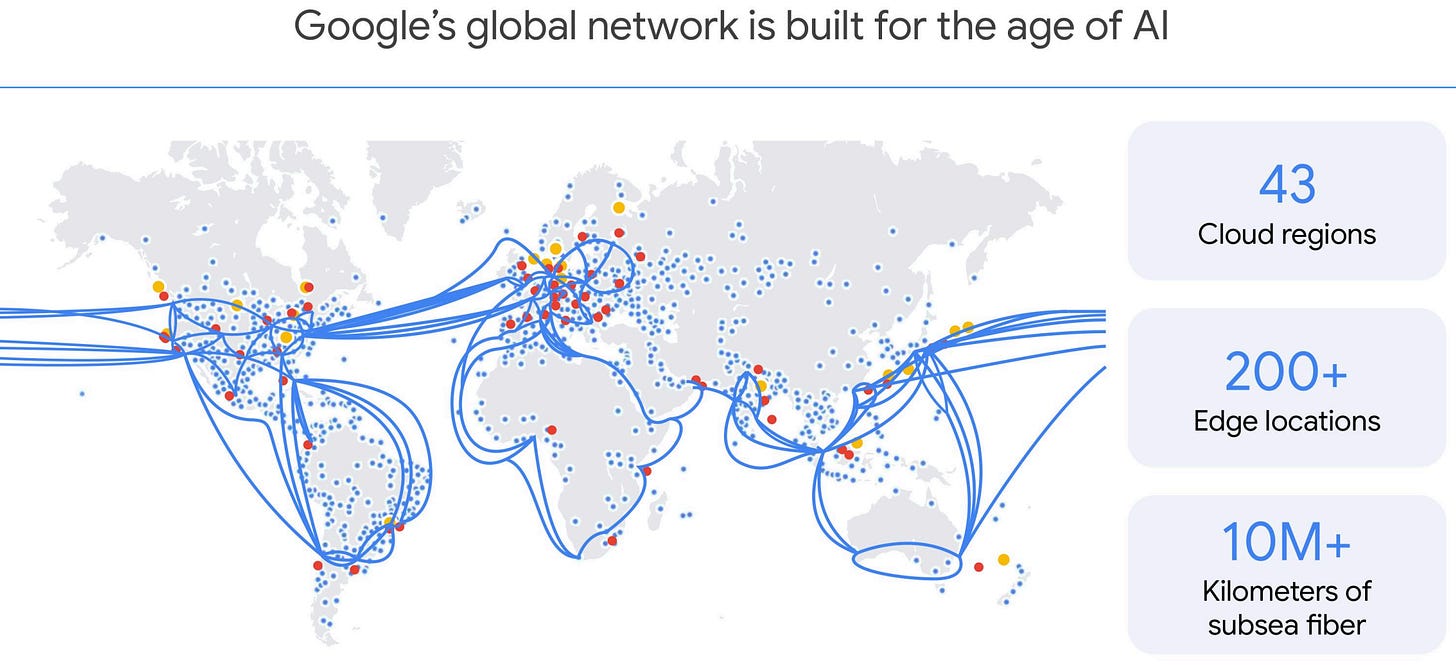
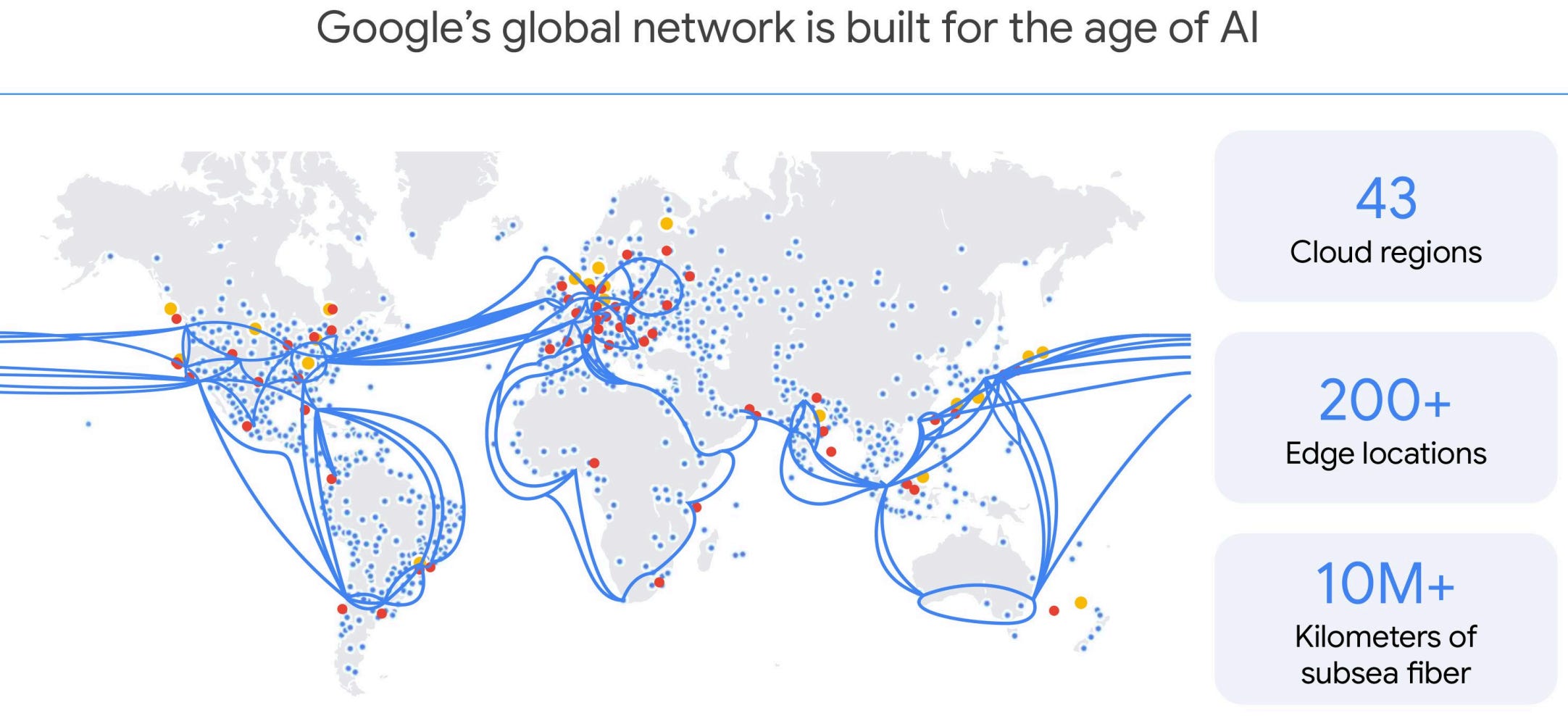
Alphabet operates more than 10m kilometers of terrestrial and subsea fiber connecting over 30 data centers and more than 40 cloud regions.
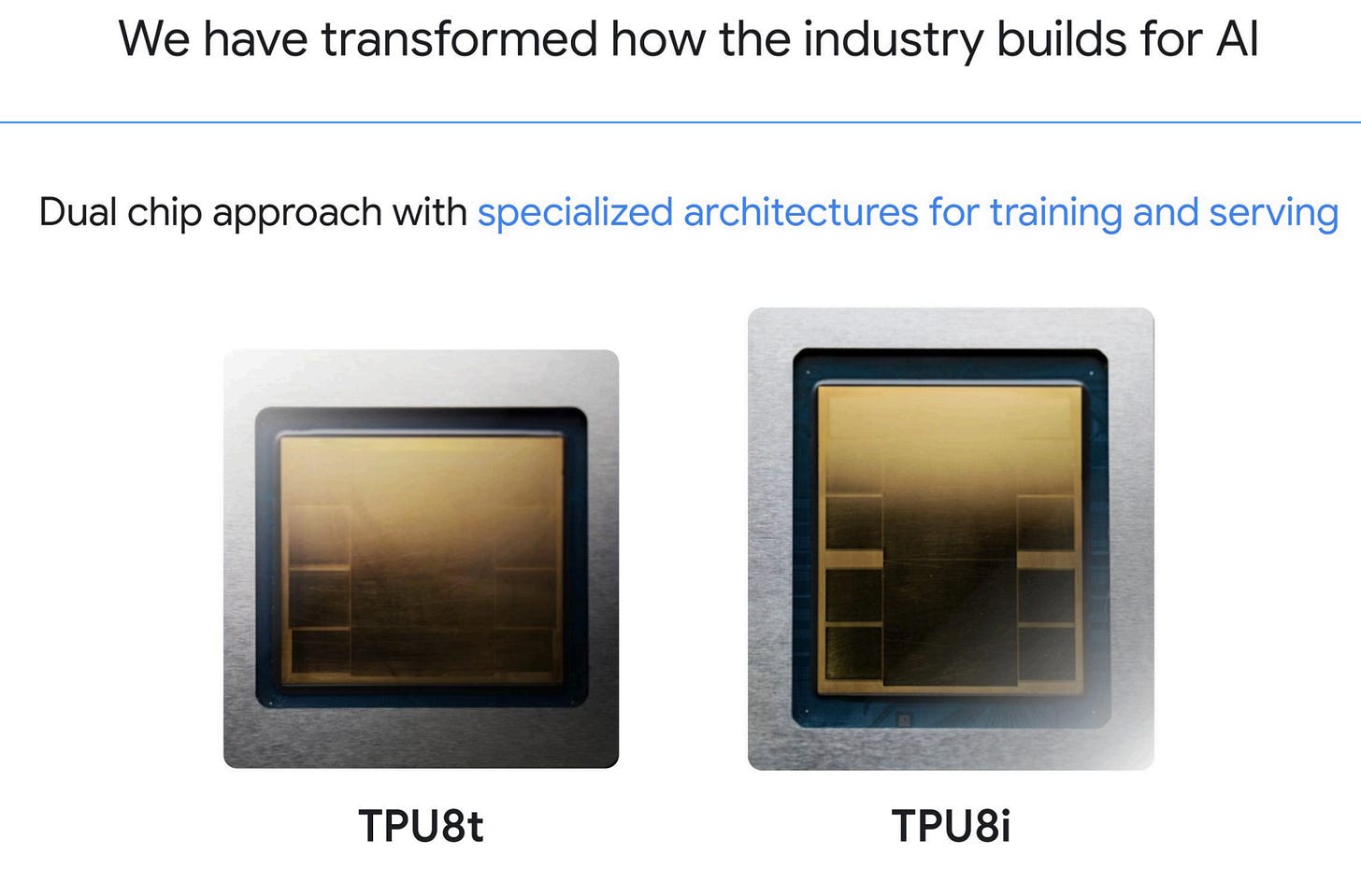
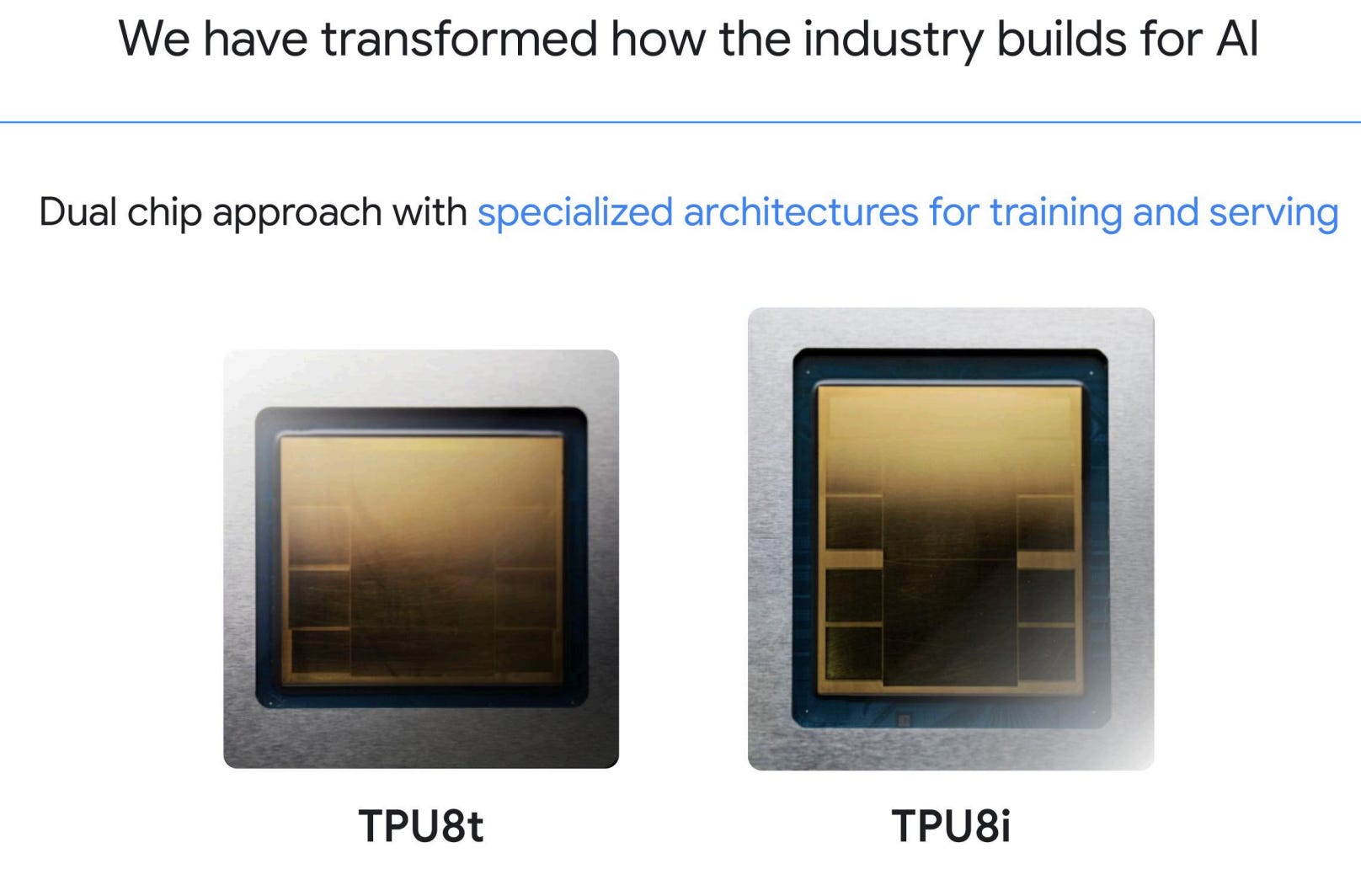
It designs its own silicon, now on the eighth generation of TPUs (the new 8i and 8t use a dual-chip design built for the agentic era) alongside Axion CPUs and the full Nvidia accelerator portfolio including the new Vera Rubin platform. This is something I had already touched on in my Age of Inference piece last November, writing “The custom silicon alternative? Google’s TPUs enable internal AI workloads at roughly 20% of the cost of purchasing equivalent Nvidia chips, a 4-6x cost advantage. Google TPU: Co-designed by Broadcom for Google since 2015, the TPU has been deployed to mainly run Google Search related workloads”
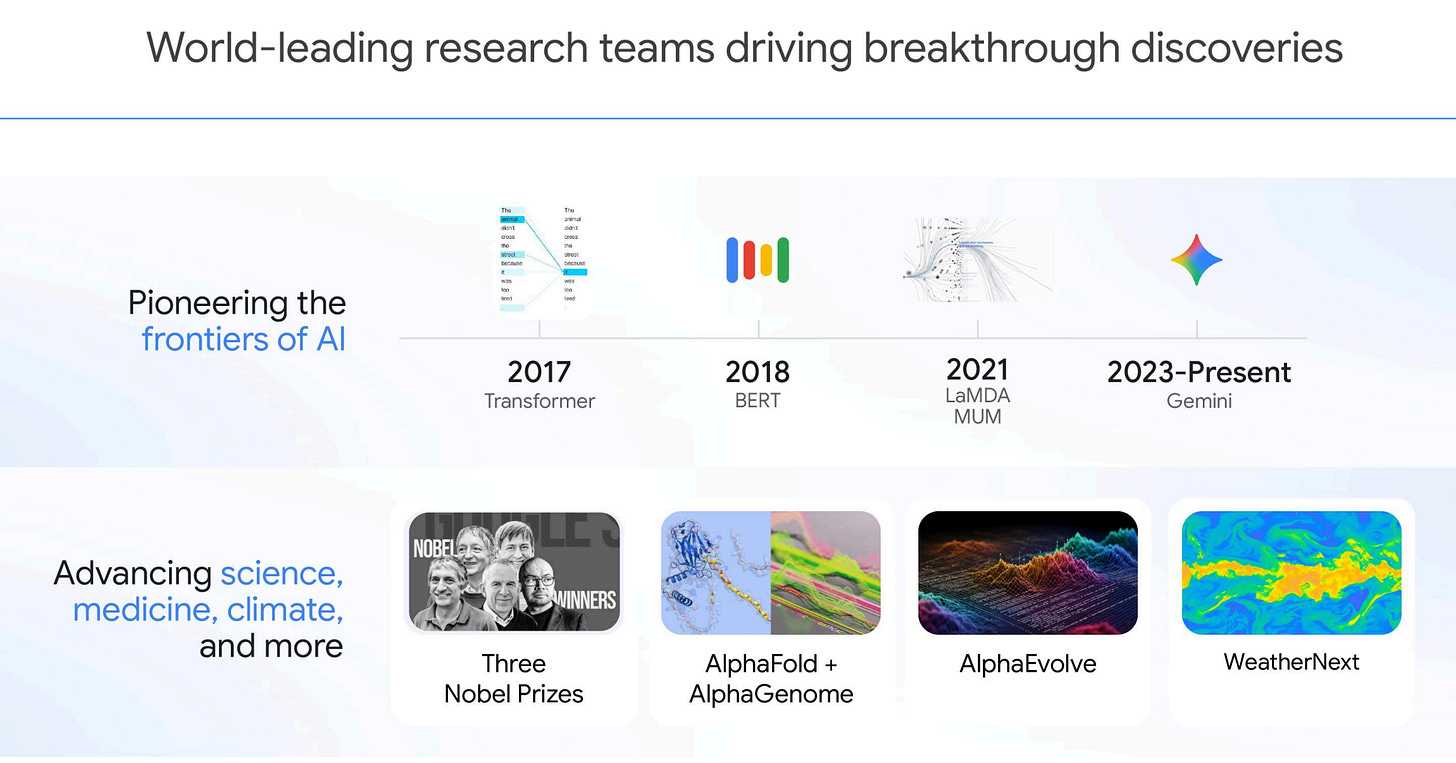
Google DeepMind, the research engine that invented the Transformer architecture (on which LLMs are based) and won a Nobel Prize for AlphaFold, feeds the model layer.
And the product layer distributes all of it to billions of people daily.
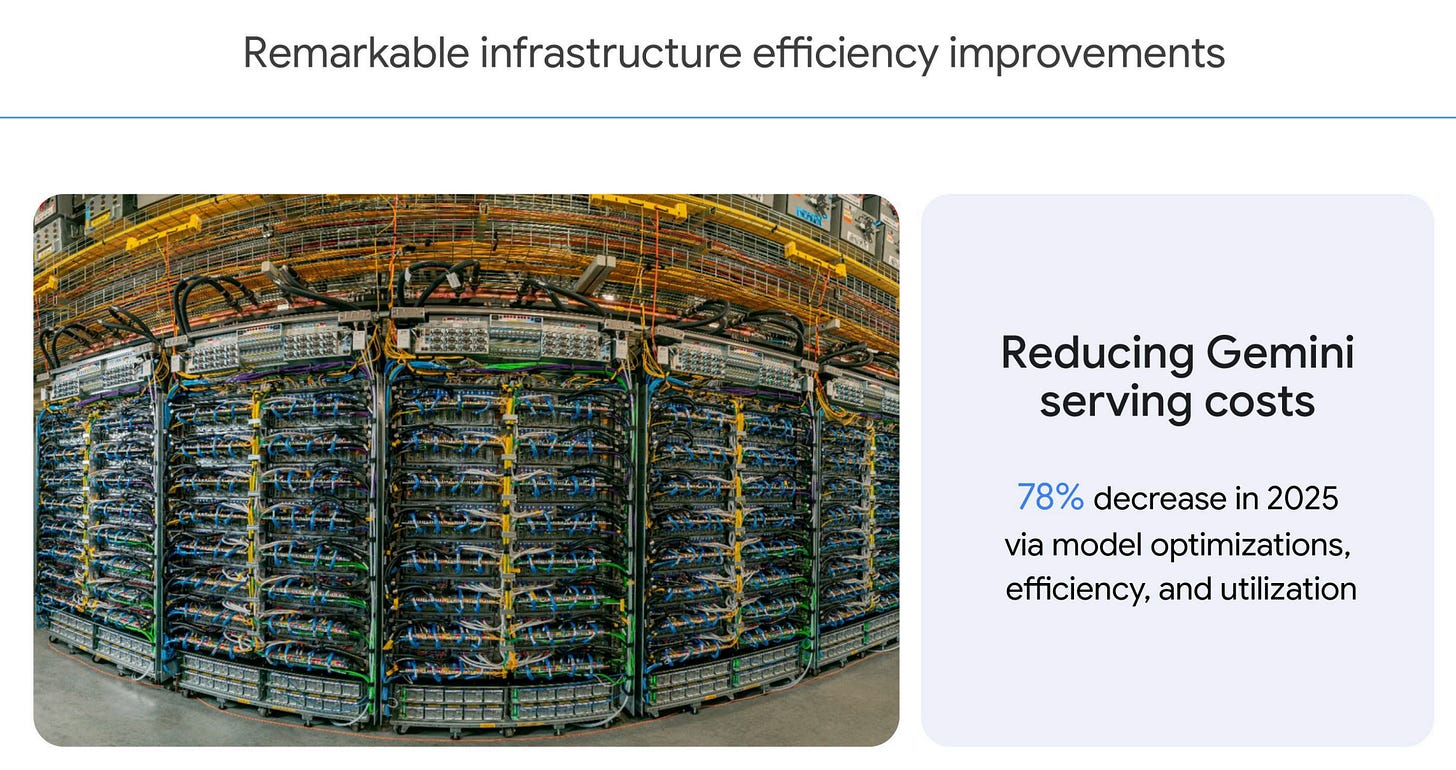
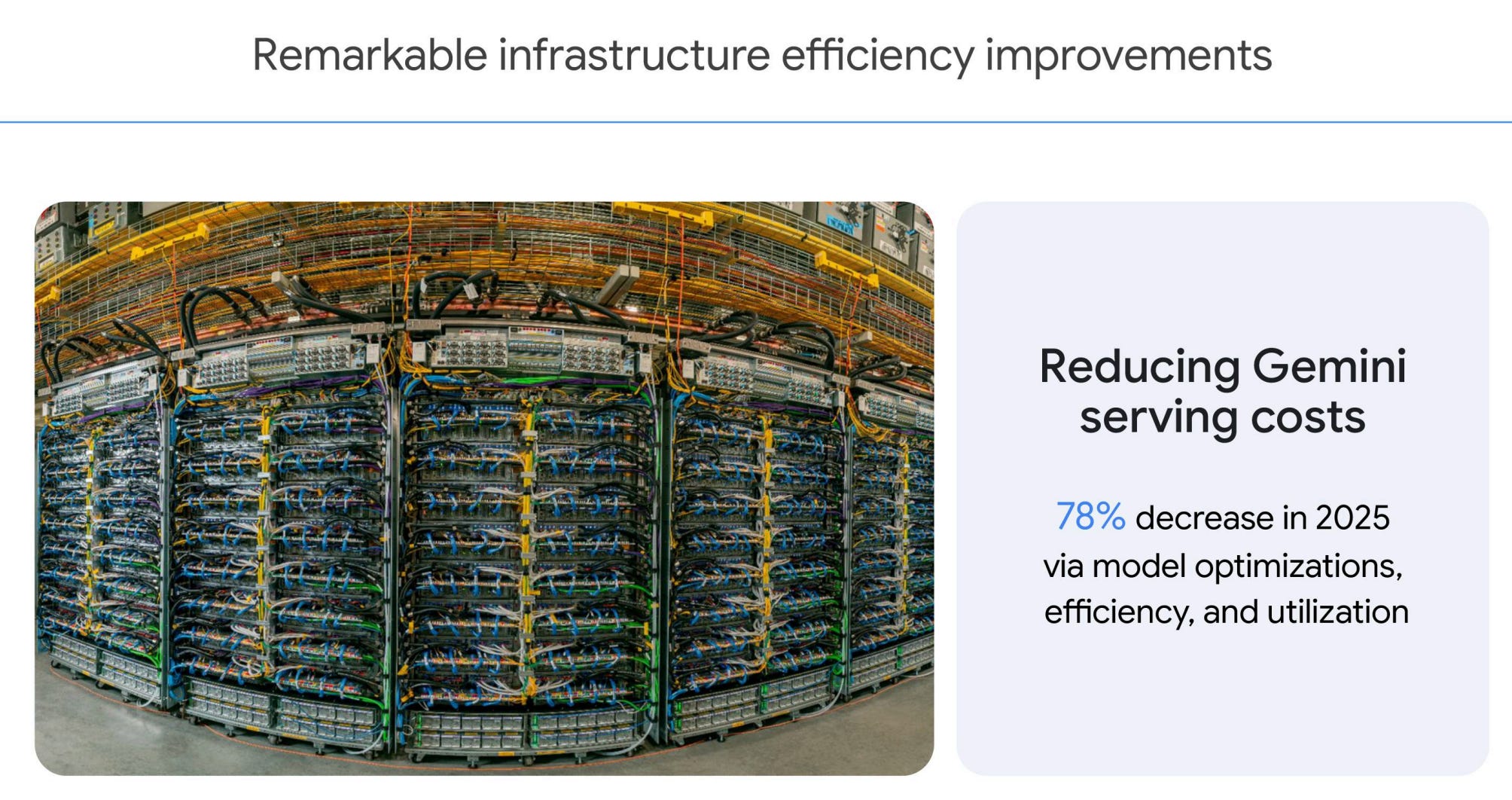
In 2025 alone, engineering and hardware optimization cut Gemini serving costs by 78%. Keep that number in mind, because it is Alphabet bending the token cost curve I described in the token piece, inside its own four walls.

A brief history of Alphabet:
1998: Larry Page and Sergey Brin incorporate Google in a Menlo Park garage, built on the PageRank insight that links are votes.
2000: AdWords launches, the greatest business model discovery in the history of media.
2004: IPO at $85 per share, valuing the business at $23bn, with a dual-class structure preserving founder control. There have since been stock splits (2014 and 2022) meaning one share back then equates 40 shares today.
2005 to 2007: Android acquired for around $50m, YouTube for $1.65bn, DoubleClick for $3.1bn, three of the greatest acquisitions ever made.
2008: Chrome launches and eventually wins the browser race.
2014: DeepMind acquired for around $500m, arguably one of the greatest acquisitions in history.
2015: Alphabet holding structure created, Sundar Pichai becomes CEO of Google, and the first TPU is deployed internally.
2016: Pichai declares Google an AI-first company.
2017: Google researchers publish the Transformer paper that ignites the modern AI era.
2022: ChatGPT launches on Google’s own architecture (the transformer, the T in ChatGPT) and the market writes Google’s obituary with the end of search, the company responded by declaring Code Red.
2023: Bard stumbles, Gemini launches, DeepMind and Brain merge.
2024: The DOJ antitrust ruling lands with behavioral rather than structural remedies, Alphabet initiates its first dividend.
2025: Revenue passes $400bn, Gemini 3 launches in November and changes the competitive narrative, Google goes from an AI loser to an AI winner.
2026: Wiz closes in March, the June investor day announces an equity raise to fund the buildout, and the Q2 print delivers 82% Cloud growth alongside a $195-205bn capex year. The stock is up roughly 65% over twelve months but flat YTD.
