

This piece kickstarts my series on memory semiconductors. The violence of this quarter, and its knock-on effects across tech (the Apple price hike is the most visible, but rising hyperscaler capex is the deeper one), has pushed me to spend real time on this space.
Memory has gone from the most ignored corner of the chip world to the binding constraint of the entire AI build, and over the coming weeks I will go deep on the supply-demand model, HBM and the accelerator value chain, the Asian incumbents and the Chinese challengers, and the question that sits above all of it: whether the AI economy can pay for the memory it is consuming.
Micron is where I start, because it is the bottom-up anchor for the whole series and the only US champion in the room.
Welcome to the 74th investment case, 36th AI & Technology idea, 47th Reshoring & Sovereignty investment case on Crack the Market (and the most comprehensive Micron investment case you will find online)! Join me as I dissect the memory maker that just printed the most important quarter in its history, the only US-headquartered memory champion, with a market cap over $1tn, and the best Western vehicle to play the most violent memory supercycle on record, driven by the historic AI data buildout, along with the risks that come with a business the market has spent thirty years treating as un-investable.
Twice a week, I will release deep dives into stocks and sectors that fit into the 6 themes that I see winning in the coming years and decades: AI & Technology, Electrification & Energy, Reshoring & Sovereignty, Healthcare & Longevity, China & Asia, Resilience & Quality.
Take advantage of this once in a generation opportunity to build long term wealth by investing in great stocks that will deliver returns for your portfolio for years to come.
Last week, Micron printed the most important quarter in its history, and the stock surged 16% on the day to roughly $1,220, a market capitalisation near $1.40tn. DRAM and NAND both set records, gross margin reached an extraordinary 84.9%, and management guided next quarter to $50bn of revenue, an 86% gross margin and $31.00 of EPS. These are numbers that simply do not happen in a business the market has spent thirty years treating as an un-investable commodity. Revenue rose 74% in a single quarter and 346% year over year, and the sequential dollar increase alone, $17.6bn, exceeds Micron’s entire revenue base in most quarters of its history.
But the headline EPS is not the story, and chasing the print is not the trade. Two things actually matter, and I want to be precise about both.
The first is that we are living through the most violent memory upcycle on record, driven by an AI demand shock colliding with a supply base that physically cannot respond inside the lead time of the demand.
The second is the sixteen Strategic Customer Agreements, or SCAs, that Micron unveiled this quarter, which the market has largely read as downside insurance and which I think are better understood as a call option that extends the upcycle rather than insuring the downcycle.
Get those two things right, whilst remembering that this remains a deeply cyclical business, and you understand both the opportunity and the risk.
In this article I go through:
What memory is, why AI has made it the binding constraint of the entire compute build, and why this supercycle is structurally unlike any before it
What is happening to pricing, why capacity cannot keep up, why capex is about to spike, and why the memory tax is now setting the price of your phone, your PC and your television
What a normal memory cycle looks like, and why this one is debated so fiercely, with the widest range of outcomes I have seen for a megacap
What Micron is, what it makes, its history of building the very oligopoly it now benefits from, its global footprint, and its technology leadership
Why the SCAs are a call option rather than an insurance policy, and the risks the bulls are underweighting
Micron Investment Case
Table of content
The Memory Supercycle: What Is Happening and Why
Before getting to Micron, you have to understand the wave it is riding, because the company is, at its core, a leveraged play on the price of memory.
Memory is one of the few genuinely commodity-like products in technology: it is fungible, priced by supply and demand at the margin, and the same chip sells into a phone, a laptop and a hyperscale server.
That commodity nature is exactly why memory has historically been a brutal boom-and-bust business, and it is why what is happening now is so remarkable.
What memory is:
Two products make up more than 95% of the market.
DRAM is the fast, volatile working memory that sits next to the processor and holds the data a chip is actively using, it loses its contents when power is cut, and it is the larger and more profitable, around 57% of the market.
NAND is non-volatile flash storage that retains data without power and provides the persistent storage in SSDs, phones and data centres, around 40% of the market.
Within DRAM sits the product that has rewired the industry, High Bandwidth Memory or HBM, whose peculiar economics are the master key to this cycle.
Why demand is exploding - AI broke the memory wall:
Every memory cycle has a trigger. In the past it was the PC, then the smartphone, then cloud. This time it is AI, and it is a far bigger one, because AI is structurally bottlenecked on memory.
Over two decades, raw compute scaled roughly three times every two years, but memory bandwidth scaled only about 1.6 times and interconnect about 1.4 times, while model sizes grew faster still.
The result is the memory wall: processors increasingly sit idle, waiting for data. HBM exists to attack that wall, and high-capacity DRAM and high-density storage exist to feed the rest of the system.
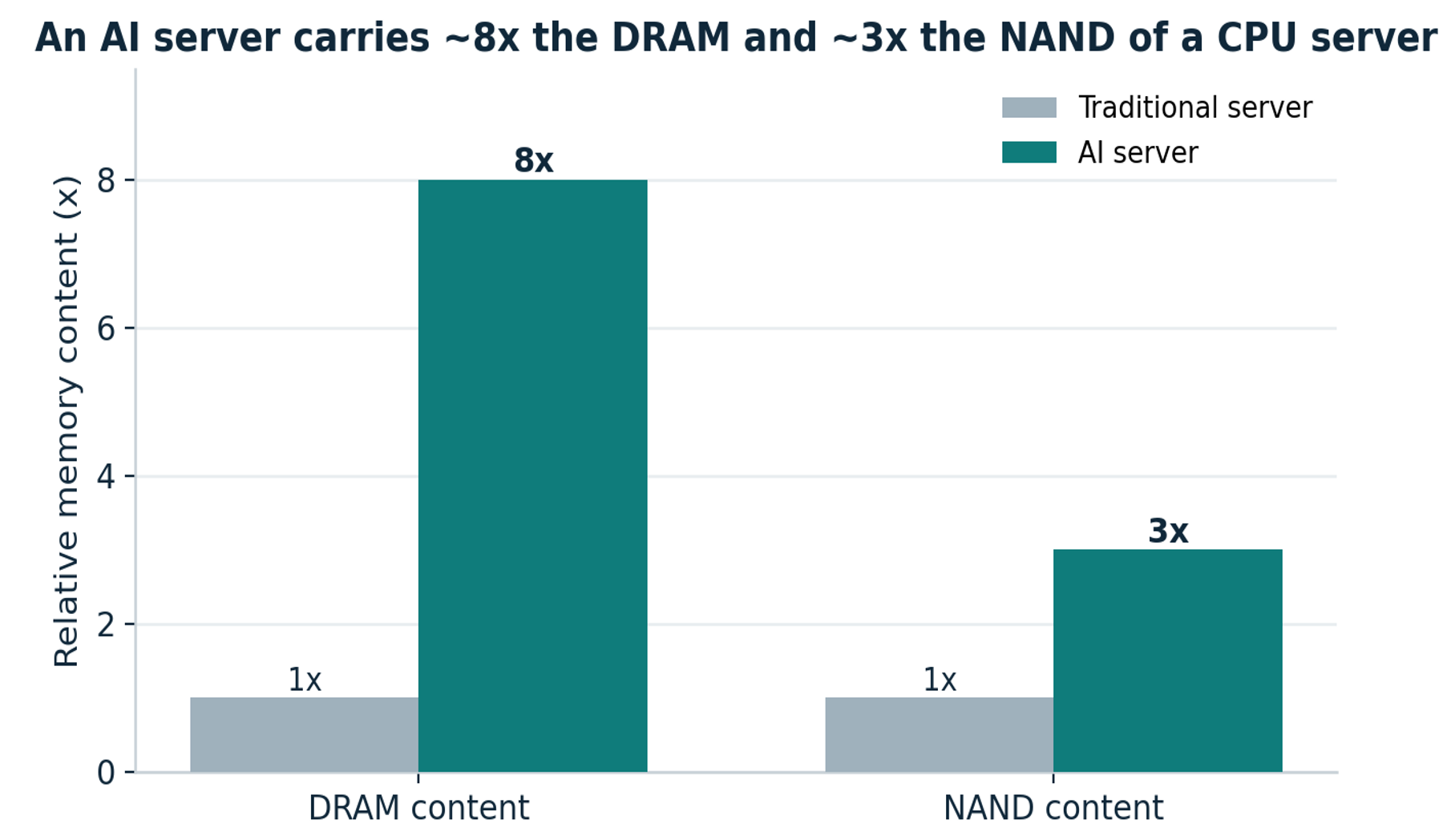
The practical consequence is that an AI server is a memory monster, carrying roughly eight times the DRAM content and three times the NAND content of a traditional CPU server.
A single flagship accelerator system (like Nvidia’s Vera Rubin) can hold well over a terabyte of HBM and several terabytes of system memory, with many thousands of dollars of memory content per box.

Multiply that by the number of systems (tens of GWs per year in AI data center capacity as I touched on in my Vertiv investment case) being built and the demand curve bends violently upward.

Source: industry research. AI servers are memory monsters relative to the CPU servers they sit beside.
And the systems are being built at unprecedented scale, as you know very well from my coverage of this AI supercycle:
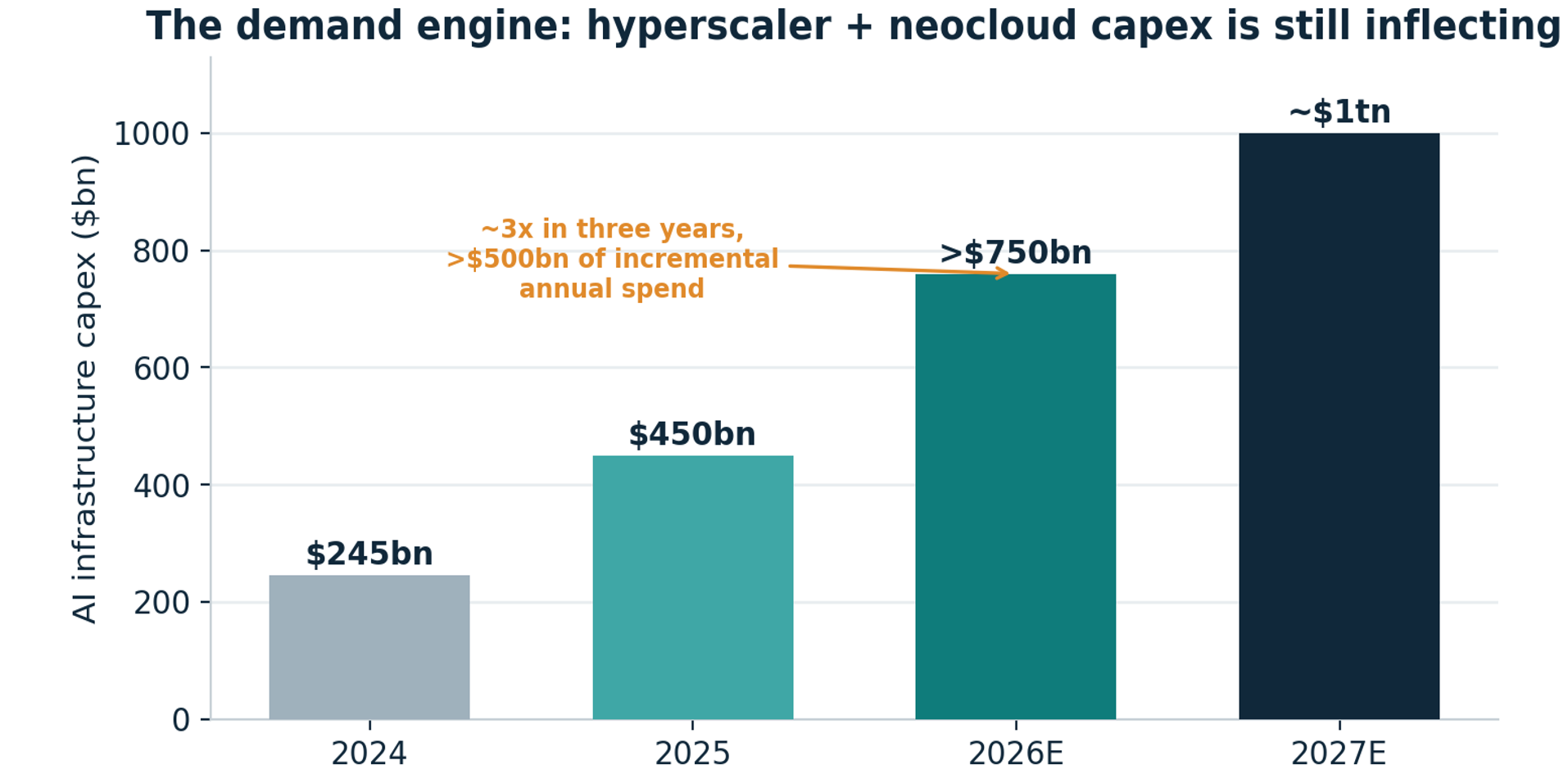
Aggregating the major hyperscalers and the neocloud cohort, total AI infrastructure capex has risen from roughly $245bn in 2024 to roughly $450bn in 2025, is set to exceed $750bn in 2026 (up around 70%), and is likely to approach $1tn in 2027, with further growth beyond.
The absolute increment from 2024 to 2026 alone is more than $500bn of additional annual spending, close to a tripling in three years, which has no precedent in any capital-goods end market.
Roughly 40% of that spend flows into physical infrastructure (power, cooling, networking, buildings) and the balance into silicon and memory.
The critical point for memory is that this demand engine is still inflecting, not rolling over.
Source: consensus aggregates across the major hyperscalers and neoclouds. The buyers of memory are still raising spending, not cutting it.
The demand is also broadening, which makes it more durable. The early AI build was about training, which is lumpy. The shift now is toward inference and agentic workloads, where a model spins up sub-agents, calls tools and queries external systems continuously.

That is memory-hungry in every dimension:
HBM and high-capacity DRAM for the working set, and a structural new pull on storage as systems offload context to fast SSDs.
Enterprise SSD is on track to move from under a third of NAND bit demand to roughly half by 2027.
Agentic AI is the gift that keeps giving for memory, because it runs all the time and touches every layer of the hierarchy.
What is happening to pricing:
When a demand shock of this size hits a supply base that cannot respond, you get price action that looks nothing like a normal cycle.
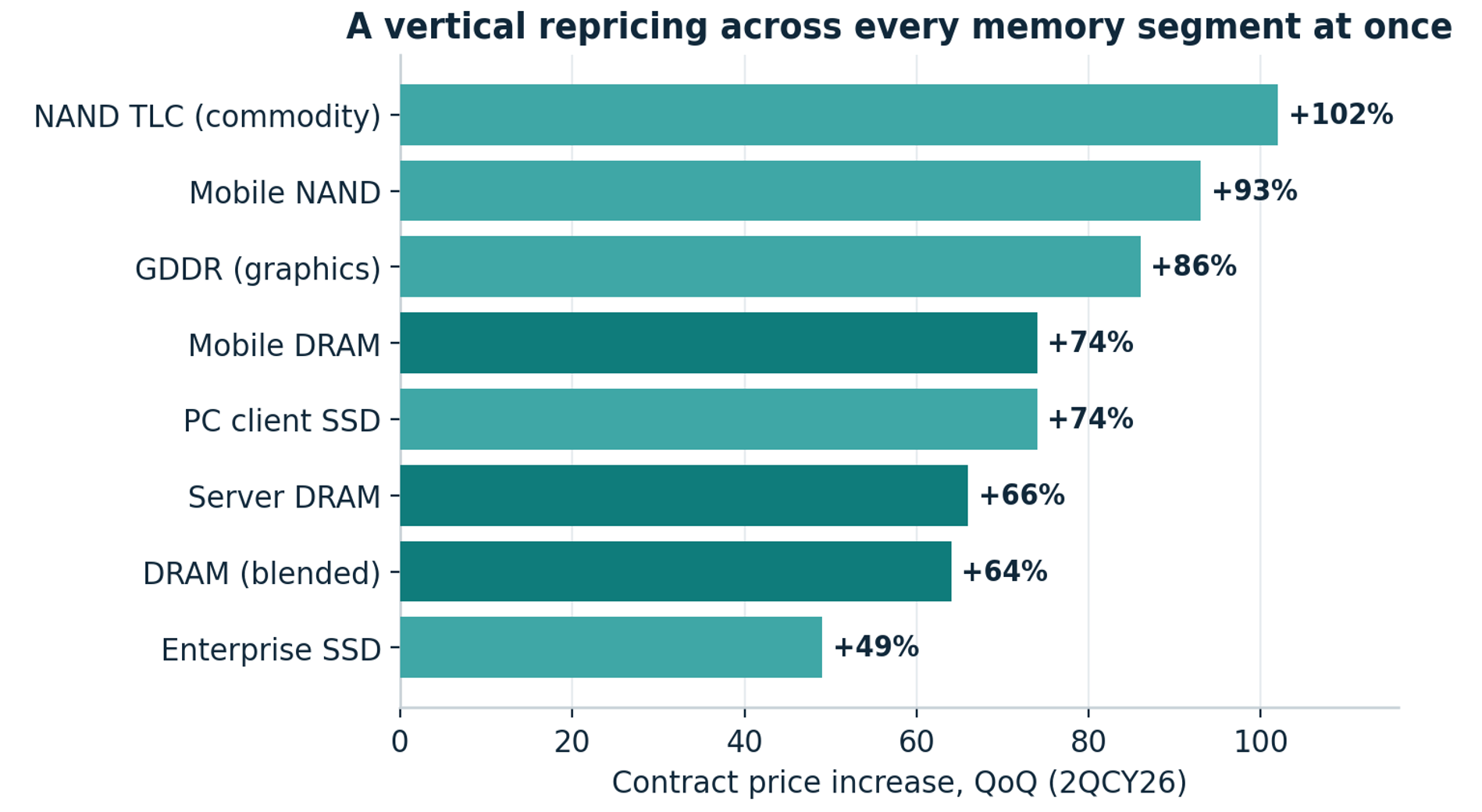
In the June quarter, blended conventional DRAM contract prices rose around 64% sequentially, and that is the blend. Underneath it, server DRAM rose around 66%, mobile DRAM 74% to 80%, consumer DRAM around 60% and graphics memory around 86%, all in one quarter.
NAND was as extreme: enterprise SSD up around 49%, PC client SSD up 74%, mobile NAND up 93% and commodity flash up over 100% sequentially.
On a year-over-year basis the figures are almost absurd, with some consumer DRAM categories up several hundred percent.
This is the most significant memory price upcycle in history, with year-on-year increases above 200% in 2026.
Source: industry price trackers. A simultaneous, vertical repricing of every memory segment, not a narrow HBM story.
The breadth is what should surprise you, this is not just HBM. Because HBM is starving the rest of the DRAM market of wafers, conventional DDR5, mobile LPDDR, graphics GDDR and commodity NAND are all repricing at once. Spot prices, which lead contract prices, surged to large premiums over contract during the worst of the squeeze, confirming genuine scarcity rather than negotiated optimism.
The memory tax - it is now setting the price of your phone:
The cycle has finally stopped being an abstraction and showed up in the real economy. Memory has gone from a modest line item to the dominant cost in a server and a punishing one in consumer devices.
On one estimate, memory now accounts for roughly 69% of the bill of materials of a conventional data-centre server, up from around 40% a year ago.
In smartphones it has gone from 12% to 13% to 25% to 35%, with the low end hit hardest, and in PCs it has roughly doubled to around 21%.
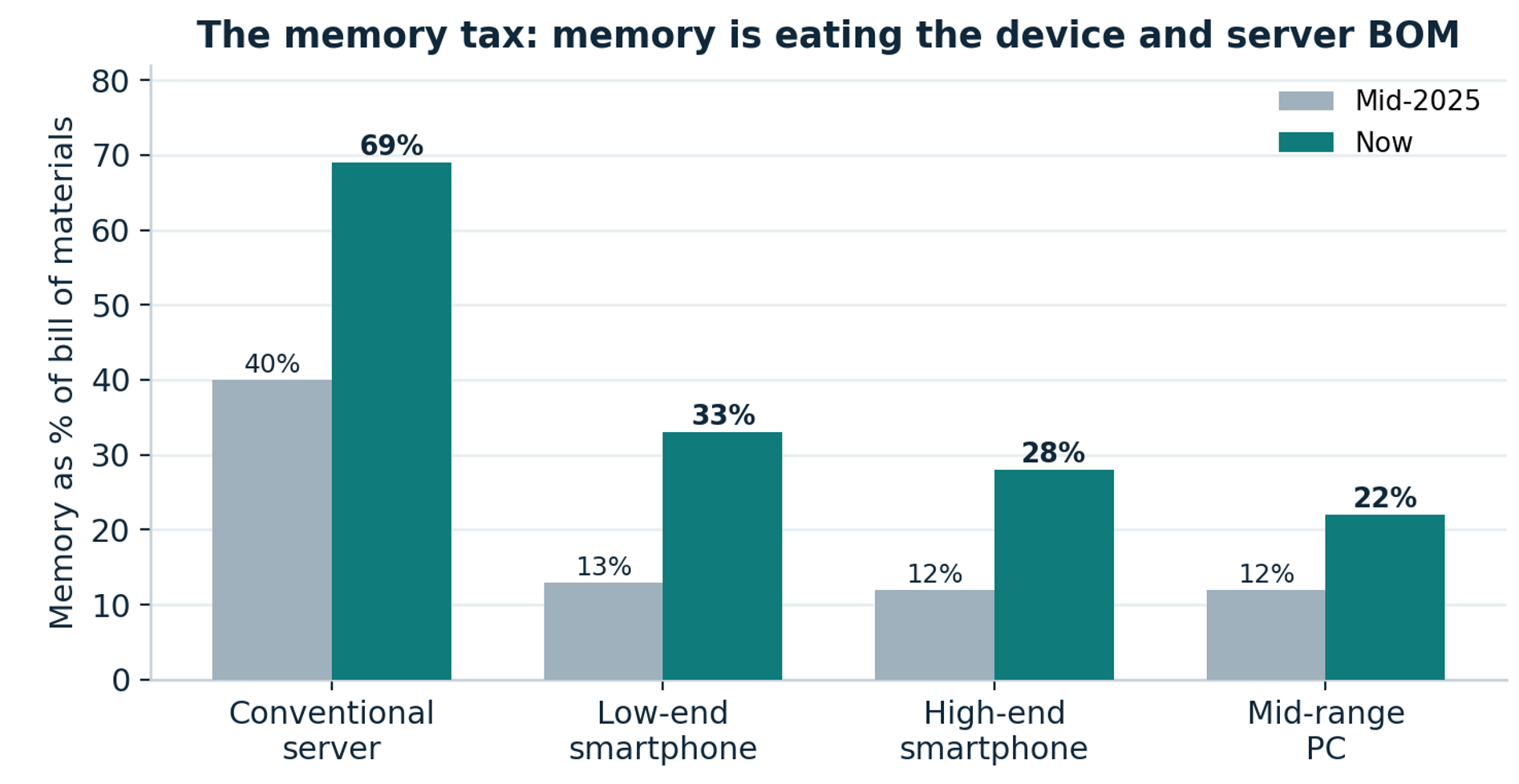
Source: industry estimates. Memory is eating the bill of materials of both servers and consumer devices.
This is the memory tax, and it is biting. Smartphone units are now expected to fall around 16% this year and notebooks around 13%, partly because the AI data centre has bid memory away from them.
Device makers are responding three ways:
Raising prices: Apple among others has lifted prices on memory-heavy configurations.
Trimming memory content.
De-speccing, meaning downgrading to lower densities or even reverting to older memory generations to contain cost.
As I put it after spending time with the people running this complex, the AI data centre is now setting the price of your television, your iPhone and your computer. That is an extraordinary statement, and it is literally true.

Why capacity cannot keep up:
Prices have behaved this way because supply genuinely cannot respond. Three structural forces are at work, and together they make this cycle different.
First, the HBM silicon-intensity shock:
HBM stacks DRAM dies on a logic base, and because of its larger die and stacking it consumes roughly three times the wafer capacity of standard DRAM to produce the same bits, rising toward four to one with HBM4 and HBM4E.
Every incremental bit of HBM therefore displaces a multiple of conventional DRAM capacity. This is why the whole market is tight, not just the AI part: HBM is quietly eating the wafers that would have made your laptop’s memory.
Supply must now be modelled in wafer starts per month, not bits, precisely because of this trade ratio.
Second, fab lead times:
A new leading-edge memory fab takes more than two years to build and equip, with very little cheaper brownfield room left until 2027. You cannot conjure wafers in response to a price signal, the short-run supply curve is vertical.
On top of the buildings, the semiconductor industry is constrained by extended lead times for lithography and deposition equipment, which further strengthens the semicap supercycle that I’ve covered, and by a shortage of the field and process engineers needed to bring new lines to yield.
Third, supply discipline:
After a decade of consolidation and a brutal 2023 downturn, the three remaining players are choosing technology migration over greenfield additions, keeping bit-supply growth restrained.
DRAM bit supply is growing only in the low-to-mid 20% range in 2026 and NAND around 20%, mostly from node shrinks. The industry has, in effect, sold out 2026 and committed much of 2027.

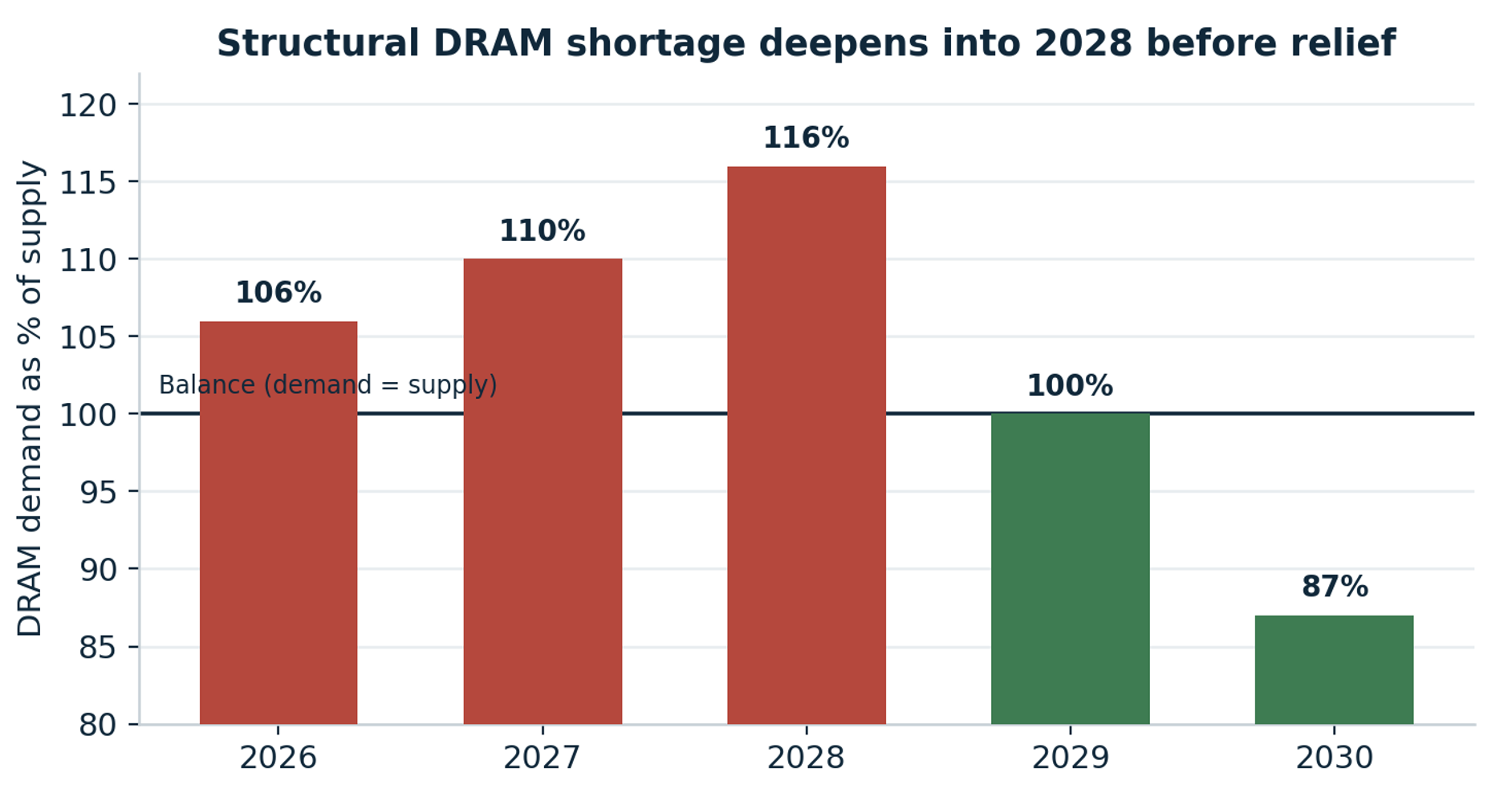
Source: detailed third-party supply-demand model. The shortage deepens into 2028 before new fabs bring relief.
Put demand and supply together and bit demand compounds at roughly 15% a year through 2030, with HBM near 30% and data-centre near 22%, against supply that grows slower and is constrained by the trade ratio.
The result, on the most detailed models, is a market in deficit through 2028 before the wave of new greenfield capacity tips it back toward balance and, eventually, surplus around the end of the decade.
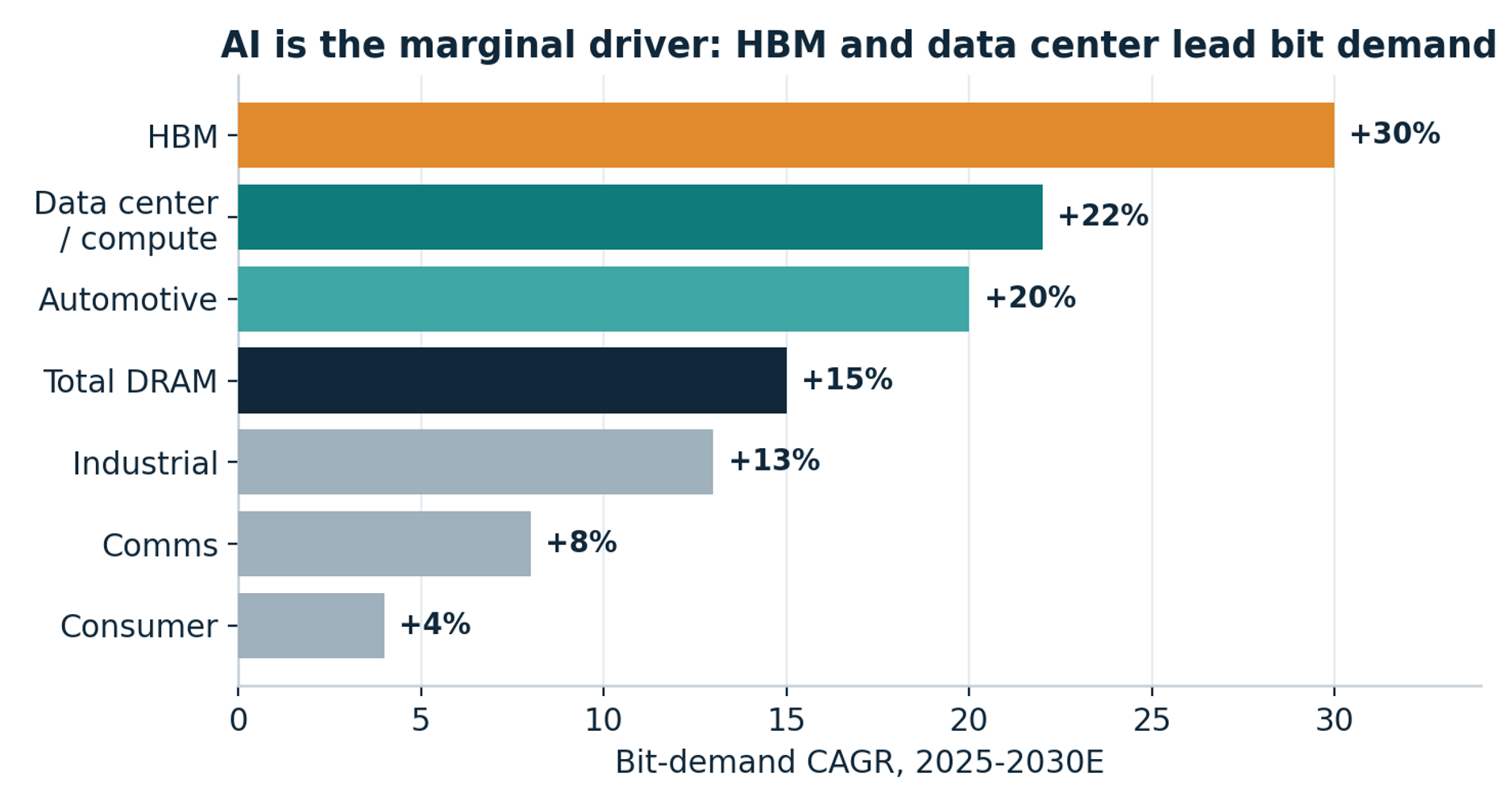
Source: third-party model. AI is the marginal driver: HBM and the data center lead bit-demand growth.
Why capex is about to spike:
The flip side of a structural shortage is a structural capex response, and it is coming.
Industry equipment spending is heading toward record levels, and the long-rumoured $1tn semiconductor market is arriving years ahead of old estimates.
For Micron specifically, net capex is set to rise from around $27bn in fiscal 2026 to north of $45bn in fiscal 2027, with more than half of the increase going into construction.
The clearest sign is the recent announcements out of Korea with a new memory fab cluster (which will take 3-4 years to come out of the ground). Korean memory makers (SK Hynix, Samsung) reiterated plans to nearly double DRAM wafer capacity by 2030 implying 15% CAGR but likely more around 10% given shutdowns of old fabs and longer manufacturing cycle time for new memory chips.
This is the cleanest read-through in the complex to the equipment makers and the broader capital-equipment chain. I will cover this massive capacity expansions and its implications in much more detail in the coming memory series.
It is also, eventually, the seed of the next downcycle, because greenfield capacity ordered at the top always arrives into a softer market. That tension is the whole debate.
A normal cycle, and why this one is debated so fiercely:
To see why opinions on this name are so split, you need to know what a normal memory cycle looks like.
Since 1999, the average DRAM upcycle has run about eight months trough to peak and lifted prices around 53%, the average NAND upcycle about six months and around 40%.
The iron law of the sector is that memory stocks peak when prices peak, because the market anticipates the mean reversion that always follows.
This cycle has blown through those norms:
The DRAM upturn is past eleven months and the cumulative move dwarfs the historical average, with year-on-year figures in triple digits.
The results keep surprising to the upside: Micron just posted its fifth consecutive quarterly revenue record and beat its own guidance on every line, and it is guiding to a sixth. Since 2019 it has beaten consensus current-quarter EPS around 84% of the time.
That track record of upside surprise is itself a source of disagreement, because every quarter the bears must mark up their numbers and the bulls are emboldened.
The entire debate reduces to one question: is 2026 the peak of an extreme cycle that will revert as it always has, or the early innings of a structural repricing of memory in the AI era?
The bull case is that this time is different: AI demand is structural and the least price-elastic in the market, the HBM trade ratio is a permanent supply tax, lead times are real, the oligopoly is disciplined, and the SCAs extend the cycle.
The bear case is that it is still memory: the consumer is buckling under the memory tax, China is adding supply, a greenfield wave lands in 2028 to 2030, and the whole edifice depends on AI monetisation growing fast enough to justify the capex, which is far from certain.
The re-rating has already been violent: the aggregate market value of the memory makers has grown by an order of magnitude since the start of 2025. Just sit with this information for a second. The market cap of the top 3 DRAM players (Micron, Samsung, SK Hynix) skyrocketed from $420bn to $3.9tn in a year and a half. This is the memory singularity.
Micron up 1200% from $100bn to $1.3tn
Samsung up 500% from $230bn to $1.37tn
SK Hynix up 1350% from $90bn to $1.22tn
A great deal of good news is already in the price.
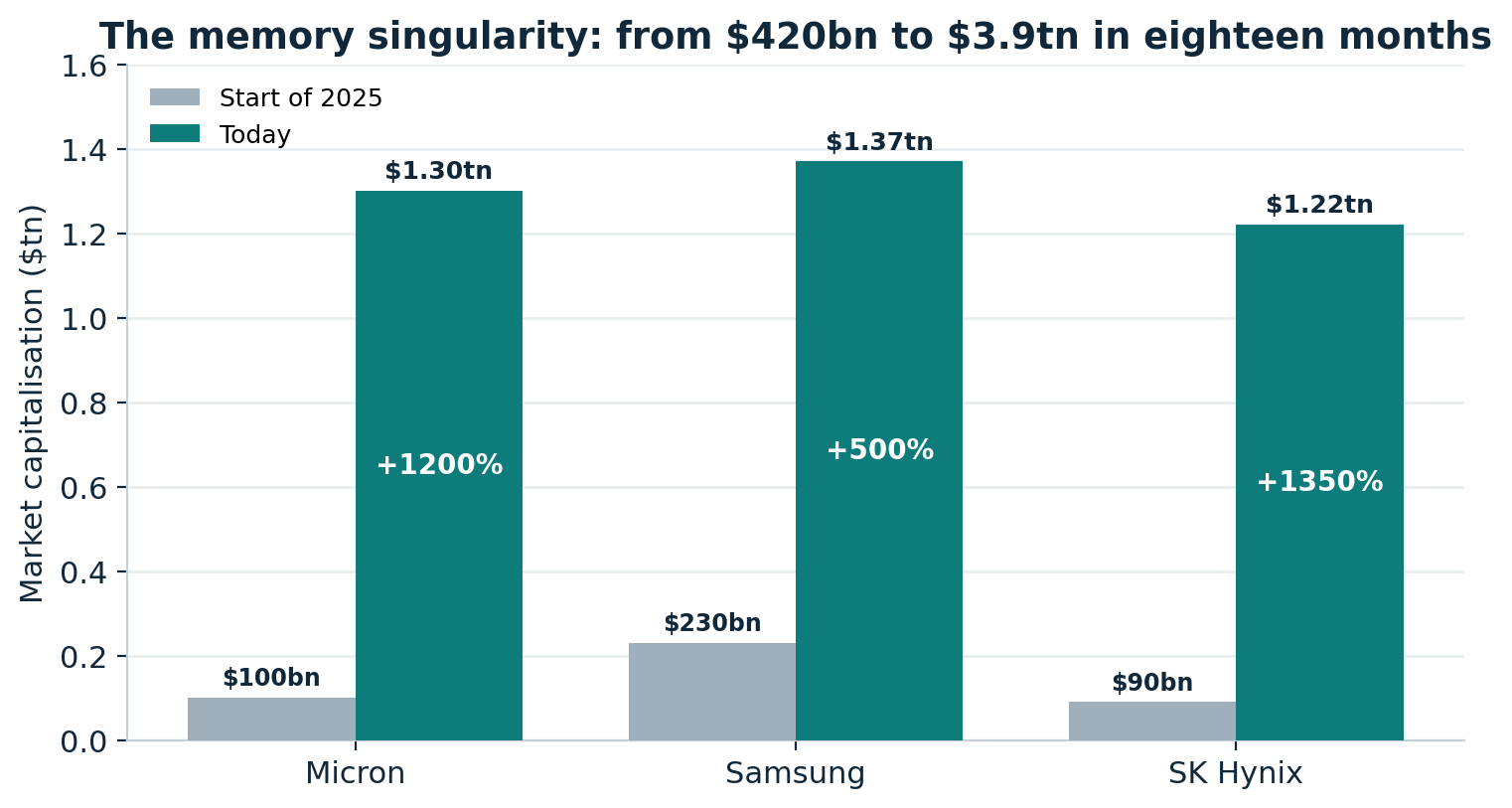
Source: industry data. The complex has already re-rated violently, much good news is in the price.
Business Description
Micron Technology is one of only three at-scale memory and storage manufacturers on the planet, and the only one headquartered in the United States.
Founded in Boise, Idaho in 1978, it designs and manufactures both DRAM and NAND, selling through its Micron and Crucial brands. Its portfolio spans the full stack: HBM, high-capacity server DRAM, DDR5, LPDDR5, graphics GDDR, MRDIMMs and CXL on the DRAM side, and TLC and QLC SSDs, enterprise SSDs and mobile managed NAND on the storage side, plus a small legacy NOR business.
The scale of what just happened in its recent results publication is hard to overstate:
Micron generated roughly $37.4bn of revenue in fiscal 2025. On the run-rate implied by this quarter’s $41.5bn and next quarter’s $50bn guide, the company is now tracking toward $120bn to $130bn of revenue in fiscal 2026.
A memory business does not normally more than triple its revenue base in a single fiscal year. This one did, almost entirely on price.
A short history - Micron built the oligopoly it now benefits from:
Micron’s history is, to a large degree, the history of memory consolidation itself.
From a Boise startup in 1978, it grew through a long series of acquisitions that removed competitors from the market: Texas Instruments’ memory business in 1998, Toshiba’s Virginia operation (now Manassas) in 2002, Lexar in 2006 and Numonyx in 2010.
The two transformational deals came later:
The roughly $2.5bn acquisition of Japan’s Elpida in 2012, which brought the Hiroshima fab, expanded capacity by nearly half and was itself a consolidation of the failed Japanese DRAM industry.
The roughly $4.1bn acquisition of Inotera in 2016, which brought previously outsourced DRAM in-house and helped lift gross margins from around 20% to over 40% within a year.
In 2018 Micron bought out Intel’s stake in their flash joint venture and later exited the failed 3D XPoint experiment.
Two important points about Micron’s history:
The three-player oligopoly that makes this cycle so powerful was built in part by Micron’s own dealmaking, which took more than twenty vendors out of the market over three decades.
Over the last five years management has been deliberately disciplined, declining to chase volume-destroying M&A and instead optimising the economics of the core portfolio. That discipline is exactly what the SCA strategy now extends.
Breakdown by segment - the four business units:
Micron reorganised its reporting in the fourth quarter of fiscal 2025 into four end-market units (replacing the old CNBU, MBU, EBU and SBU structure). Understanding each is worth the effort, because it shows precisely where the AI demand is landing, how broadly it has spread, and which parts of the franchise carry the durable economics.
Across the group, DRAM was a record $31.3bn in the June quarter (76% of revenue, up 67% sequentially, up 343% year over year, with prices up in the low-60s percent range) and NAND a record $9.9bn (24% of revenue, up 99% sequentially, up 361% year over year, with prices up in the mid-80s percent range).
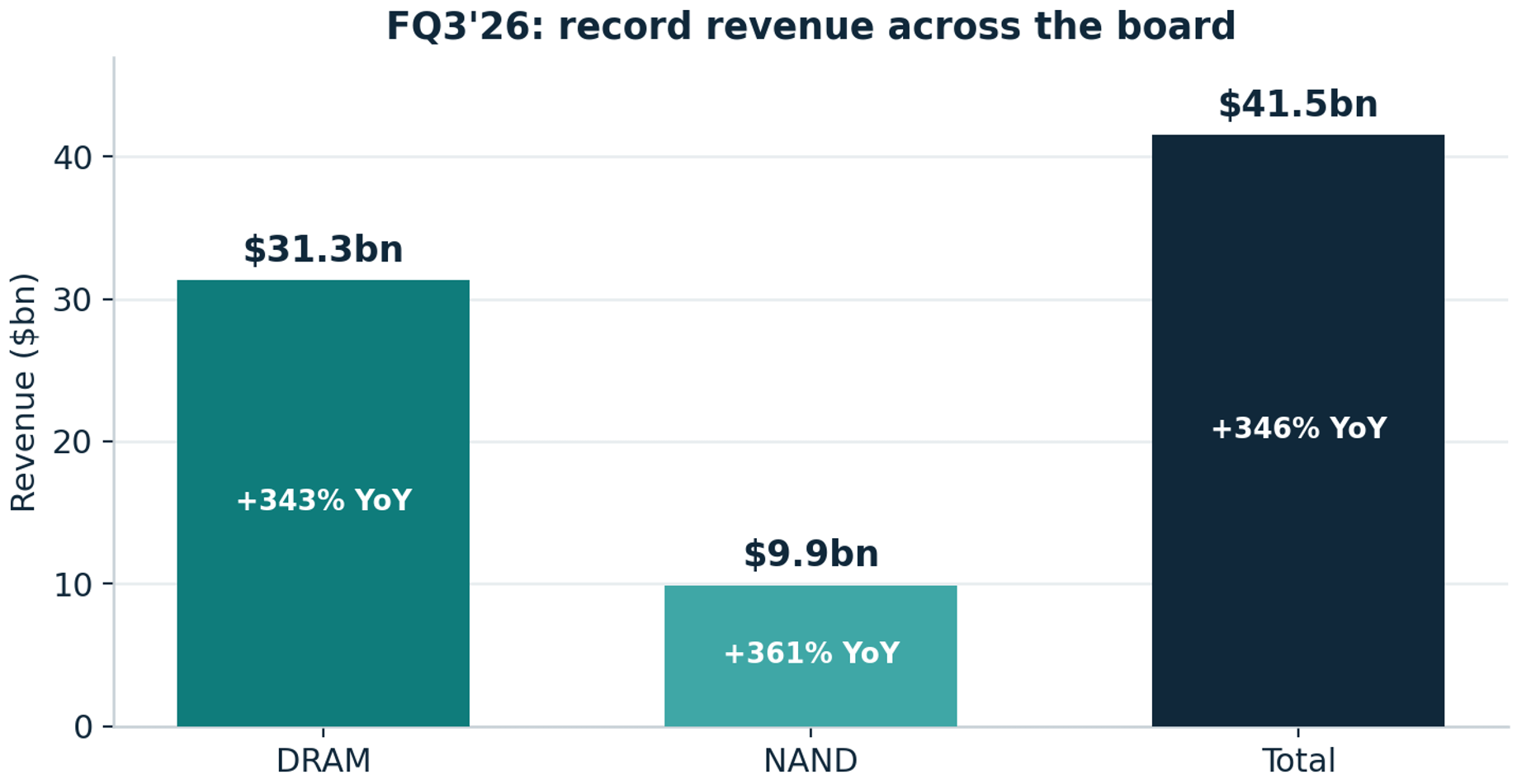
Source: company filings. Every segment set a record, but the data-center-facing units are the engine.

Cloud Memory (CMBU), $13.8bn, 33% of revenue, +78% qoq, 83% gross margin. This is the tip of the AI spear. This unit sells cloud DRAM to the large hyperscalers (Amazon, Microsoft, Google and the like) and houses all of Micron’s HBM for every data-center customer. It is the fastest-growing and most strategically important unit, and it is the vehicle for the HBM ramp. It barely existed in its current form two years ago: the products that sit here (HBM, high-capacity DIMMs, low-power server DRAM) are precisely the AI-levered categories, which is why CMBU revenue grew 257% in fiscal 2025 alone.
Core Data Center (CDBU), $11.5bn, 28% of revenue, +103% qoq, 87% gross margin. Mid-tier cloud, enterprise and OEM data-center memory, plus all of Micron’s data-center SSDs and NAND components. This is where the storage story lives: in 2025 Micron qualified and shipped its 9550 series SSD and its 6550 ION SSD, both built on G8 NAND with a fully vertically integrated controller, firmware, NAND and DRAM stack, and it added its first G9-based PCIe Gen6 SSDs. Data-center SSD revenue exceeded $5bn in the quarter and more than doubled sequentially. CDBU posted the highest gross margin of any unit at 87%.
Mobile & Client (MCBU), $11.5bn, 28% of revenue, +49% qoq, 87% gross margin. Memory and storage for smartphones and PCs (LPDDR, managed NAND, discrete NAND and DRAM), plus Micron’s Crucial-branded consumer SSDs and modules. This is the volume base of the franchise, and it is where supply is being actively constrained: MCBU bit shipments actually fell sequentially as Micron reallocated wafers to higher-value data-center demand, yet revenue still rose 49% on price. That single fact captures the whole cycle.
Automotive & Embedded (AEBU), $4.6bn, 11% of revenue, +71% qoq, 79% gross margin. Memory and storage for automotive, industrial and consumer embedded markets. Historically the steadiest, highest-quality-of-earnings unit (it was the only one that stayed solidly profitable through the 2023 trough), and increasingly an AI story in its own right through ADAS and, eventually, robotics.
Some important elements to understand the business:
The Cloud Memory unit houses HBM and high-capacity cloud DRAM and is the tip of the AI spear, but every unit set a record.
The two data-centre-facing units together cleared $25bn in the quarter, an annualised run-rate above $100bn, and data-centre SSD revenue alone exceeded $5bn and more than doubled sequentially.
DRAM was 76% of total revenue and NAND 24%.
This is the entire memory stack repricing together because the binding constraint, wafer capacity, is shared across all of it.
It is worth looking at the segment history, which tells the cyclical story better than any words. Here is revenue and operating income by unit across the last three fiscal years:

In fiscal 2023, the mobile and client unit alone lost $3.2bn and the company lost $5.7bn at the operating line. Two years later the same franchise earned $9.8bn, and on the current run-rate it will earn multiples of that in fiscal 2026.
This is the single best illustration of what memory operating leverage does in both directions, and it is the reason I keep the word cyclical stapled to every bullish sentence in this piece.
A meaningful concentration point sits inside CMBU: one customer was 17% of total revenue in fiscal 2025, up from a business where no customer cleared 10% as recently as 2023.
Geographic exposure:
By customer-headquarters location, the United States is the majority of revenue at roughly 52%, followed by Taiwan at around 19%, China ex-Hong Kong at around 12%, and all other regions at around 17%.
That US skew, unusual for a memory maker, is a structural asset in a reshoring world (as I discuss below), and it is a big part of why US-headquartered hyperscalers are willing to sign multi-year agreements with the only domestic champion. It also means the China revenue at risk from Beijing’s critical-information-infrastructure restrictions is a manageable slice, much of it sold to US firms operating in China rather than to Chinese state buyers.
Manufacturing footprint and the reshoring angle:
Micron’s front-end manufacturing is concentrated in Taiwan (Taichung and Taoyuan, which together make roughly two-thirds of its DRAM), Japan (Hiroshima), Singapore (DRAM, NAND and a new HBM advanced-packaging facility) and Virginia (Manassas), with back-end assembly and test across Malaysia, China, India and Singapore.
What is changing is the centre of gravity: Backed by the CHIPS Act (grants of up to $6.4bn, a 35% investment tax credit on qualified US investment, and a non-binding New York term sheet for up to $5.5bn over twenty years), Micron is building leading-edge DRAM capacity in Boise, Idaho and Clay, New York, and bringing advanced HBM packaging onshore for the first time.
The first Idaho fab is pulled forward to deliver output in mid-2027, Hiroshima is being accelerated, Singapore comes on through 2028, and New York is a multi-decade, four-fab build for supply around the end of the decade.
As mentioned above, roughly half of Micron’s revenue already comes from US-headquartered customers, and those customers increasingly value a US-anchored supply plan. The reshoring angle is not a side note, it is a second structural theme stacked on the AI one, and a key reason customers are signing multi-year agreements with Micron specifically.
