

Welcome to the 64th investment case, 52nd Resilience & Quality, 31st AI & Technology idea on Crack the Market (and the most comprehensive Microsoft investment case you will find online)! Join me as I dissect the most important enterprise technology company in the world, which is being sold off in one of the clearest misvaluations in large-cap technology, despite being the only company on Earth that monetizes the AI revolution across every layer of the stack simultaneously, from the GPU silicon to the hyperscale datacenter, from the model API to the agent orchestration platform, from the code editor to the 450 million enterprise knowledge workers who spend their entire working lives inside Microsoft’s digital real estate.
Twice a week, I release deep dives into stocks and sectors that fit into the 6 themes that I see winning in the coming years and decades: AI & Technology, Electrification & Energy, Reshoring & Sovereignty, Healthcare & Longevity, China & Asia, Resilience & Quality.
Take advantage of this once in a generation opportunity to build long term wealth by investing in great stocks that will deliver returns for your portfolio for years to come.
After reading this article, you will understand why Microsoft is one of the definitive end-to-end winner of the AI supercycle despite trading close to its lowest valuation in six years, why the Software Armageddon of early 2026 has created one of the most asymmetric entry points in large-cap technology, and why the market is confusing a temporary supply constraint and a Copilot product gap with a permanent deterioration in competitive position.
In this article I go through:
Microsoft’s business and how it dominates enterprise software, cloud infrastructure, and AI platforms, making it one of the most compelling long-duration compounders in global technology.
How the company is executing a full-stack AI transformation that no analyst has yet priced.
How management sustains 15 to 17% revenue growth through a $141 billion capex cycle and why the FY27 FCF inflection is the most powerful unpriced catalyst in large-cap technology.
How its $625 billion backlog, four distinct OpenAI revenue streams, and the world’s largest enterprise knowledge graph create a compounding monetization engine only beginning to convert demand into revenue.
Why the Copilot code red is being addressed with genuine urgency, and why the bear/base/bull scenario analysis points to profoundly asymmetric upside from current levels.

Microsoft Investment Case
Table of content
Business Description
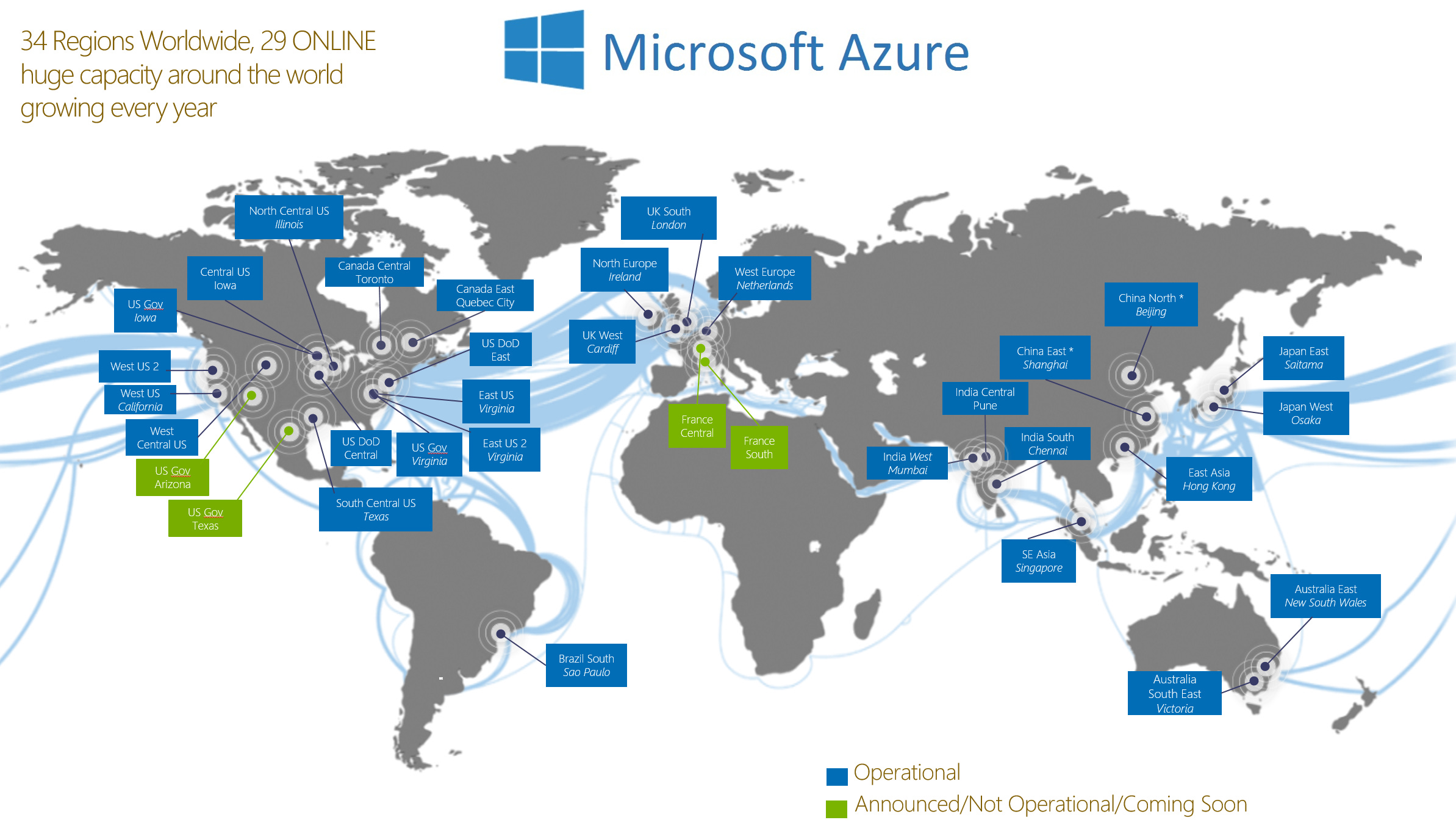
Microsoft is the world’s largest software company, a $3tn market cap and $281.7bn revenue behemoth (up 15% yoy) , having transformed its business model from a component-driven PC/server model to a subscription and cloud-capacity-driven model. Founded in 1975 by Bill Gates and Paul Allen, Microsoft has executed one of the most successful corporate transformations in history under CEO Satya Nadella since 2014, shifting from a Windows-centric boxed-software company into a cloud-first, AI-first platform. The company generates approximately $330bn in annualized revenue, operates globally with approximately 228,000 employees, and runs more than 400 datacenters across 70 regions, more than any other cloud provider, all now designated AI-first. In FY25 alone, Microsoft added more than 2 GW of incremental datacenter capacity. Copilot applications have surpassed 100 million monthly active users across consumer and commercial surfaces combined. More than 230,000 organizations, including 90% of the Fortune 500, have used Copilot Studio to build custom AI agents, with 3 million custom agents already deployed. The advertising business crossed $20bn in annual revenue for the first time in FY25.
Microsoft is the world’s most vertically integrated AI company. Not in the semiconductor sense, that distinction belongs to TSMC and Nvidia (both of which I have covered), but in the enterprise sense: it is the only company that monetizes artificial intelligence simultaneously at the infrastructure layer (Azure), the platform layer (Azure AI Foundry, Azure OpenAI Service, GitHub), and the application layer (Microsoft 365 Copilot, GitHub Copilot, Security Copilot, Dragon Copilot, Dynamics 365). This vertical integration is not incidental. It is the primary strategic advantage that separates Microsoft from every hyperscaler, every SaaS vendor, and every AI-native startup attempting to displace it.


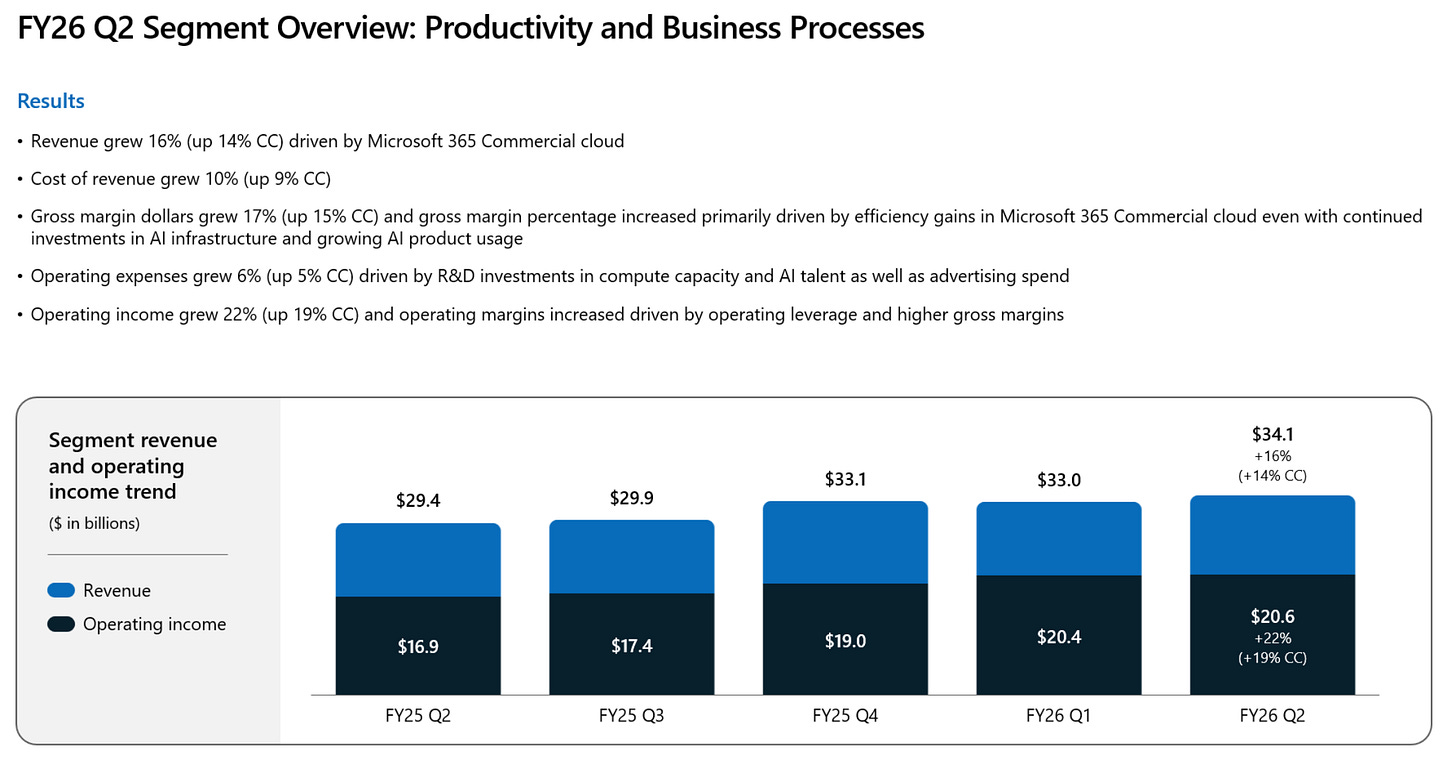
Microsoft operates through three primary segments: Productivity and Business Processes (Microsoft 365, Dynamics, LinkedIn), Intelligent Cloud (Azure, Server Products, GitHub), and More Personal Computing (Windows, Xbox, Search/Bing, Devices). In August 2024, Microsoft reorganized its reporting to align the commercial components of Microsoft 365 entirely within the Productivity and Business Processes segment, allowing investors to view the commercial user as a unified monetization surface.:
Productivity and Business Processes (43% of sales, $120.8bn of sales, 54% of operating income, $69.8bn operating income): This segment consists of Microsoft’s portfolio of productivity, communication, and information services. This is the primary interface for enterprise workers. Key products include Microsoft 365 Commercial and Consumer (which houses the world famous Office, Teams, Exchange, SharePoint, and Microsoft 365 Copilot), LinkedIn, and Dynamics 365 (ERP and CRM applications). Notably, in August 2024, Microsoft reorganized its reporting structure to bring all commercial components of Microsoft 365 into this segment, establishing a unified view of the commercial user as a single monetization surface.
Microsoft 365 Commercial (31% of sales) and Consumer (3% of sales): An AI-powered business platform including Office, Teams, SharePoint, and Microsoft 365 Copilot. In August 2024, Microsoft reorganized its reporting to group all commercial components of M365 into this segment, allowing the company to view and monetize the commercial user as a unified surface. M365 boasts over 450 million paid commercial seats and 89 million consumer subscribers.
LinkedIn (6% of sales): The world’s largest professional network with 1.2 billion members, generating revenue through Talent Solutions, Marketing Solutions, and Premium Subscriptions.
Dynamics 365 (3% of sales): A unified set of cloud-based intelligent business applications for Enterprise Resource Planning (ERP) and Customer Relationship Management (CRM), tightly integrated with low-code platforms like Power Apps.
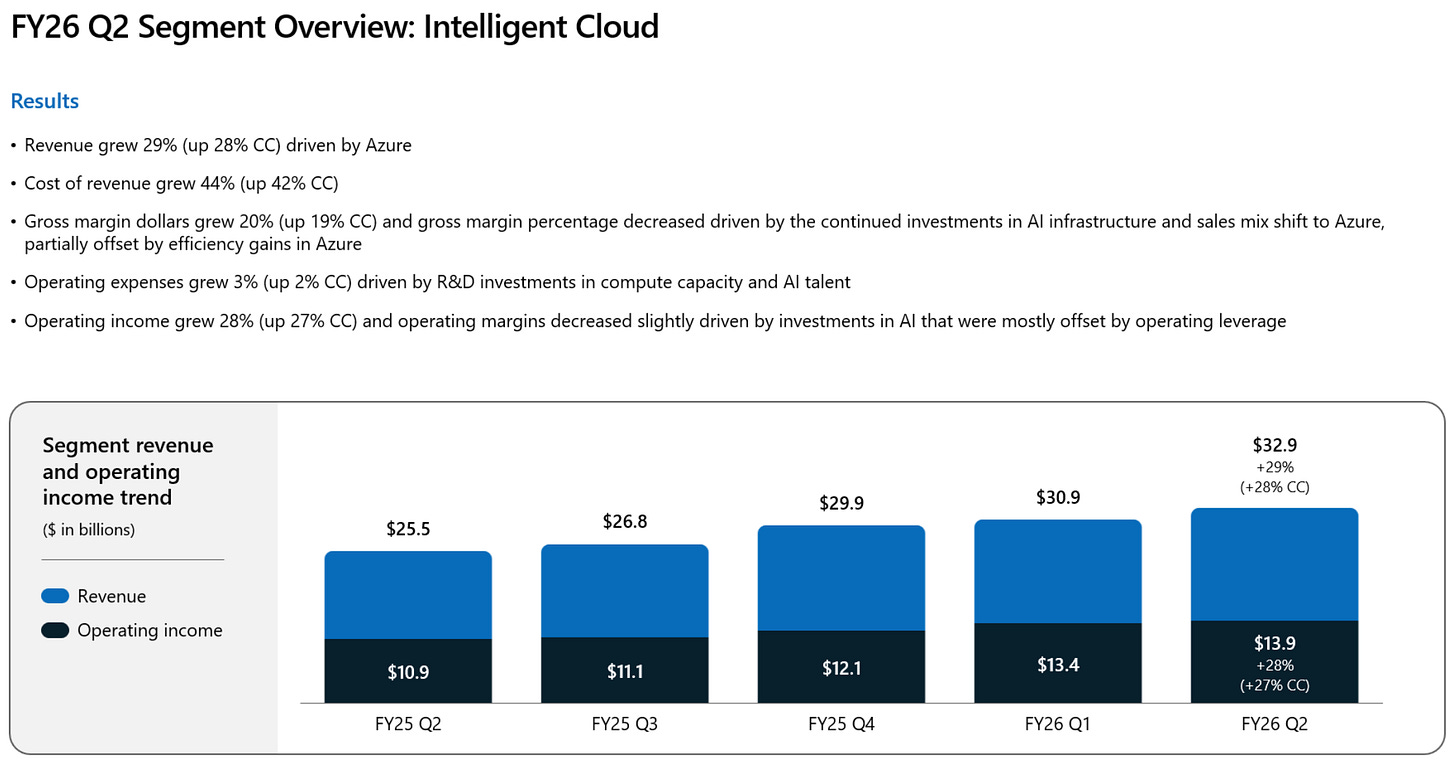
Intelligent Cloud (38% of sales, $106.3bn of sales, ): Acting as the company’s primary growth engine, this segment houses the public, private, and hybrid server products and cloud services that power modern businesses and developers. It includes Azure, which surpassed $75bn in revenue for the first time in FY25, along with GitHub, Nuance Healthcare, enterprise support services, and traditional on-premises server products like Windows Server and SQL Server.
Azure (27% of sales): A comprehensive set of cloud services offering computing, networking, storage, and AI capabilities. Azure enables enterprises to outsource their hardware management and scale their digital operations.
AI, Data, and Developer Tools (3% of sales): This includes Azure AI Foundry, a platform hosting over 11,000 models used by 80% of the Fortune 500 to customize AI apps. It also includes Microsoft Fabric, the company’s unified data analytics platform, and GitHub, a developer collaboration platform boasting over 20 million GitHub Copilot users.
Server Products & Enterprise Services (8% of sales): Traditional on-premises offerings like Windows Server and SQL Server, alongside consulting and premier support services.
More Personal Computing (19% of sales, $54.6bn of sales): This segment focuses on end-user experiences and includes Windows OEM licensing, Devices (such as Surface and PC accessories), Search and news advertising (Bing, Edge), and Gaming (Xbox hardware, content, and Game Pass subscriptions, bolstered by the $75.4bn acquisition of Activision Blizzard).
Windows and Devices (6% of sales): Revenue generated from Windows OEM licensing to computer manufacturers, as well as first-party Surface devices and PC accessories.
Gaming (8% of sales): A massive ecosystem spanning Xbox hardware, content, and the Xbox Game Pass subscription service, reaching 500 million monthly active users across platforms.
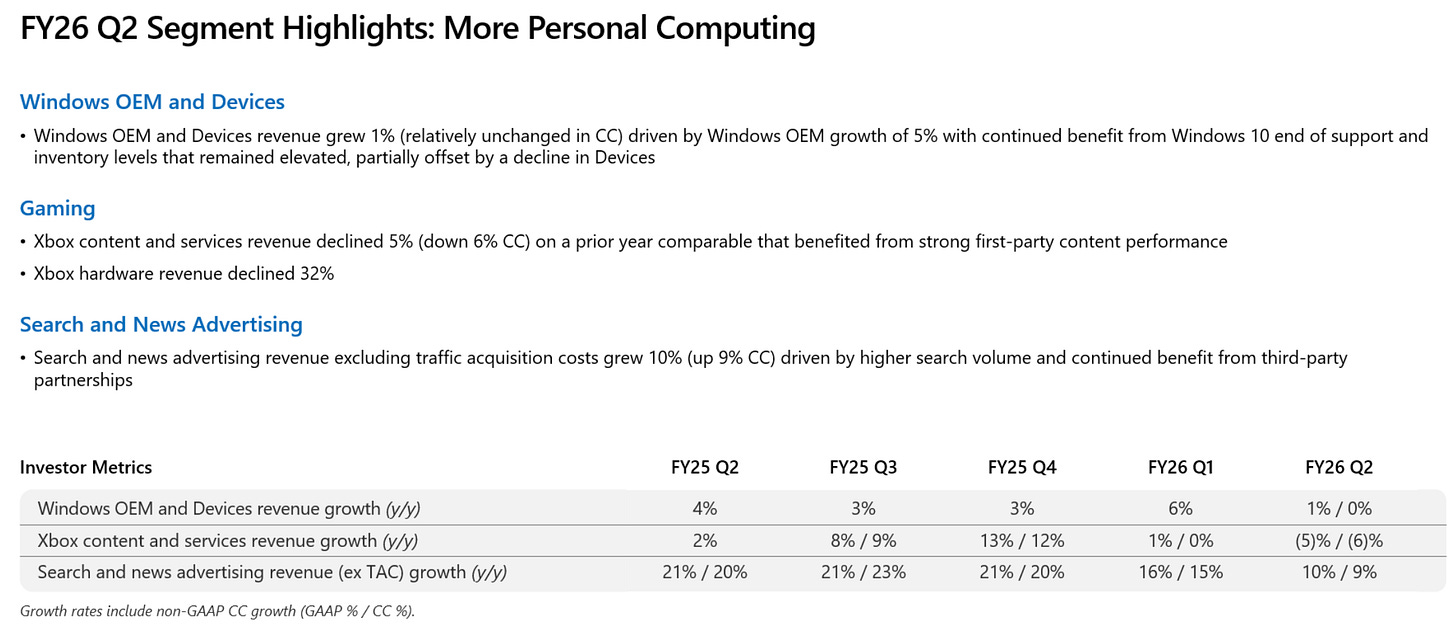
Search and News Advertising (5% of sales): Digital advertising delivery via Bing, Microsoft Edge, and the Copilot consumer app.
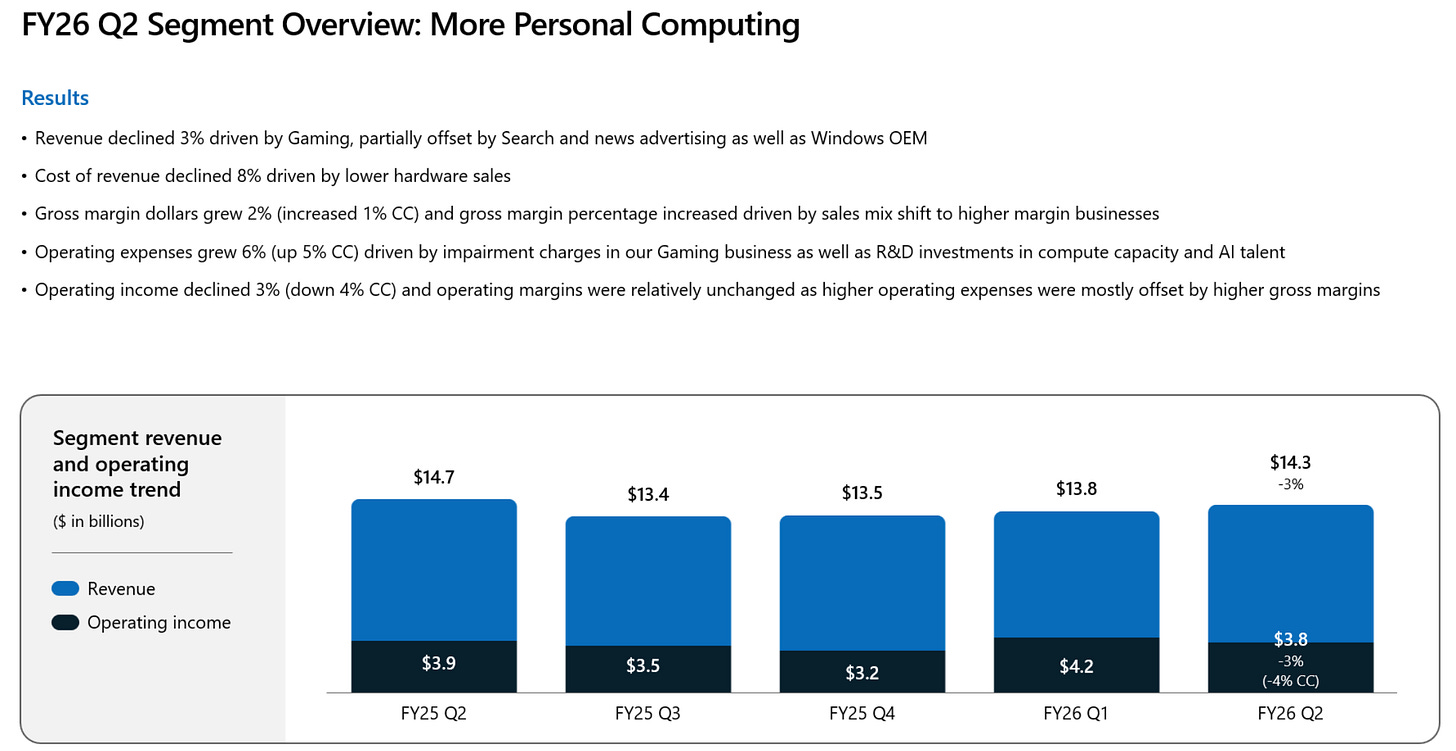
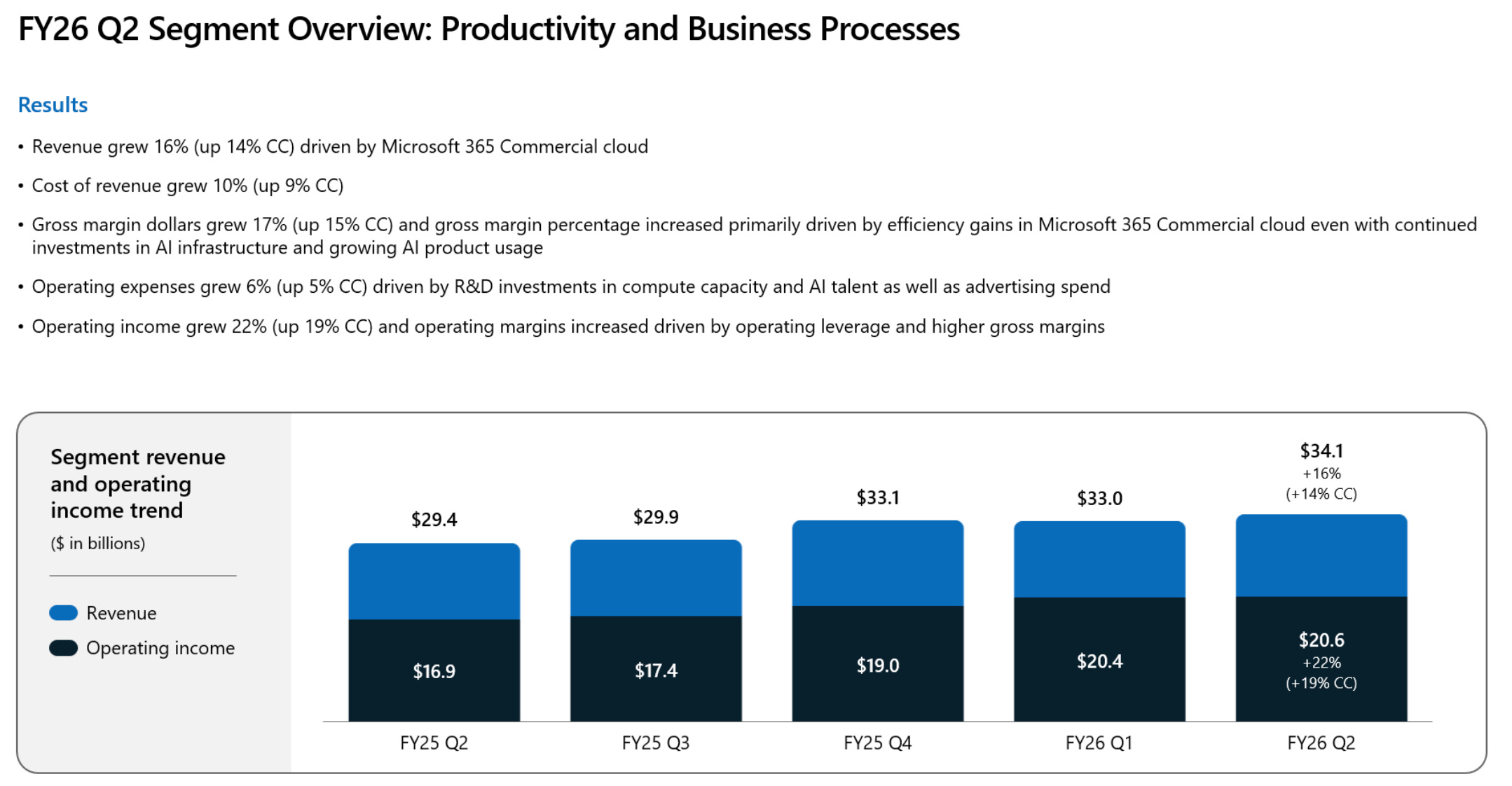
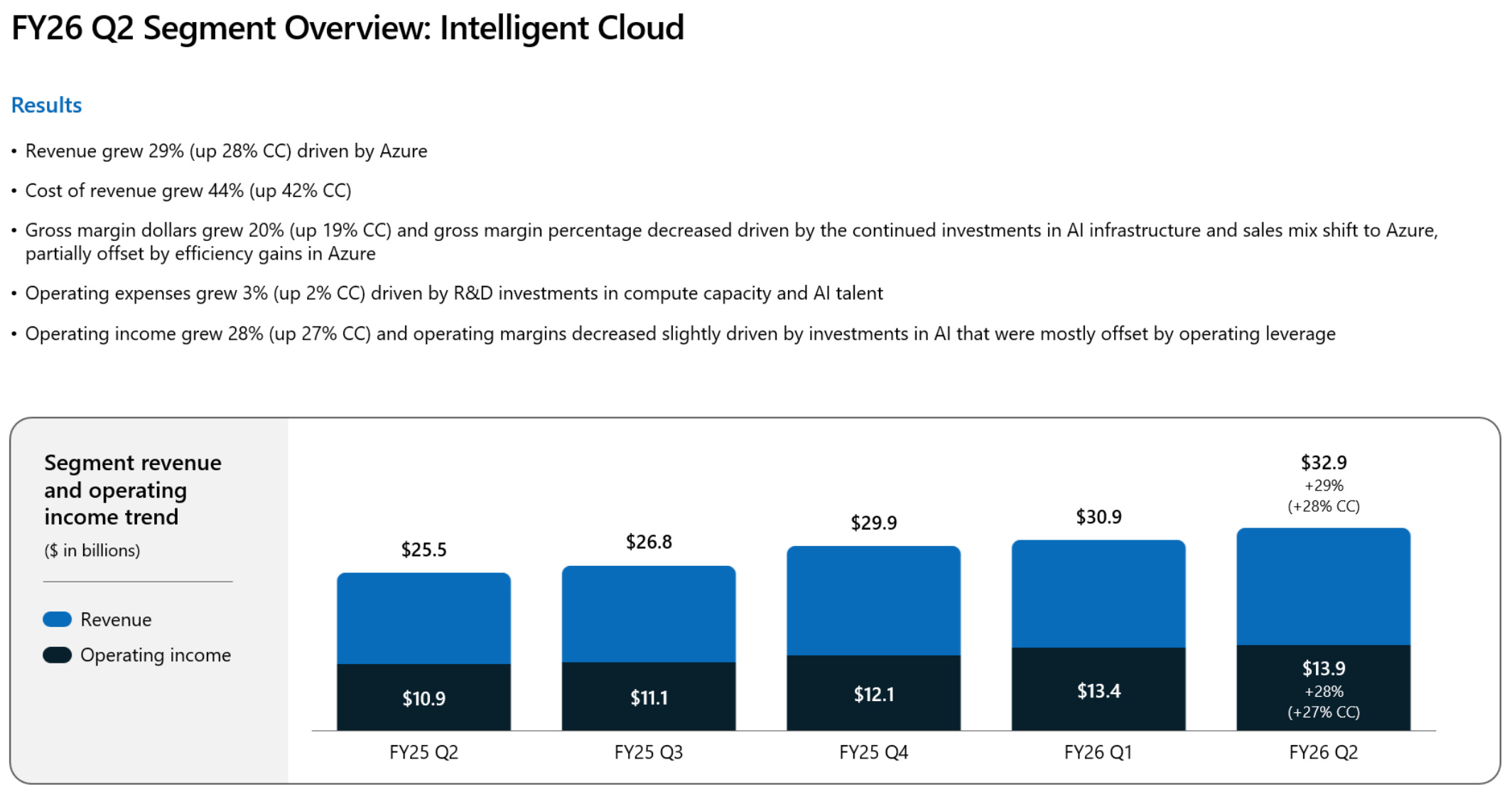
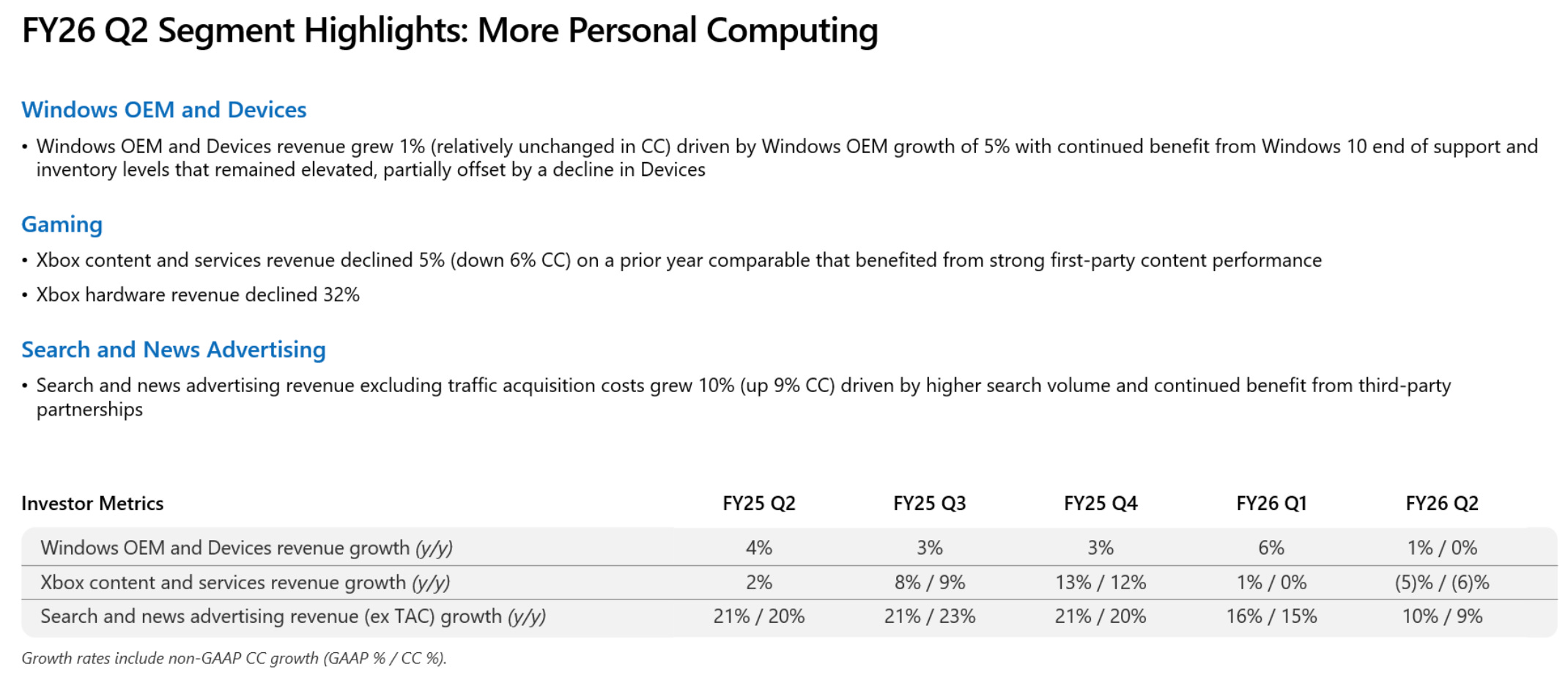
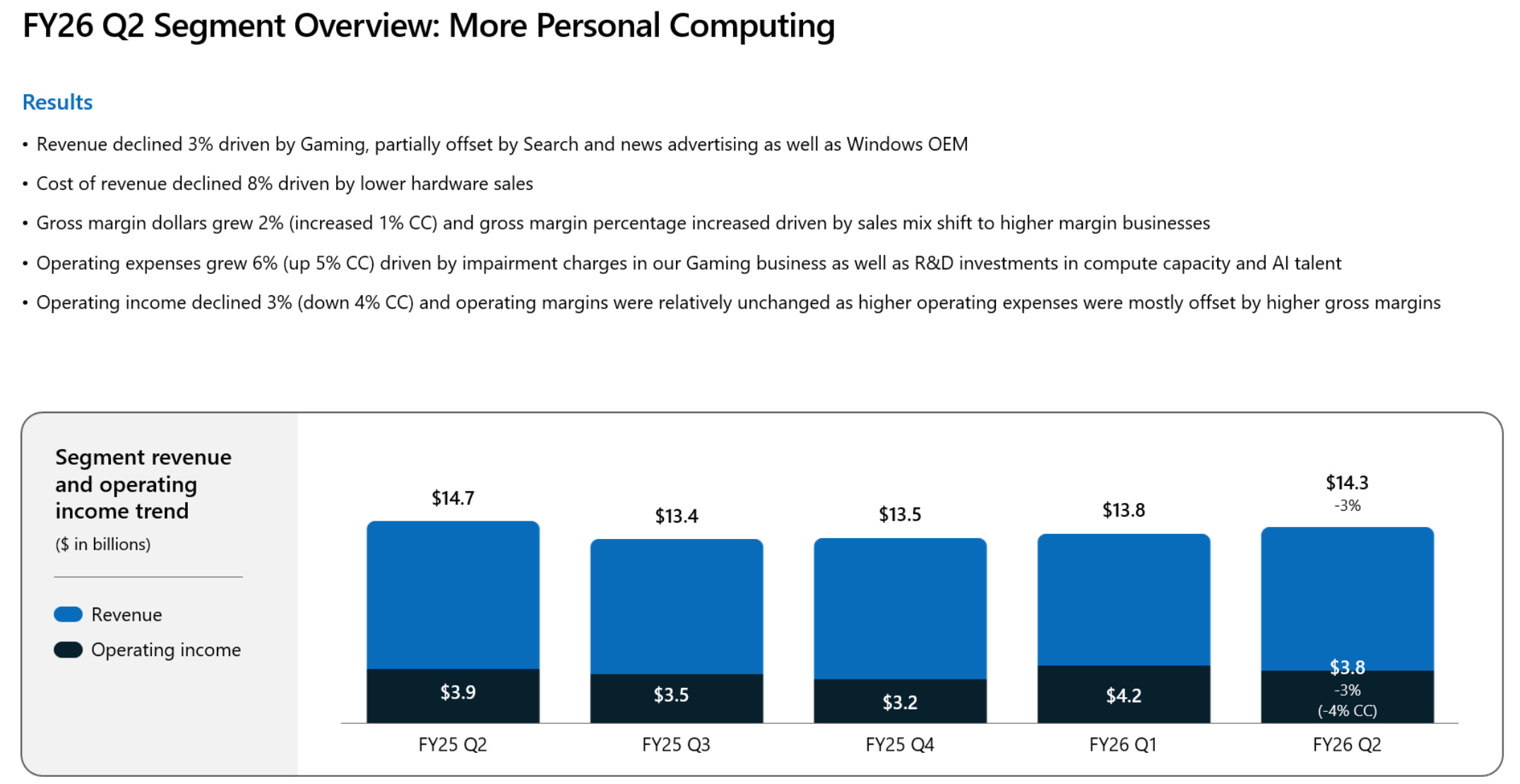
Underpinning these distinct segments is the Microsoft Cloud, a commercial classification that aggregates cloud-based revenue streams across the company (such as Azure, M365 Commercial Cloud, and Dynamics 365). The Microsoft Cloud generated $168.9bn in FY25, representing roughly 60% of the company’s total revenue and growing at approximately 23-24% annually. In Q2 FY26, the Microsoft Cloud surpassed $50bn in quarterly revenue for the first time. The three segments share unified infrastructure that creates the structural moat: identity through Entra (1 billion monthly active users), data sovereignty through Purview, security through Defender and Sentinel (1.6 million security customers), and development through GitHub and VS Code. An enterprise deeply embedded in this ecosystem cannot be displaced without rebuilding its entire digital operating system from scratch.
Today, Microsoft sits at the center of the generational AI platform shift, embedding generative AI and agentic capabilities directly into every layer of its technology stack. By leveraging a massive installed base that includes over 450 million paid Microsoft 365 commercial seats and 1.2bn LinkedIn members, Microsoft functions as a foundational platform for the modern enterprise.
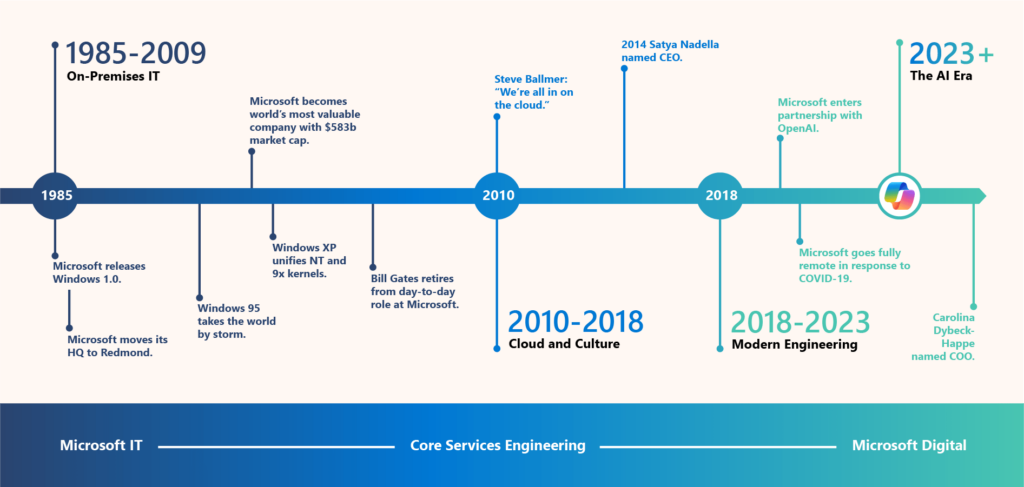
1975: Bill Gates and Paul Allen found Microsoft in Albuquerque, New Mexico, building a BASIC interpreter for the Altair 8800 microcomputer.
1980: IBM partnership changes history. Microsoft licenses QDOS, rebrands it as MS-DOS, and becomes the de facto operating system for the IBM PC, establishing the core business model of software licensing.
1986: IPO at $21 per share. Raises $61m. Gates becomes a billionaire within a year.
1990: Windows 3.0 launches, selling 2 million copies in six months and establishing the graphical user interface as the standard for personal computing.
1995: Windows 95 launches to queues around the world. Internet Explorer ships, beginning the Browser Wars with Netscape. Microsoft becomes the most valuable company in the world.
1997: Microsoft invests $150m in Apple, saving the company from bankruptcy and avoiding antitrust scrutiny. Microsoft Office becomes the dominant enterprise productivity suite globally.
2000: Steve Ballmer becomes CEO. The dot-com crash wipes trillions from tech valuations. Microsoft faces its existential antitrust trial. The company is temporarily ordered to be broken up before an appeals court overturns the ruling.
2001: Xbox launches, beginning Microsoft’s foray into gaming hardware. Windows XP launches. The company misses the mobile revolution that is coming, a near-fatal strategic error.
2007: The iPhone launches and begins to make Windows irrelevant on the device that will become the primary computing platform for billions of people. Microsoft’s attempts at mobile (Windows Mobile, then Windows Phone) fail comprehensively.
2008 to 2013: The lost decade. Microsoft’s stock trades essentially flat. The company misses mobile, loses relevance in search (Bing never threatens Google), and watches as Amazon, Google, and Salesforce build the cloud and SaaS markets it should have owned.
2011: Azure launches commercially, Microsoft’s first serious entry into cloud infrastructure. The company is already three years behind Amazon.
2014: Satya Nadella becomes CEO. The transformation begins. Mobile-first, cloud-first strategy replaces the Windows-centric culture. The decisive early signal is Nadella announcing Office for iOS, putting Microsoft productivity software on Apple’s platform.
2016: LinkedIn acquired for $26.2bn, Microsoft’s largest acquisition at the time. GitHub acquired for $7.5bn in 2018. Both become foundational assets in the AI era.
2019: Microsoft invests $1bn in OpenAI, establishing what will become the most consequential corporate partnership in technology history.
2020: The pandemic massively accelerates cloud migration and Teams adoption. Teams goes from 75 million daily active users to 145 million in one year. Azure passes $20bn in annual run rate.
2021: Microsoft becomes a $2tn company for the first time. Azure surpasses Google Cloud in market share. The company makes its largest bet on gaming with the announced acquisition of Activision Blizzard for $68.7bn.
2023: ChatGPT launches in November 2022 and changes the world. Microsoft integrates GPT-4 into Bing (briefly the most interesting thing on the internet), launches GitHub Copilot commercially, and begins embedding AI across the entire product portfolio. The OpenAI partnership expands with $10bn in new investment.
2024: Microsoft becomes the world’s most valuable company briefly, touching $3.2tn market cap. Azure surpasses $75bn in annual revenue. Copilot launches across M365. The company adds 2 GW of AI datacenter capacity in a single year.
2026 (today): Microsoft trades at approximately $400-420, down 22% from its Oct 2025 highs. It is back to 2020 valuation levels despite being a fundamentally more valuable business. This is the entry point.
Investment Case
The market has constructed a coherent but ultimately misdiagnosed bear case around Microsoft entering 2026. The stock is down approximately 20% from its 2025 highs and 10% YTD, with the worst post-earnings day coming in January 2026, when Microsoft lost $357bn in market value in a single session, the second-largest single-day value destruction in stock market history. I think Bloomberg captured the moment exceptionally well: “The selloff comes amid heightened skepticism from investors that the hundreds of billions of dollars Big Tech is spending on AI will eventually pay off. Microsoft’s results showed a 66% rise in capital expenditures in its most recent quarter to a record $37.5bn, while growth at its closely tracked Azure cloud-computing unit slowed from the prior quarter.”
The Azure miss was exactly one percentage point versus what the buyside expected: 38% constant currency instead of consensus 39%. Management explicitly said growth would have been above 40% if all incremental GPUs had been directed externally. That single percentage point triggered $357bn in value destruction. This is the market conflating timing risk with structural risk. At approximately $420-420 per share, Microsoft trades at roughly 20-21x CY27 forward non-GAAP earnings, back to approximately 2020 valuation levels, and a historically anomalous discount for a business with 46%+ operating margins, $625bn in contracted backlog, and Azure growing 38 to 39% in constant currency with demand exceeding supply.
Why Is Microsoft So Attractive:
