

The market does not care about Nvidia and Broadcom right now, this is a rare opportunity.
Nvidia reported a beat-and-raise quarter, lifted its forward revenue envelope, added an $80bn buyback and a 25x dividend increase, and the stock barely moved.
Broadcom grew AI revenue 143% yoy, printed a record bookings quarter, and the shares fell roughly 14% on a guide that was light by a single-digit percentage against an already heroic consensus.
The two companies that sit at the absolute center of the largest capital cycle in modern history are, after the recent selloff, trading at the cheapest valuations relative to their own growth that they have offered in years.
Meanwhile capital has rotated into photonics, memory, power, into the second-derivative names that have run precisely because they had not yet run.
This is an update, not a fresh introduction. I have already laid out the full case on both companies, so I will not re-explain CUDA or VMware here.
Twice a week, I will release deep dives into stocks and sectors that fit into the 6 themes that I see winning in the coming years and decades: AI & Technology, Electrification & Energy, Reshoring & Sovereignty, Healthcare & Longevity, China & Asia, Resilience & Quality.
Take advantage of this once in a generation opportunity to build long term wealth by investing in great stocks that will deliver returns for your portfolio for years to come.
The purpose is narrower and more urgent: to show why, across the entire AI value chain I have mapped over the past year, these two remain the only places where the durable economics actually accrue, how much visibility now sits behind their forward numbers, how large the opportunity still is, and why the market has handed you an entry point into both at the same time.

A reminder of where this fits. For subscribers who want the full architecture before this update:


Where the value actually accrues
Over the past year I have taken you, layer by layer, through the physical stack of the AI buildout, this piece is the compute-layer capstone of this series. If you have not yet read the rest of the map, the articles below together form the full picture of how to own this buildout:
The Golden Age of Power and the turbine trilogy, where GE Vernova, Siemens Energy and Mitsubishi Heavy sit at the binding constraint of electricity generation.
The Nuclear Renaissance powering the AI data center buildout as the only scalable solution.
The cable makers, Prysmian and Nexans, as the pure plays on the grid and electrification supercycle.
The Optical & Networking Supercycle at the Heart of the AI revolution, with a focus on the value chain and European photonics winners.
The semiconductor equipement companies enabling this AI supercycle.
TSMC, the tollbooth manufacturing every single AI chip.
And most recently Vertiv, the tissue between the silicon and the facility, where every watt of compute has to be powered and cooled.


Each is a genuine business with a real moat. But each is also, fundamentally, a derivative play on a demand signal that originates somewhere else.
That somewhere else is the compute layer. And the cleanest way to see who captures the economics of this entire edifice is not a narrative argument, it is a margin chart. The businesses that design the silicon earn six to seven times the operating margin of the businesses that power it, cool it, and wire it together.
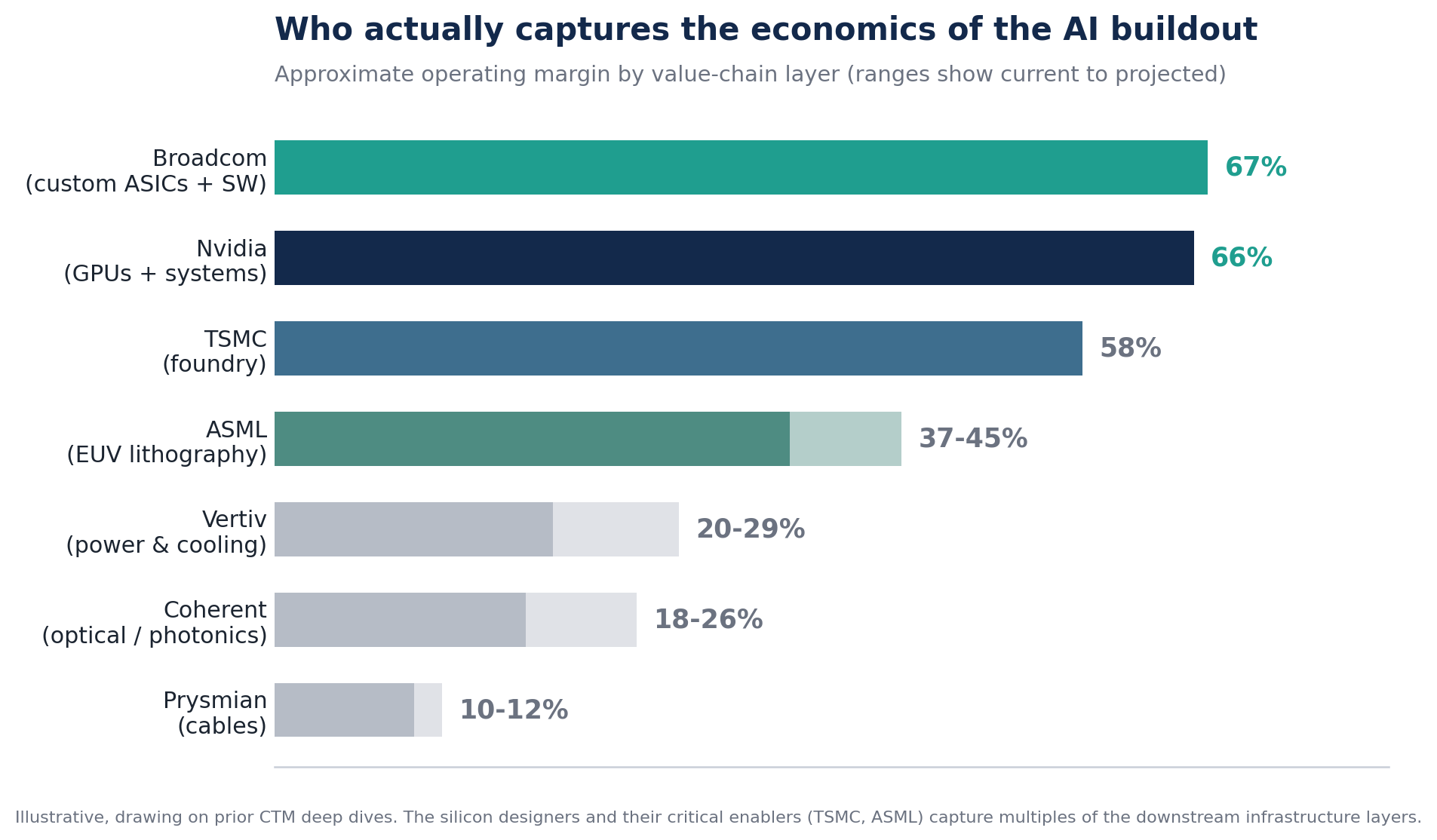
Approximate operating margin across the AI value chain. Compute-layer economics dwarf the infrastructure layers.
This is the heart of the value-extraction argument. Coherent is at 18-26%, Vertiv at roughly 20% going to 28-29% in 2030, the turbine OEMs in the low teens, the cable makers around 9% on an operating basis, these are excellent franchises and I own the thesis on all of them.
But Nvidia and Broadcom convert revenue to operating profit at near 66-67%, with free cash flow margins of roughly 50% and 46%.
When a megatrend is this large, the question for a portfolio is not only who participates but who keeps the money. The answer has not changed. It is the two companies that own the accelerator, the systems and the software around it.
The only comparable companies are TSMC at 58% and ASML at 37-45% operating margins, which still remain two of my top pick to play the AI buildout.

The structural point: the further you move from the silicon, the thinner the margin and the more cyclical the cash flow.
The compute layer is where pricing power, switching costs and the highest incremental margins in the S&P 500 live. Everything downstream is leverage on a signal these two control.
How big is this opportunity
The inference inflection is the single most important shift, and it is now visible in the numbers rather than the narrative. For the first time, inference has overtaken training as the dominant workload.
AI is no longer just being built, it is being used at scale (something that I will write a lot more about with my feedback from a leading global technology conference I attended), and the economics change completely when that happens.
Every agent reasoning through a problem generates tokens at each step, every token requires compute, and more compute produces more capable AI, which drives more usage and more tokens again.
The flywheel is no longer conceptual, it is turning, and it is the structural reason the demand curve keeps extending rather than maturing.
This reframes what a data center even is. The better mental model, and the one the operators themselves now use, is the AI factory: a production system whose only purpose is to manufacture tokens at scale.
Token throughput determines how much work it can do, cost per token determines the economics, and tokens per watt determine revenue per megawatt. That last point is the entire argument for why the best silicon wins, and it is the one the merchant-versus-custom debate keeps missing.
A gigawatt of AI factory costs roughly $40bn to stand up across its life regardless of what you put inside it, so the only question that matters is which compute extracts the most valuable tokens from each watt.
As Jensen Huang puts it, if you have the wrong architecture, even if it is free, it is not cheap enough. Blackwell delivers up to 50x the throughput per megawatt and 35x the lower cost per token of the prior generation. The economics are set at the system level, not the chip level, which is exactly why a cheaper standalone ASIC does not automatically win the workload.
Two concrete markers of how fast the newer layers are scaling, both from the most recent fiscal year: Nvidia’s sovereign AI business more than tripled to over $30bn, and roughly 9GW of Blackwell AI factory capacity has already been deployed. Neither sovereign demand nor the full scale of inference is in anyone’s base case, and each is a separate call option on top of the numbers.
The bear argument for two years has been that we are near peak capex. The data keeps refusing to cooperate. The AI hyperscaler capex is now >$700bn this year (up >60% yoy) and should continue to accelerate next year, quickly approaching $1tn/year and well north of the $3-4tn buildout that I first covered last year.
Importantly, the demand signals coming directly out of these two companies are not softening, they are extending in both magnitude and visibility.
The AI accelerator market alone (GPUs plus custom ASICs) is heading toward $450bn-plus by 2028 on current estimates, and I have argued consistently that the ASIC share of that number is structurally underestimated by consensus in my Age of Inference piece.
A useful anchor that will shock you: as recently as a year or so ago, the standard third-party estimate had the entire custom-ASIC market at roughly $50bn by 2028. Broadcom alone is now guiding to $100bn-plus of AI revenue in FY27. When the single largest supplier is guiding to double the figure the consensus used for the whole market, the consensus is wrong, not the supplier.
The layers of the opportunity that are not in most models.
First, inference. Training built the first wave, inference is the recurring, volume workload that scales with usage, and it is the use case where ASICs become economic and where Nvidia’s installed base compounds.
Second, sovereign and enterprise AI. Management has talked about dozens of gigawatts of sovereign capacity being built at $40-50bn per gigawatt, so even a 10-20GW pipeline over the next couple of years is hundreds of billions of dollars of revenue that barely features in base-case estimates.
Third, the agentic-compute CPU opportunity (something I will soon write more about), a market Nvidia now sizes at roughly $200bn that it scarcely addressed a year ago, targeting $20bn of its own CPU revenue in a single year.
None of inference scale, sovereign buildout, or the CPU TAM is fully reflected in the numbers, and each is a separate call option on top of the base case.
This is the distinction that matters for positioning.
The downstream names (power, cables, cooling, photonics, memory) are leveraged to the volume of the buildout.
Nvidia and Broadcom are leveraged to volume and to the expansion of the addressable market itself, because they keep adding new categories (networking, CPUs, sovereign systems, software) to what they sell into each watt of capacity.
