Welcome to the 76th investment case, 37th AI & Technology idea and 49th Reshoring & Sovereignty investment case on Crack The Market (and the most comprehensive Samsung Electronics investment case you will find online)! Join me as I dissect the largest company in the memory singularity and the cheapest trillion-dollar company in the world, the only memory maker that also owns a leading-edge foundry, the only company on earth positioned on both sides of the memory tax, and the only foundry challenger in history whose catch-up is being funded by the boom itself rather than by a government, along with the risks that come with the widest outcome distribution of any name in the memory group.
Twice a week, I will release deep dives into stocks and sectors that fit into the 6 themes that I see winning in the coming years and decades: AI & Technology, Electrification & Energy, Reshoring & Sovereignty, Healthcare & Longevity, China & Asia, Resilience & Quality.
Take advantage of this once in a generation opportunity to build long term wealth by investing in great stocks that will deliver returns for your portfolio for years to come.
After reading this article, you will understand why Samsung stands out as one of the cheapest large expressions of the most violent memory supercycle on record, how the AI inference build-out inverted a twenty-year hierarchy so that conventional DRAM margin now exceeds HBM margin, rewarding exactly the capacity Samsung has the most of, and how the company is flexing that position into the fastest earnings ramp in its history. You will understand exactly what the four divisions do, how the HBM catch-up is quantified from 1% toward 21% of the Nvidia wallet, and why the foundry the market values below zero just landed Tesla, Anthropic and Meta on a reported W50tn order backlog. Most importantly, you will grasp why Samsung could print the highest operating profit of any company on earth in 2027 at a fifth of Nvidia’s market capitalisation, and why at 4.6 times earnings you are paying nothing for three separately dated options: the foundry turnaround, a W110tn shareholder return, and an American listing. You will also understand the risks, the governance history, and the brutal cyclical characteristics of a business whose annual operating profit was W6.6tn three years ago.
A week ago, Samsung printed the most important quarter in its history, and the stock fell 7% on the day. Preliminary operating profit came in at W89.4tn on revenue near W171tn, an operating margin above 52%, nineteen times the year-ago quarter, roughly W107tn before absorbing more than W15tn of one-off labour provisions, and a beat against a consensus sitting in the mid-70s to mid-80s.
These are numbers that simply do not happen at a company of this size: the sequential increase in quarterly operating profit alone, W32tn, exceeds Samsung’s full-year operating profit in most years of the last decade. Six days later the KOSPI fell 8% on an oil shock, tripped its seventh circuit breaker of the year, and took the stock to W255,000, down 30% from the 18 June peak of W362,500.
But the drawdown is not the story, and neither was the print. Three things actually matter, and I want to be precise about all of them.
The first is that the most violent memory upcycle on record is, for once, Samsung’s home game: the conventional squeeze rewards the largest commodity capacity base in the industry, the very scale that was the discount on this stock for a decade.
The second is the option book: at 4.6 times forward earnings the market is paying a discounted price for the memory engine and nothing at all for a foundry now signing the biggest names in AI, a return policy implying a quarter of the market value back in cash over three years, and an American listing under active review.
The third is the calendar: the full results on 30 July carry the LTA disclosure and the shareholder return framework, and I do not think the current multiple survives them.
Get those three right, whilst remembering that this remains the widest outcome distribution in the memory group and a business whose cycle has never been abolished, and you understand both the opportunity and the risk.
I recently gave my verdict on Samsung in The Memory Basket: the value leg of the satellite, one of the cheapest large expressions of the theme, held below SK Hynix and Micron because it carries the widest outcome distribution in the group. This is the promised deep dive, and the market has obligingly made it cheaper while I wrote it. The stock closed at W255,000 yesterday, down 30% from the 18th of June peak of W362,500, after a Monday session in which the KOSPI fell 8% and tripped its seventh circuit breaker of the year. This piece publishes into the window before the full second quarter results on 30th of July, because that date carries the disclosures I have argued the 4.6x multiple does not survive.

In this article I go through:
What Samsung actually is with the four divisions, the products, the footprint, the ownership web, and why 94% of the profit now comes from one floor of the building
The investment case with the conventional squeeze as Samsung’s home game, the HBM catch-up quantified, and the paradox of collecting and paying the memory tax simultaneously
The foundry business which is going head-to-head against TSMC, the Anthropic and Meta wins landing this month, the W50tn order backlog, and why the memory windfall changes the arithmetic of the catch-up forever
The financials and why Samsung could print the highest operating profit of any company on earth in 2027 at a fifth of Nvidia’s market capitalisation, and the W110tn shareholder return the policy implies
The potential American listing, the risks the bulls are underweighting, a full scenario framework for the valuation, and the catalyst calendar
Samsung Investment Case
Table of content
The Drawdown You Are Buying Into
Before getting to the company, I want to address the environment around memory and the AI trade, because a 30% decline in eighteen trading days deserves to be understood properly before we call it an entry. It came in three steps, and it is worth being precise about the fact that none of them touched the earnings power
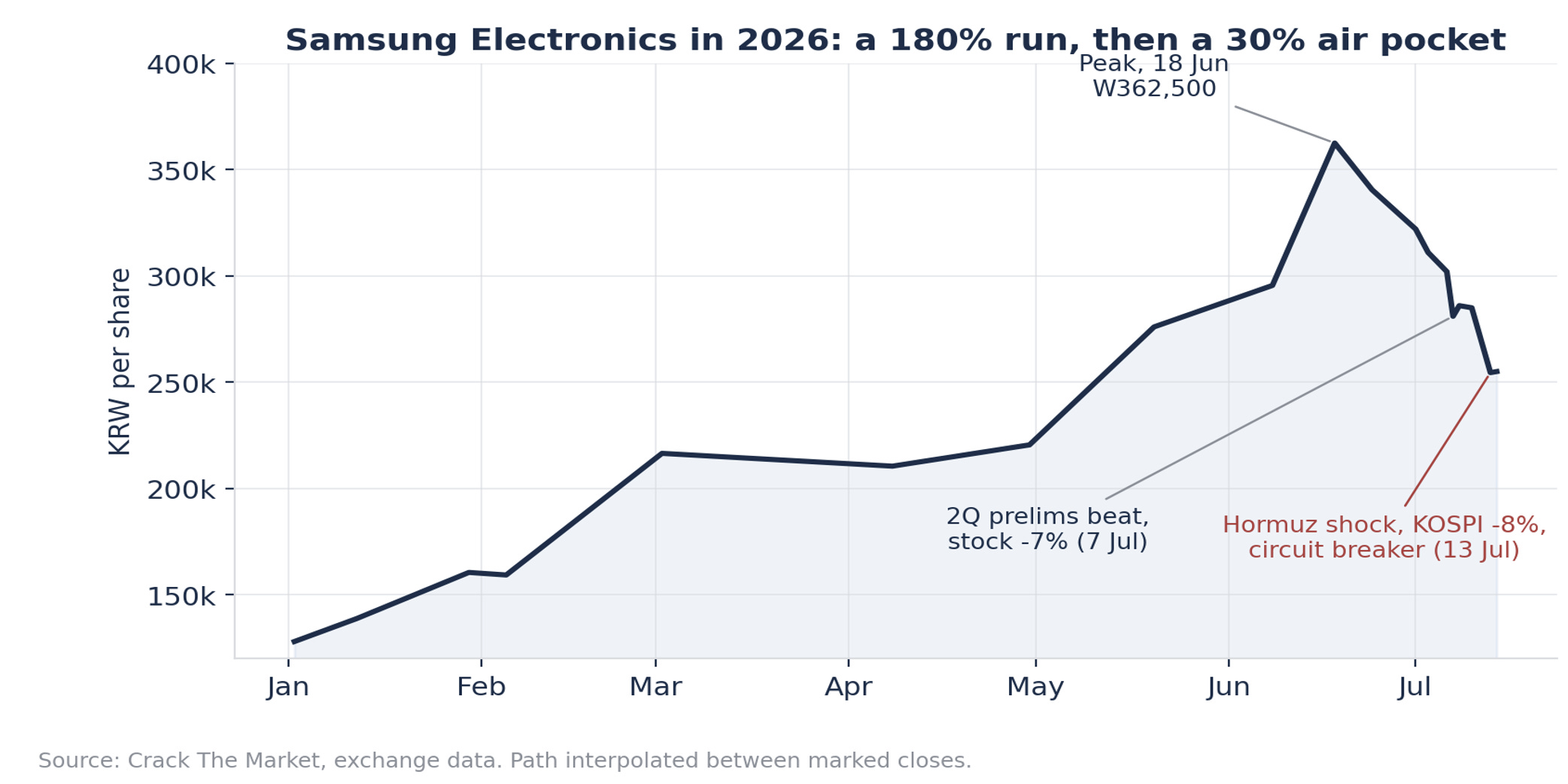
The 2026 path: from W128,000 in January to W362,500 on 18th of June, then three layers of selling in three weeks. Source: Crack The Market.
The first layer was the preliminary results themselves:
On the 7th of July Samsung published preliminary second quarter numbers ahead of every peer: operating profit of W89.4tn on revenue near W171tn, an operating margin above 52%, 19x the year-ago quarter, and a beat against a consensus sitting in the mid-70s to mid-80s despite absorbing more than W15tn of one-off labour cost provisions covering the first half. Strip the provision and the underlying quarter was roughly W107tn (or $72bn).
The stock fell as much as 10% intraday and closed down 7%. The complaint, in so far as one was articulated, was that the beat was only 6% and the shares had already risen 130% YTD. That is a positioning statement, not a fundamental one.
This was in the midst of The Great AI Reckoning, with investors questioning the sustainability of the AI trade and spending, which I covered recently, and which led to a positioning unwind in the AI complex that hurt memory names disproportionately.
The second layer was the SK Hynix ADR aftermath:
The largest foreign listing in US history priced on 10th of July at $26.5bn, seven times covered, and, exactly as I argued in the ADR piece, the debut catalysed profit-taking in the Seoul-listed complex rather than fresh buying, amplified by the single-stock leveraged ETFs the Korean regulator had already flagged as a volatility risk.
Samsung was collateral in its competitor’s celebration.
The third layer was this Monday 13th of July, and it was macro: Over the weekend the Hormuz conflict re-escalated (something I have also extensively written about, stating that escalation remains the default path), Iran declared the strait closed, Brent spiked toward $83, and on the 13th of July the KOSPI fell 8.07% to 6,807 with a market-wide circuit breaker at 1:28pm, the seventh of 2026. SK Hynix fell 15%, Samsung fell 10.7% to W254,500, and foreign and institutional investors sold over W2.8tn of KOSPI stock in a single session. An export-dependent economy was sold indiscriminately on an oil shock. Nothing in that sentence contains the words DRAM, NAND or HBM.


My read of this selloff: profit-taking on a beat, mechanical supply from a competitor’s listing, and a geopolitical risk-off that hit Korea hardest because Korea is the most export-levered market in Asia. Memory contract prices did not fall. The LTA negotiations did not pause. The 30th of July disclosures did not move. What changed is the price, and the price is the one input to this thesis that just improved by 30%.
Business Description
Samsung Electronics (also called Samsung or SEC, ticker: 005930.KS) is the largest technology manufacturer on earth by breadth, and very possibly the most misunderstood large company in any market.
It is simultaneously:
The world’s largest memory maker
The world’s largest smartphone maker by units
The world’s largest television maker for twenty consecutive years
The second-largest foundry after TSMC
A leading OLED display producer.
A top-three image sensor designer
Through Harman, a major automotive electronics and audio supplier
It employs roughly 270,000 people, generated W333.6tn of revenue in 2025, and crossed $1tn of market capitalisation this year for the first time. On the run-rate implied by the second quarter preliminaries it is now tracking toward roughly W700-830tn of 2026 revenue, more than doubling in a single year, almost entirely on the price of memory.
A short history - Samsung does not do small bets:
Samsung was founded in 1938 as a trading company and entered electronics in 1969, making cheap televisions in Suwon under licence.
The company you are buying today was born in 1983, when founder Lee Byung-chul issued the Tokyo Declaration committing the group to semiconductor memory against the unanimous advice of the industry, the government and most of his own executives. Within a year Samsung had produced a 64K DRAM, within a decade it had passed the Japanese incumbents, and by 1992 it was the largest DRAM maker in the world, a position it has never relinquished. NAND leadership followed in 2002, television leadership in 2006, and the Galaxy franchise made it the largest smartphone maker on the planet in the 2010s.
The pattern that matters for this thesis repeated at every step: Samsung enters a capital-intensive commodity business late, out-invests everyone through the downturns that bankrupt the incumbents, and emerges owning the industry structure.
It is the only company that has run that playbook successfully three separate times, and the open question this deep dive keeps returning to is whether the foundry, where the playbook has so far failed against TSMC, becomes the fourth.
Two more dates frame the modern company:
In 2017 the foundry business was carved out of System LSI as a standalone division with the ambition of self-sufficiency.
In 2019 the group announced its System Semiconductor Vision, a W133tn commitment to lead logic as well as memory by 2030, since expanded many times over and culminating in the W2,450tn fifteen-year national investment programme announced on 29 June this year.
The four divisions:
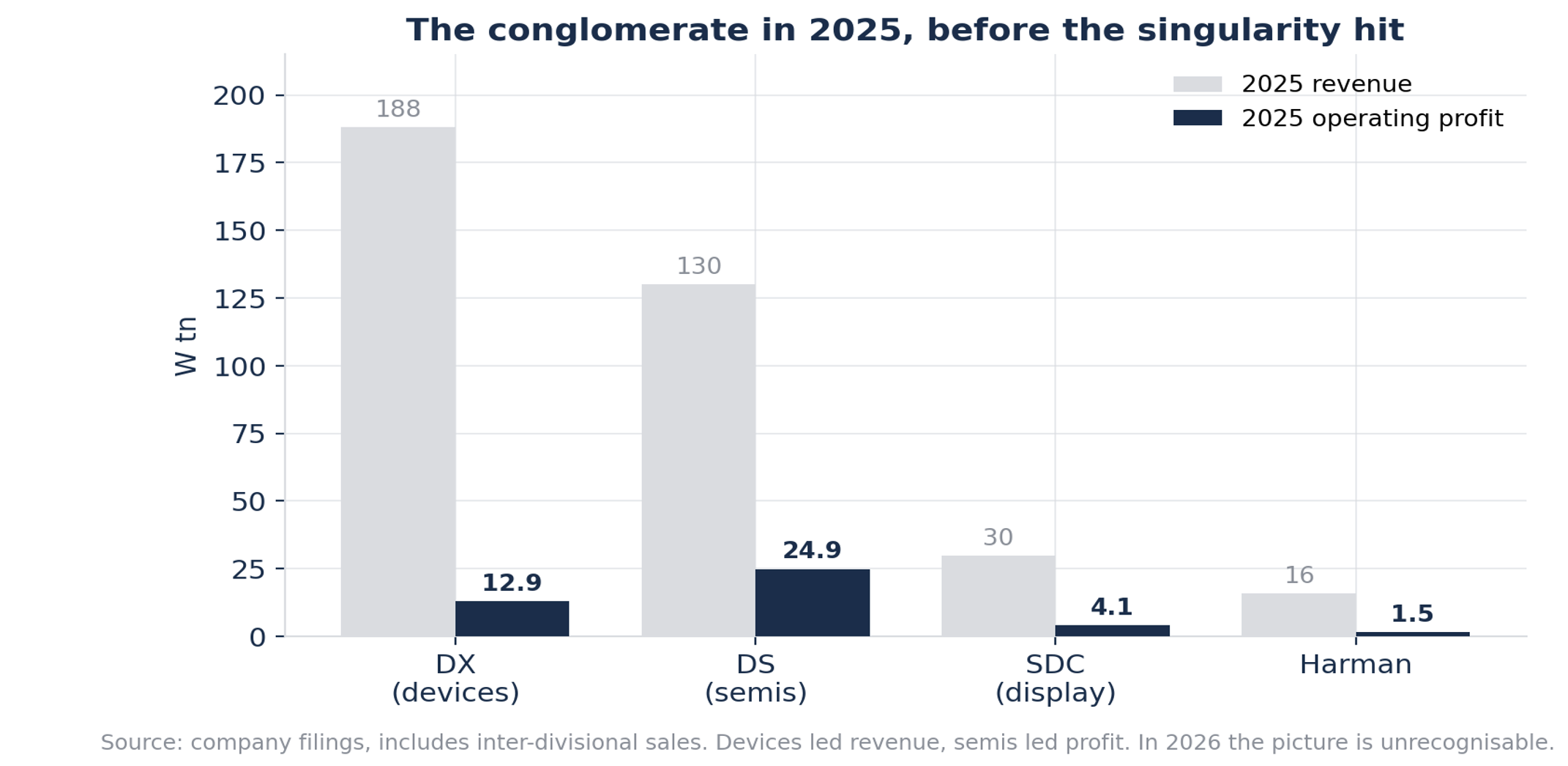
The 2025 mix: devices led revenue, semis led profit, and the ratio was still recognisably a conglomerate. Source: company filings.
DS, Device Solutions, the semiconductor engine, 39% of 2025 revenue and now roughly 94% of group profit. Three businesses live here:
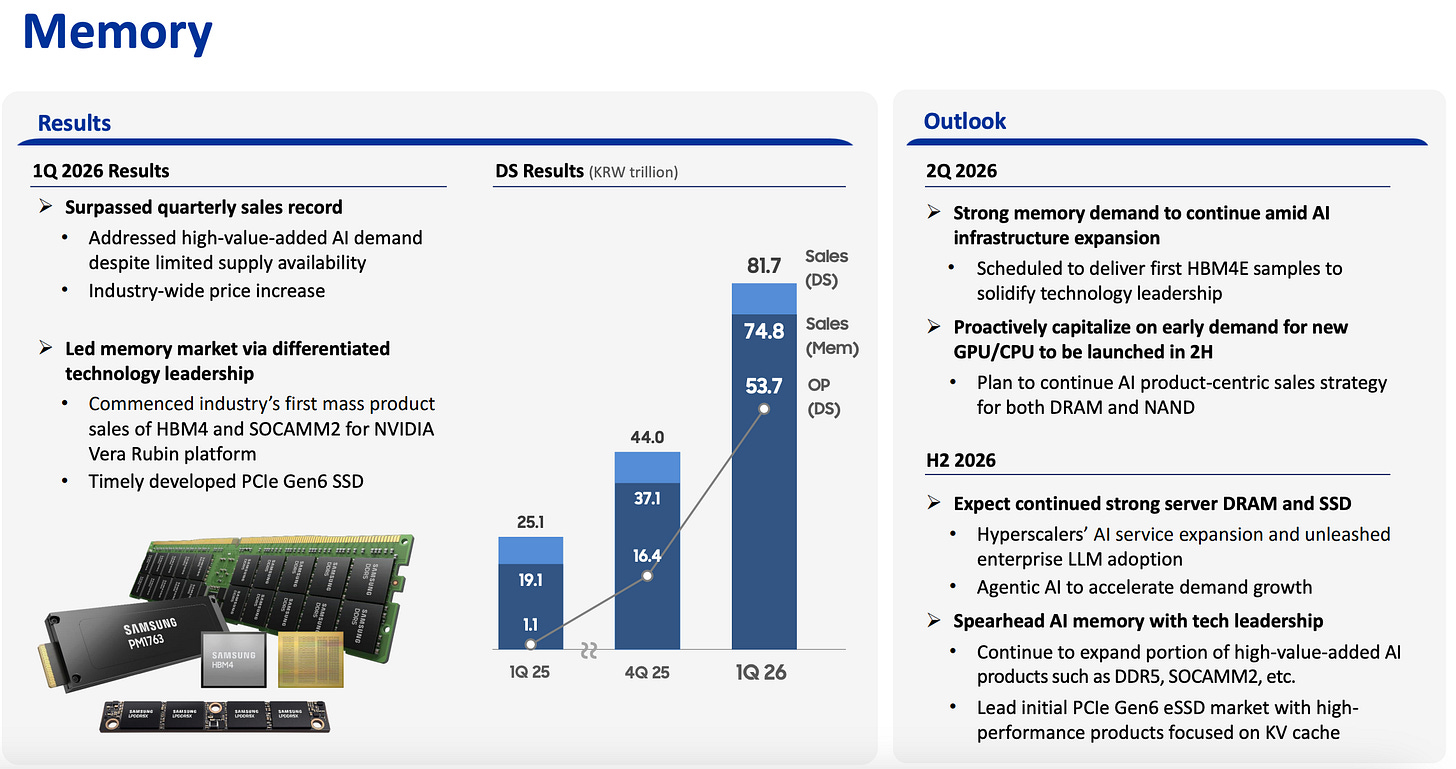
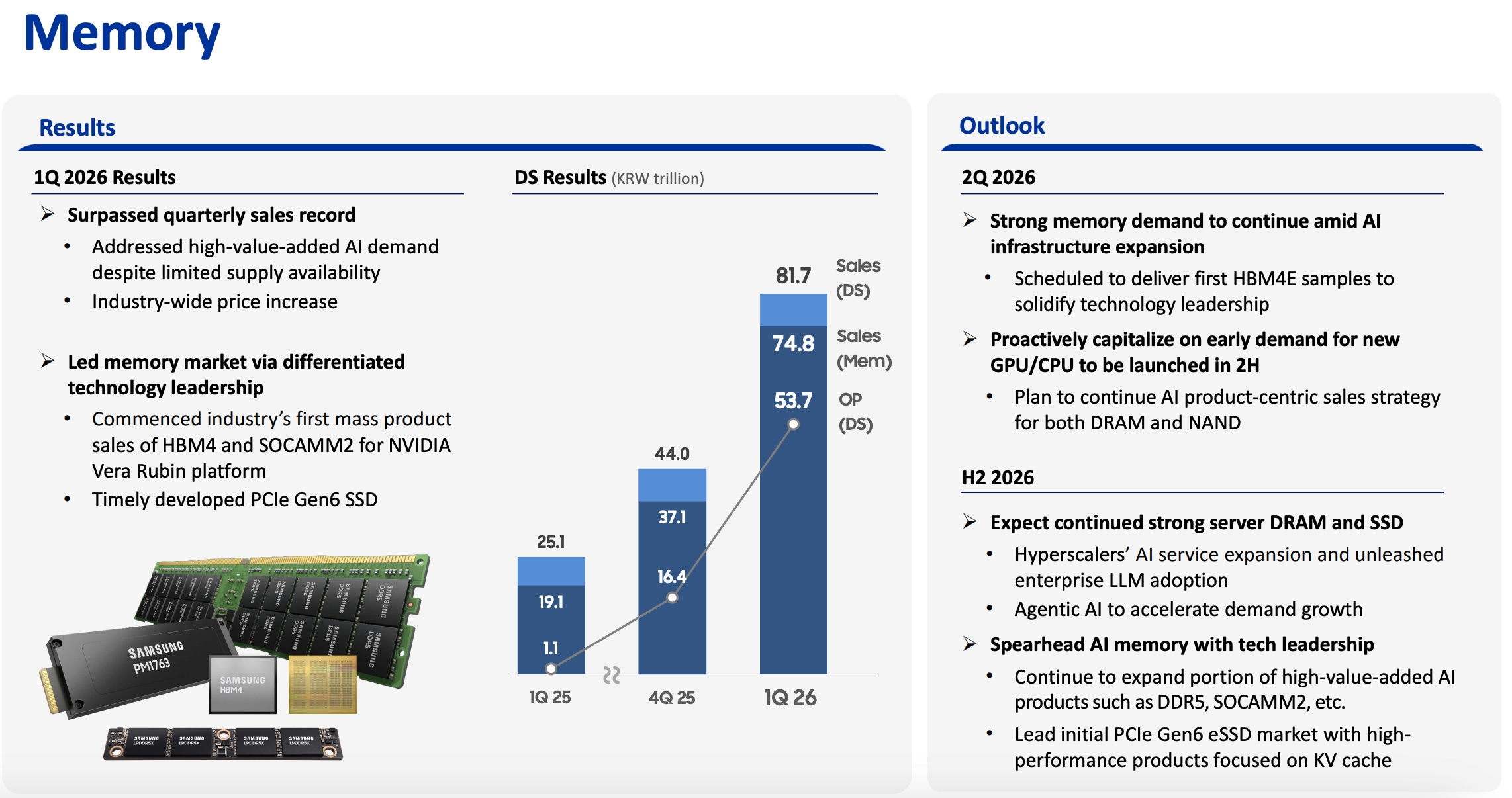
Memory is the crown jewel: the number one DRAM maker with roughly a third of the market, the number one NAND maker with a similar share, and the full portfolio across HBM, server DDR5, LPDDR, GDDR, enterprise SSD and mobile storage, produced across Hwaseong, Pyeongtaek and Xi’an at a scale no competitor matches.
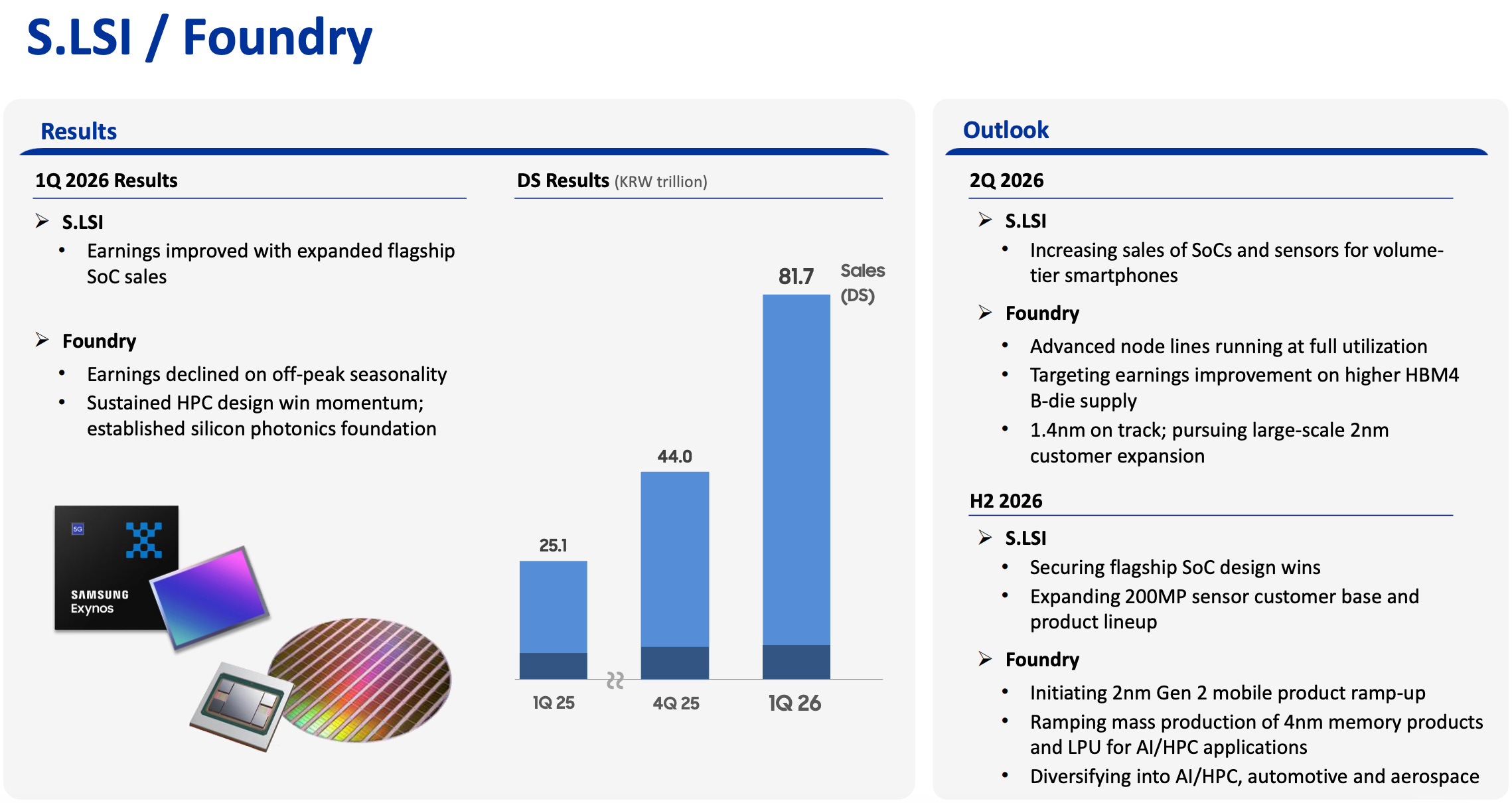
System LSI is the in-house fabless designer: Exynos application processors, the ISOCELL image sensor franchise that leads the industry at 200 megapixels and is now landing in Apple’s iPhone, display driver ICs and connectivity silicon.
The foundry, the second-largest contract manufacturer in the world, which gets its own full section below because it is the most mispriced line in the company in my view.
DX, Device eXperience, the device empire, 56% of 2025 revenue.
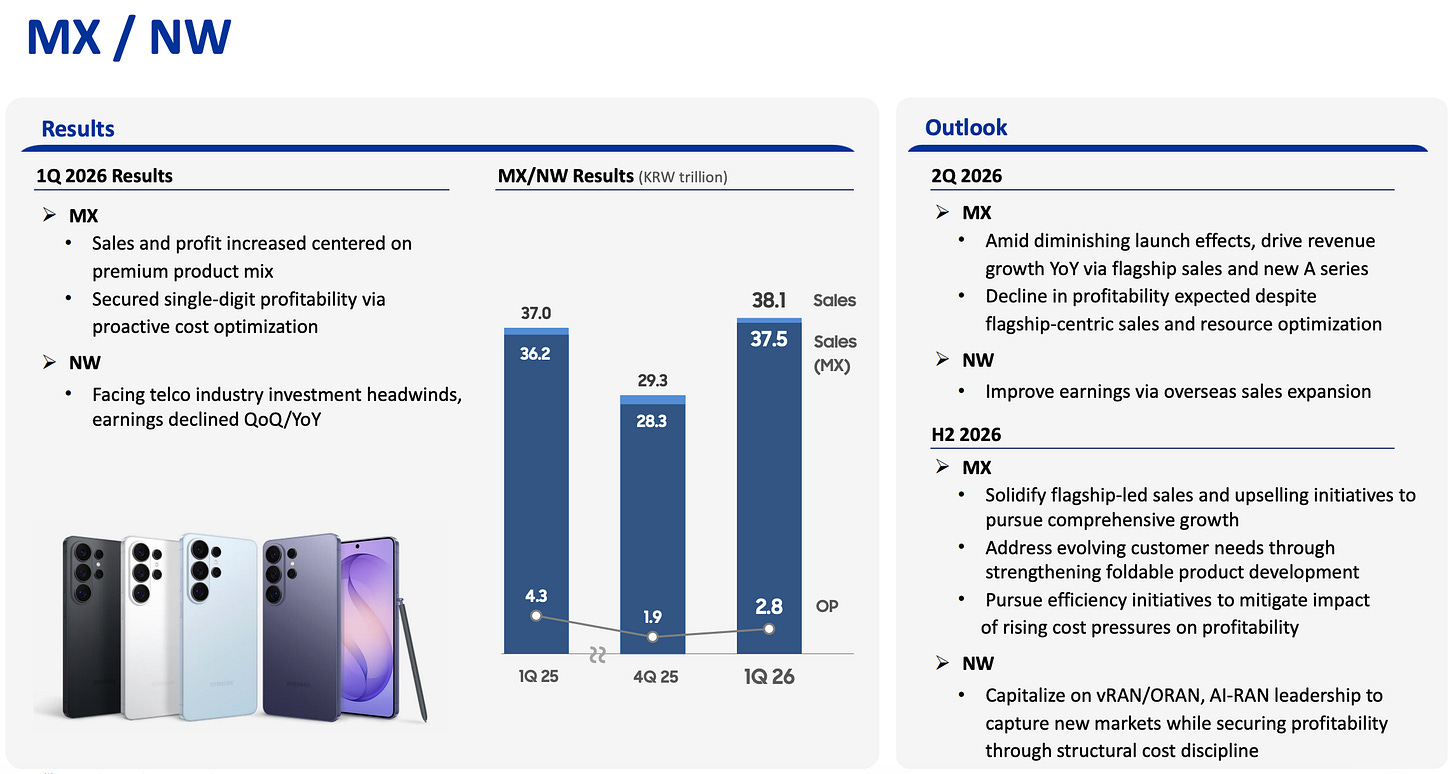
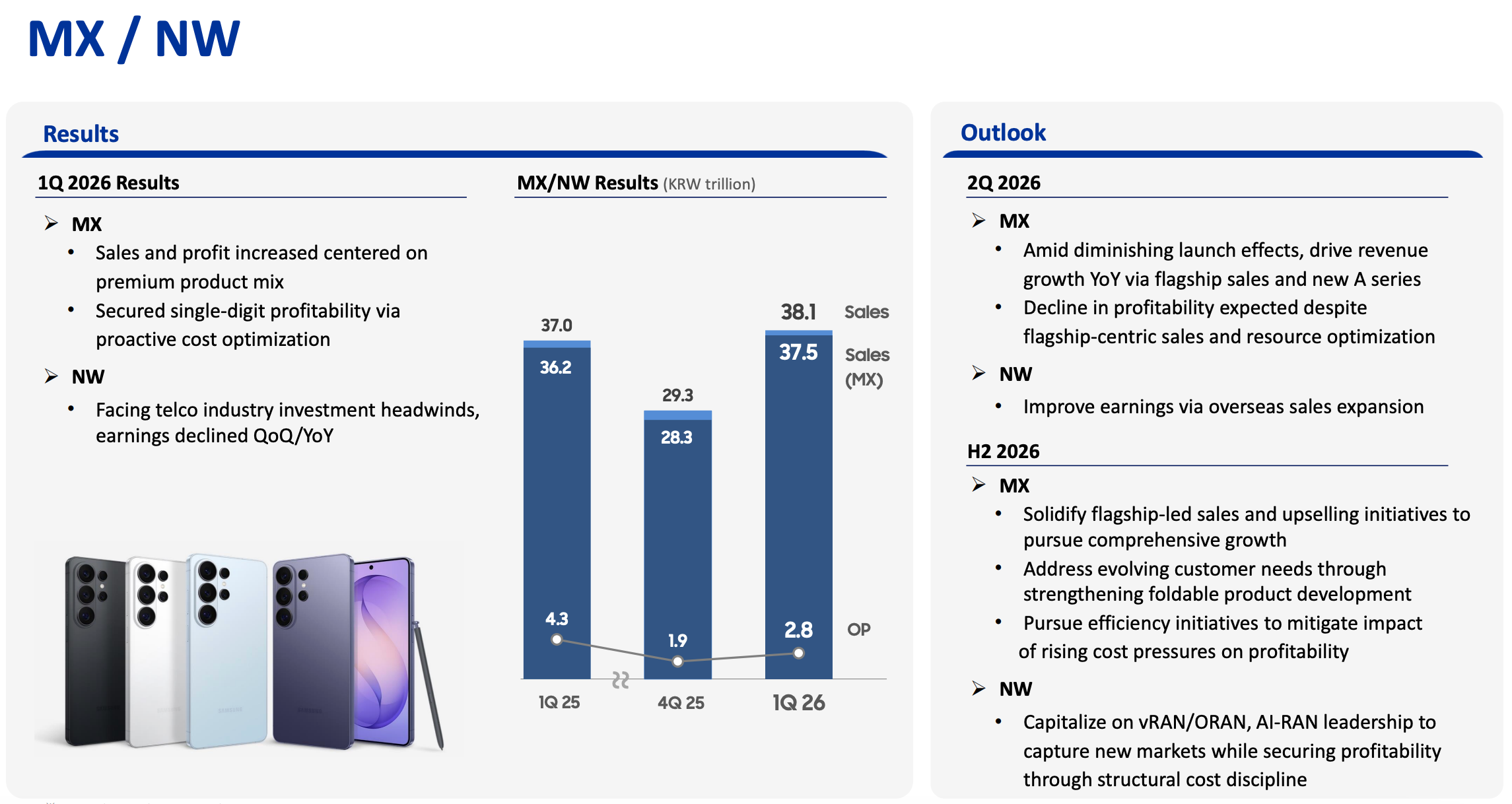
MX is the mobile business, roughly 214 million smartphones produced last year, the number one position globally by units reclaimed this year on the back of secured internal memory supply while competitors scrambled, and the Galaxy S26 flagship cycle driving average selling prices higher.
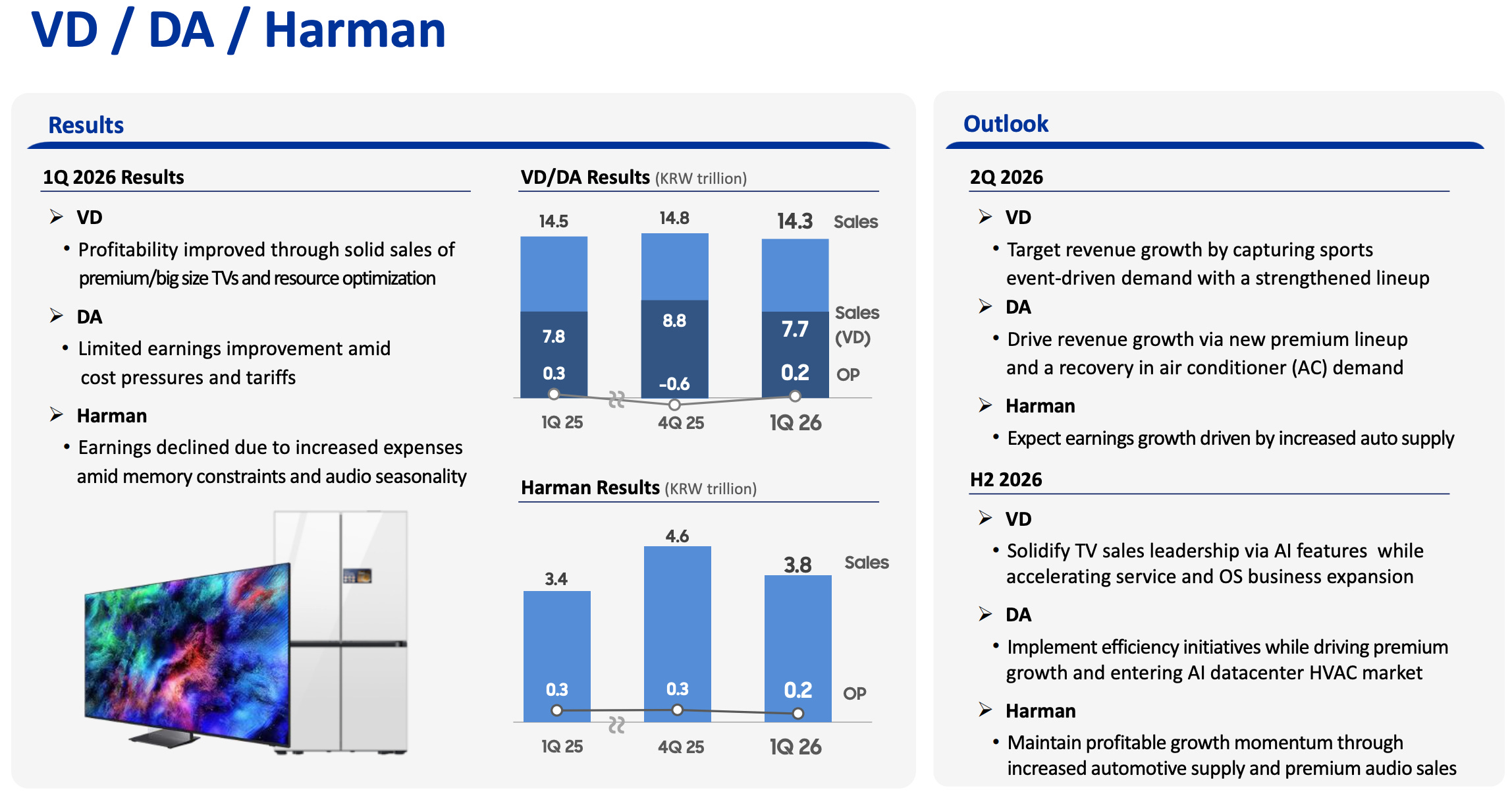
VD and DA are televisions, where Samsung has been number one globally for twenty consecutive years, and appliances.
DX matters to this thesis mostly as the payer of the memory tax, of which more below, but do not forget its strategic function: it is the demand sensor, the brand, and the internal customer that keeps the component divisions honest on quality.
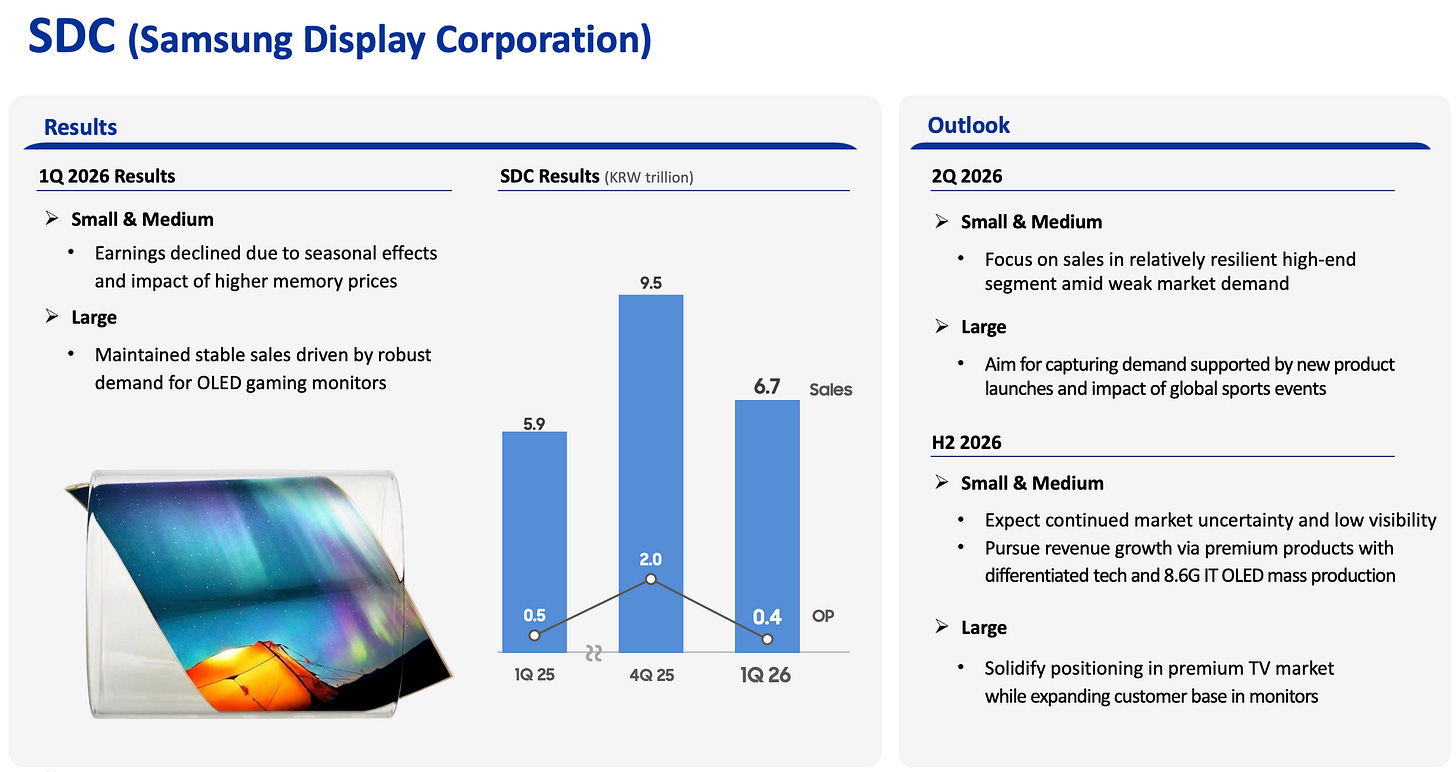
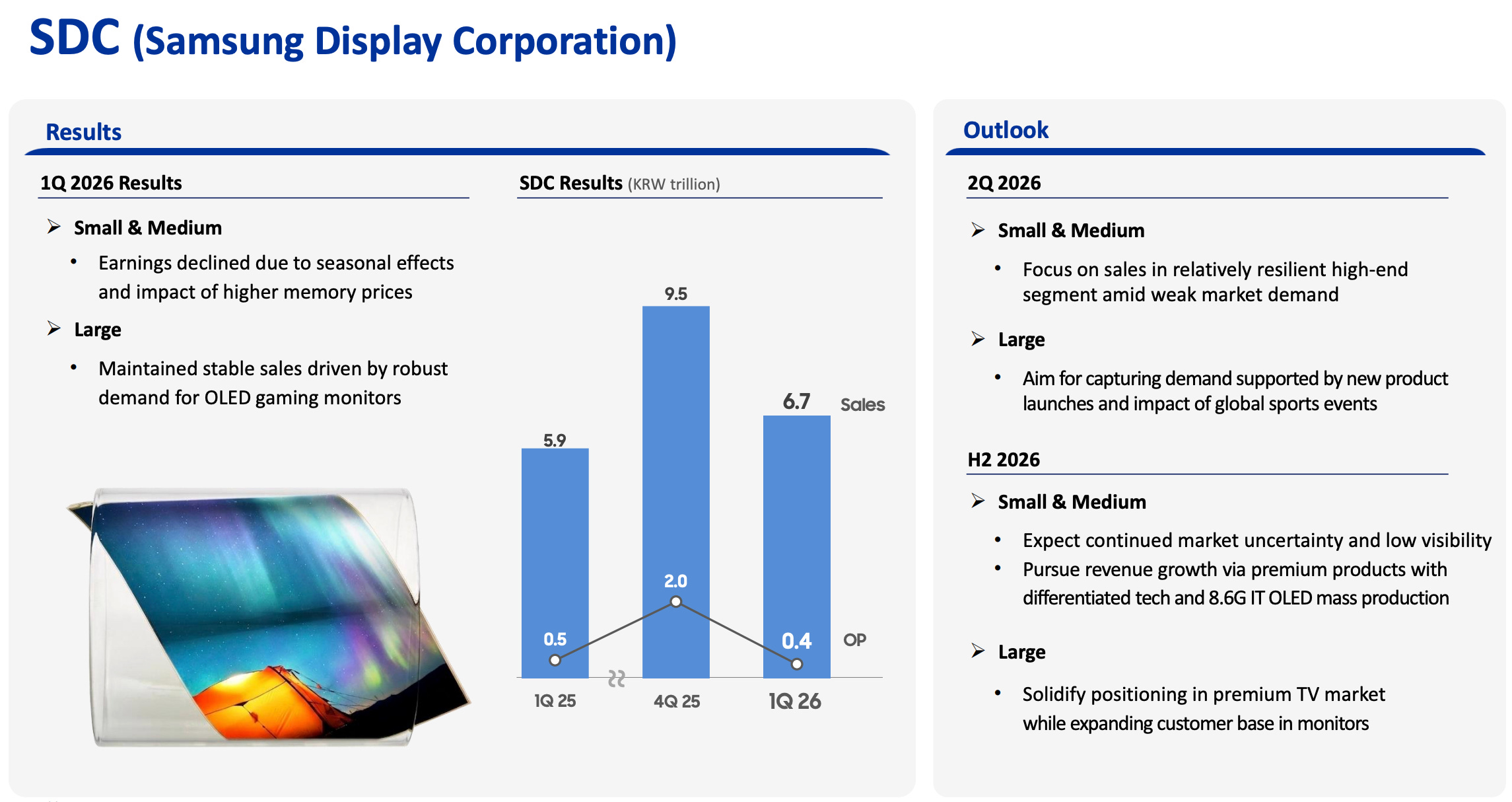
SDC, Samsung Display, roughly W30tn of revenue.
The leader in small and mid-sized OLED, supplier to its own Galaxy line and, profitably and ironically, to Apple, with foldable and micro-display investment carrying the roadmap.
A solid, cyclical, cash-generative business that the market values at almost nothing inside the group.
Harman, roughly W16tn of revenue.
The 2017 acquisition that gave Samsung automotive credibility: digital cockpits, roughly 5.9 million units shipped last year, car audio under JBL, Harman Kardon and Bang & Olufsen automotive licences.
An increasingly interesting position as vehicles become rolling computers stuffed with the memory and sensors the other divisions make.
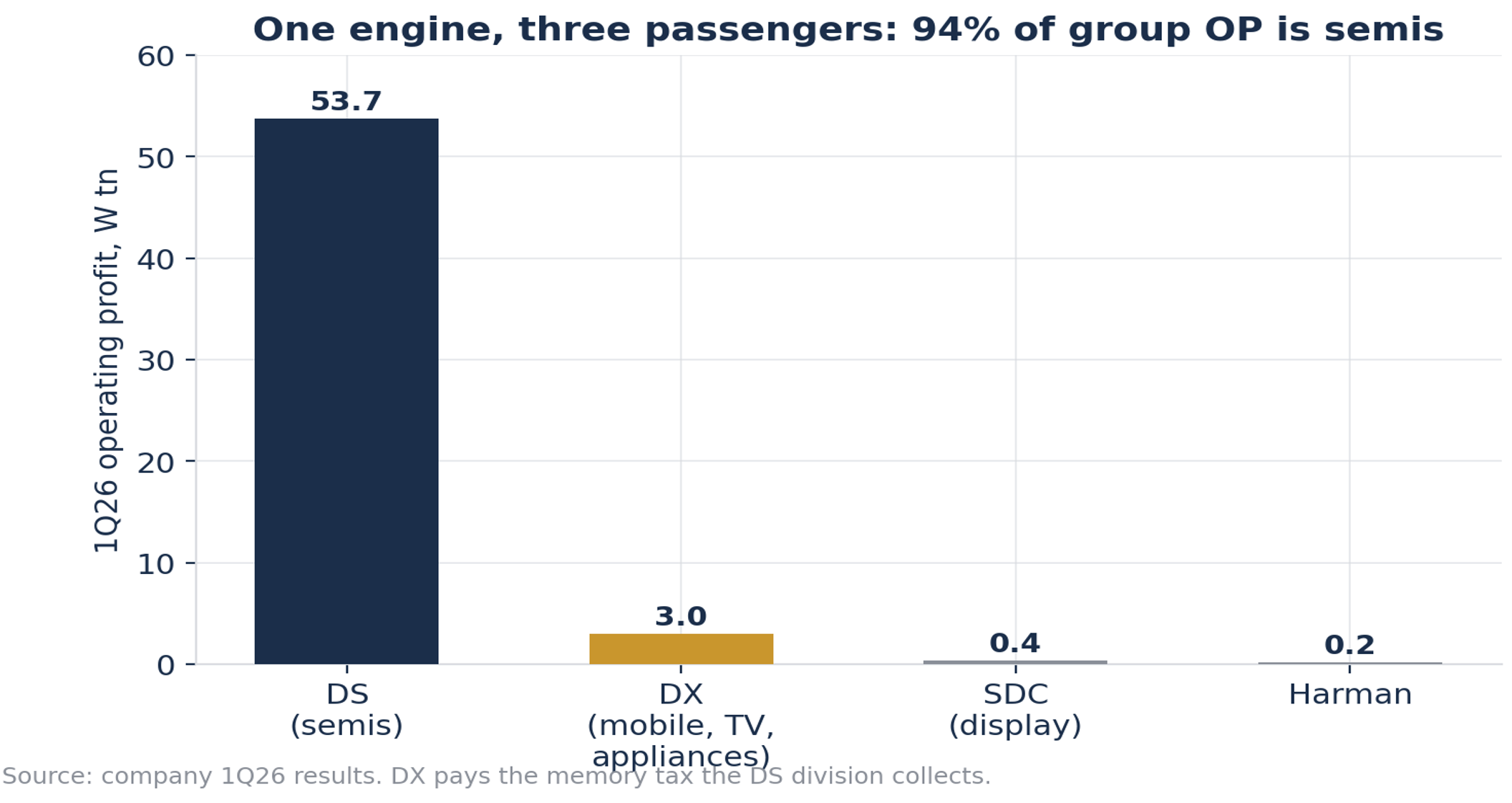
Q1 26 operating profit by division. The conversation is over. Source: company filings.
Hold the two charts (2025 and Q1 2026) side by side, because the transformation between them tells the whole story:
In 2025 the group earned W43.6tn and the divisions had a conversation about who contributed.
In the first quarter of 2026 alone DS earned W53.7tn of the group’s W57.2tn, the memory business printed W74.8tn of revenue at DRAM margins the sell-side pegs near 80%, and the other three divisions combined earned less than the memory business earns in a fortnight.
Samsung has become, temporarily but violently, a memory company with a device empire attached, and the multiple the market pays reflects its refusal to believe the word temporarily has been deleted.
A massive footprint:
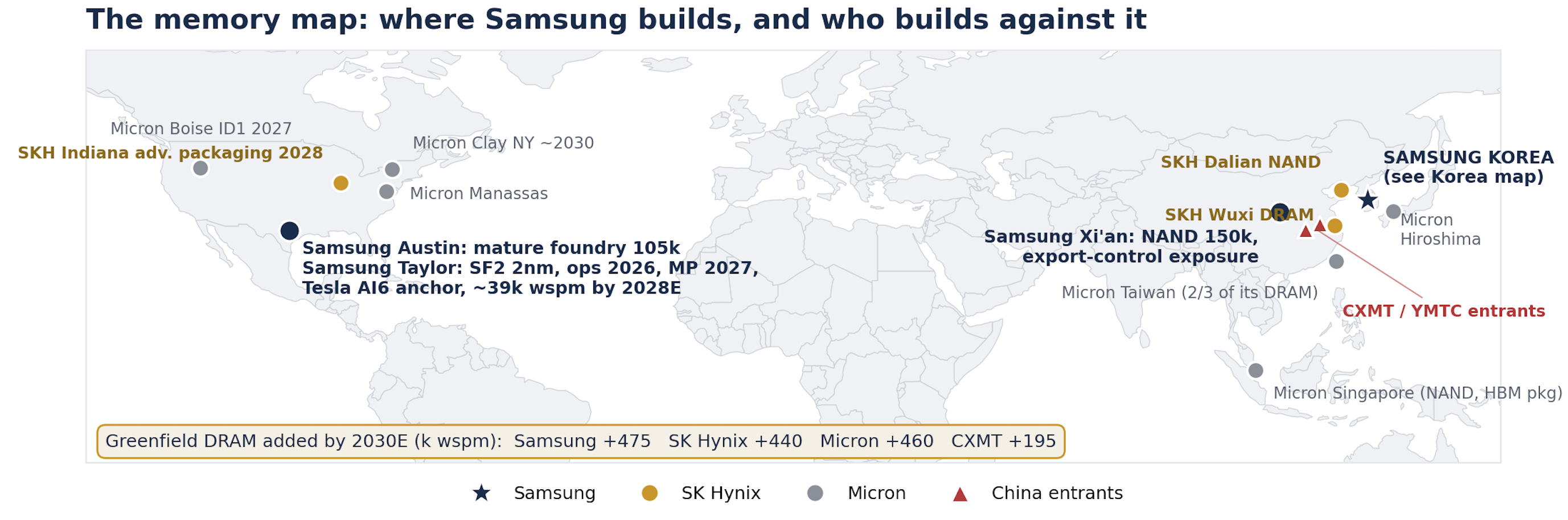
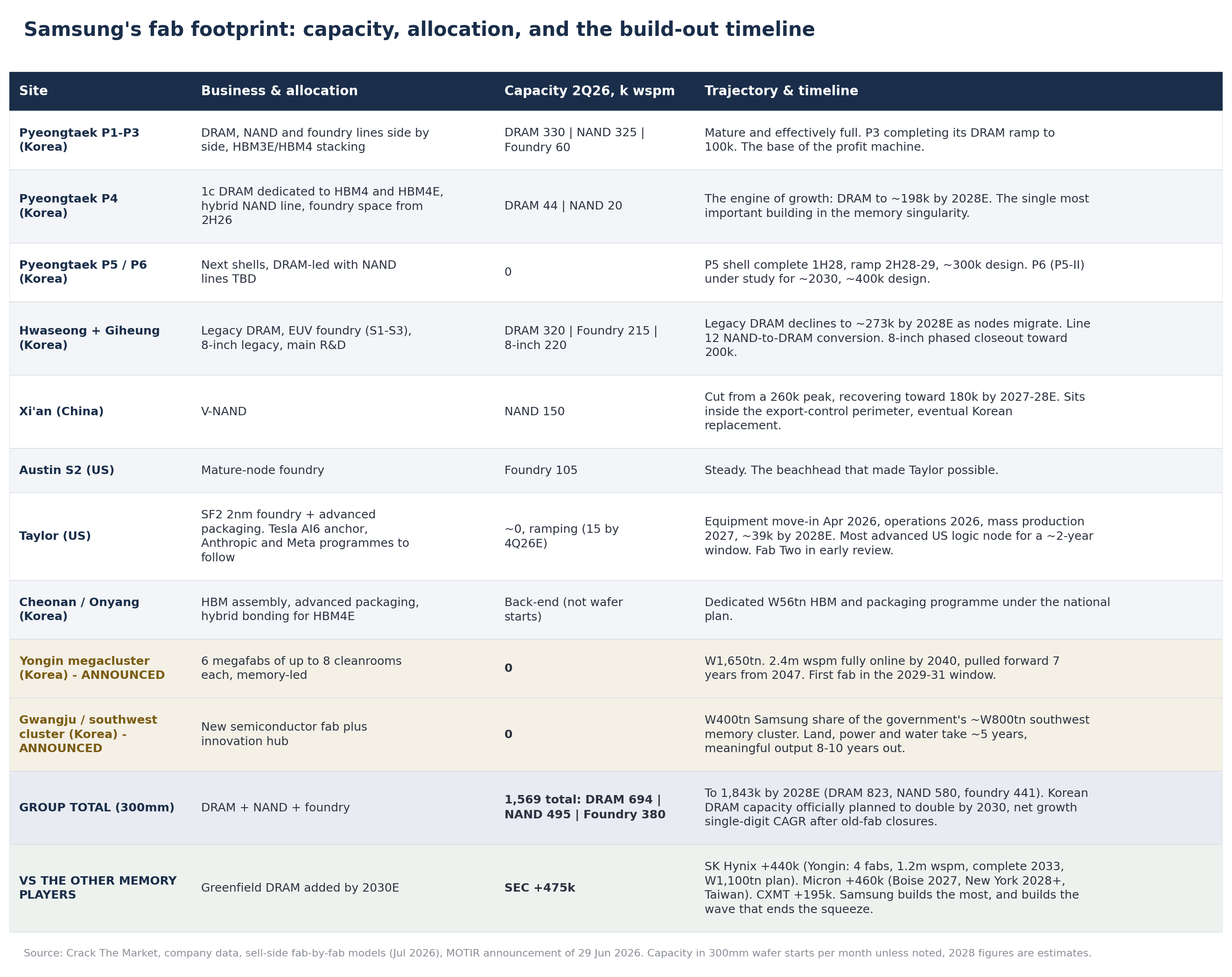
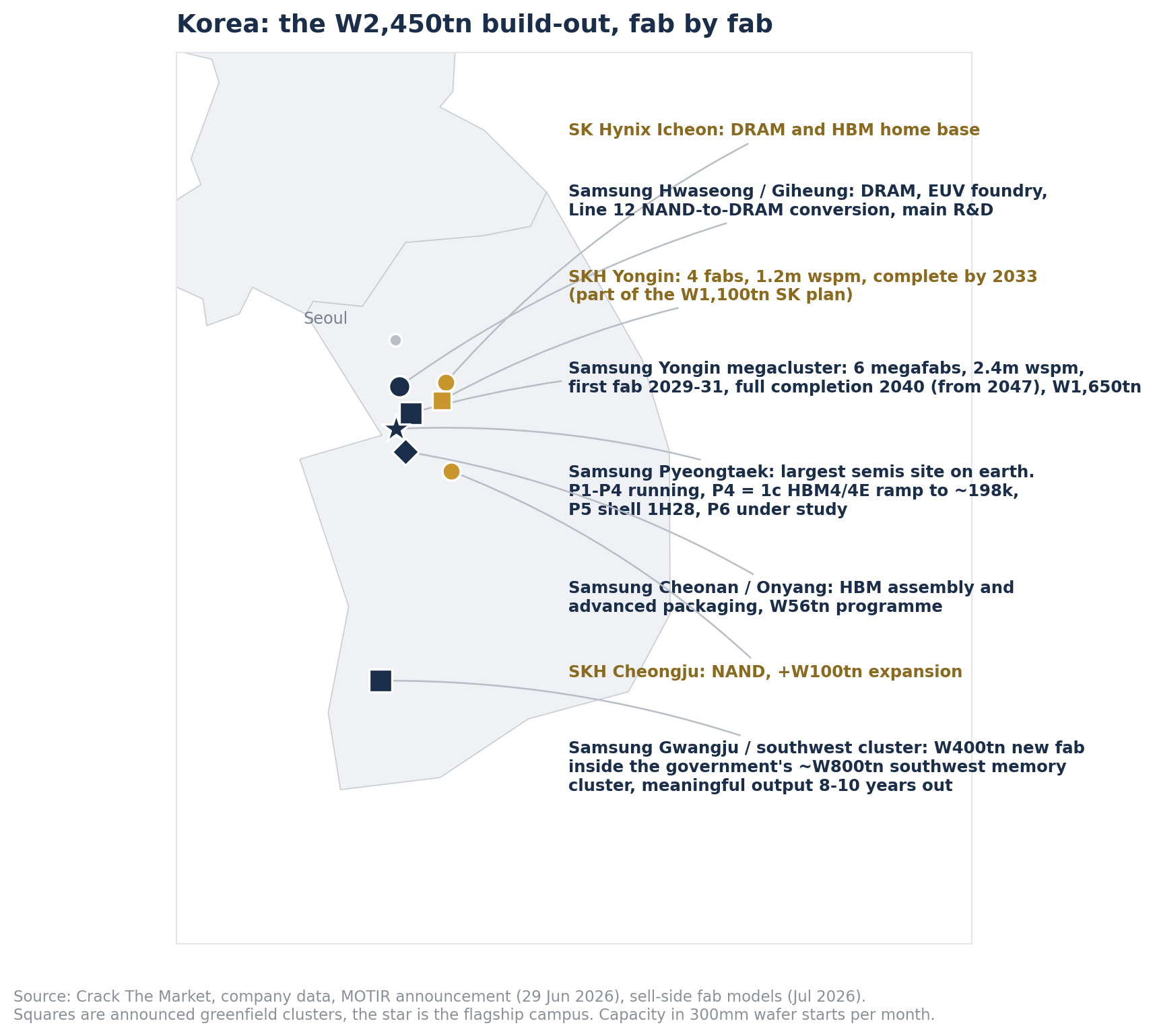
Manufacturing runs through Korea above all.
The Pyeongtaek campus, the largest semiconductor site on earth, where P4 is being allocated to 1c-based HBM4 and HBM4E and P5 is breaking ground, P6 will soon break ground.
Plus Hwaseong and Giheung for memory and foundry, and Cheonan and Onyang for advanced packaging.
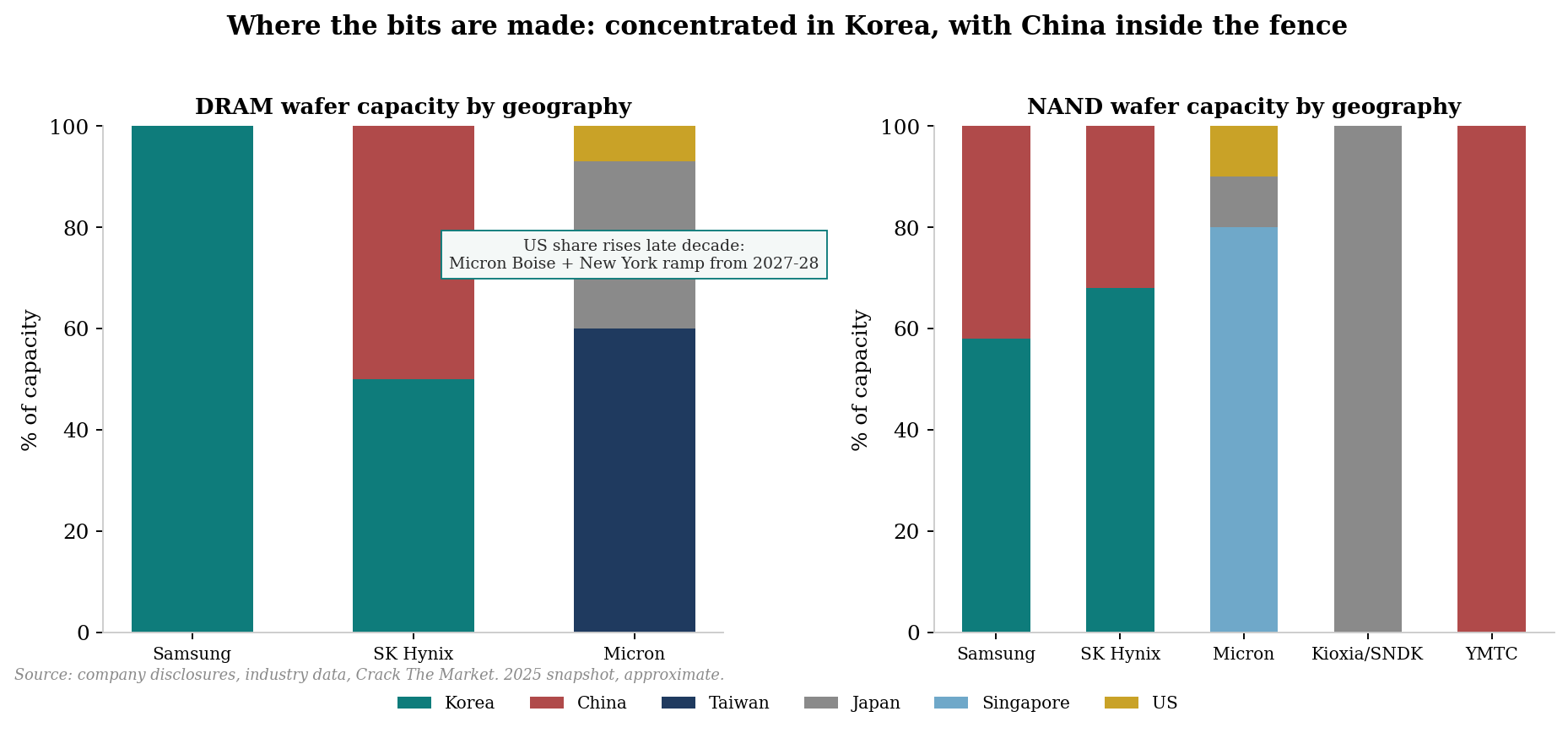
Overseas, the Xi’an campus in China produces a meaningful share of NAND output, a geopolitical fact to respect, Austin and now Taylor in Texas carry the foundry’s American ambitions, and the phone volume is built in Vietnam and India.
The 29th of June national announcement layers the Yongin megacluster, pulled forward seven years to 2040, and a new southwest cluster on top of all of it.