

The number that should scare you
Today, on the back of a press release that contained no financial terms, Sivers Semiconductors broke through SEK100 for the first time in its history, up roughly 60% on the session and trading north of SEK100 intraday.
It was the single most-traded name on the Stockholm exchange, with turnover above SEK1.3bn. At that price the company is worth around SEK30bn (>$3bn).
The trigger was a “strategic collaboration” with GlobalFoundries to integrate Sivers’ laser arrays into GF’s silicon-photonics reference designs and its SCALE co-packaged-optics platform. No volumes, no committed revenue, no economics of any kind disclosed. A reference-design agreement, the optical-interconnect equivalent of being added to a compatibility list, added roughly SEK11bn of market value in a few hours.
Year-to-date the stock is up somewhere around 2,000%, off an all-time low of SEK1.75 in late 2024. That is a 20x move in five months. And it has happened while the actual business went the other way: first-quarter revenue fell 22%, the photonics segment, the part everyone is buying, fell 32%, and the company lost money at every line of the P&L.
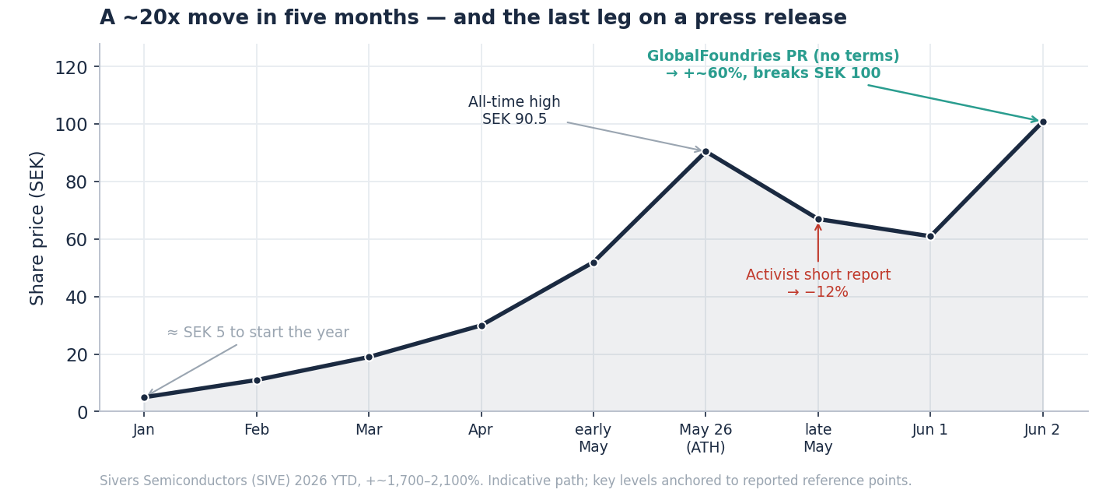
Indicative path; key reference levels (ATH SEK90.5, the short-report dip, the Jun-2 break above SEK100) are anchored to reported figures.
Where I land, and why this is not Soitec
Readers know the discipline I preached in Soitec: Still A Photonics Winner, But At What Price? A great business and a good investment are two different things, and the gap between them is called price. With Soitec I loved the company and hated the security, a near-monopoly substrate with 95% share and a twenty-year head start, priced for perfection at €192. I told you to separate the two and own the theme through quality.

Sivers is the inverse on both axes, and that is why this is a different kind of note.
It is not “great company, insane price.” It is an unproven, sub-scale company at an even more insane price, and on top of the valuation you have three things Soitec never had: a financial restatement that widened the loss, an activist short alleging that roughly a third of last year’s revenue is questionable, and an open market-abuse investigation by Swedish prosecutors.
Let me be clear about where I land: I would not own this here. This is not a clean short recommendation, the borrow is scarce and expensive and the reflexivity is violent, as today proved, but if the asymmetry on Soitec was poor, the asymmetry here is among the worst I have seen in the entire photonics complex.
Twice a week, I will release deep dives into stocks and sectors that fit into the 6 themes that I see winning in the coming years and decades: AI & Technology, Electrification & Energy, Reshoring & Sovereignty, Healthcare & Longevity, China & Asia, Resilience & Quality.
Take advantage of this once in a generation opportunity to build long term wealth by investing in great stocks that will deliver returns for your portfolio for years to come.
The bull case, made properly
Let me give the story its full due, because the theme is one I have written at length and believe in completely. In Optical & Networking Supercycle at the Heart of the AI Revolution (with Nick Nemeth) and in The European Photonics Supercycle, I laid out why the AI data center is migrating from copper to photons, and why the bottleneck is no longer compute but the nervous system that moves data between chips at scale.


Sivers occupies a genuinely interesting position in that migration:
As optics move on-package (we are just getting started, this is not where volumes lie today), co-packaged optics (CPO), linear pluggable optics (LPO), the laser cannot move with them, because lasers hate the heat next to a switch or accelerator die.
So the light source gets pulled out into a separate, cooled module: an external laser source. Every incremental shift toward CPO therefore increases the addressable market for exactly what Sivers makes: high-power DFB and CW laser arrays. The company’s own framing, “lasers stay external, light-source TAM increases” is, for once, the correct way to think about it. This is the layer that benefits from the architectural disruption rather than being threatened by it, which is the same architecture-neutral quality I admired in Soitec.
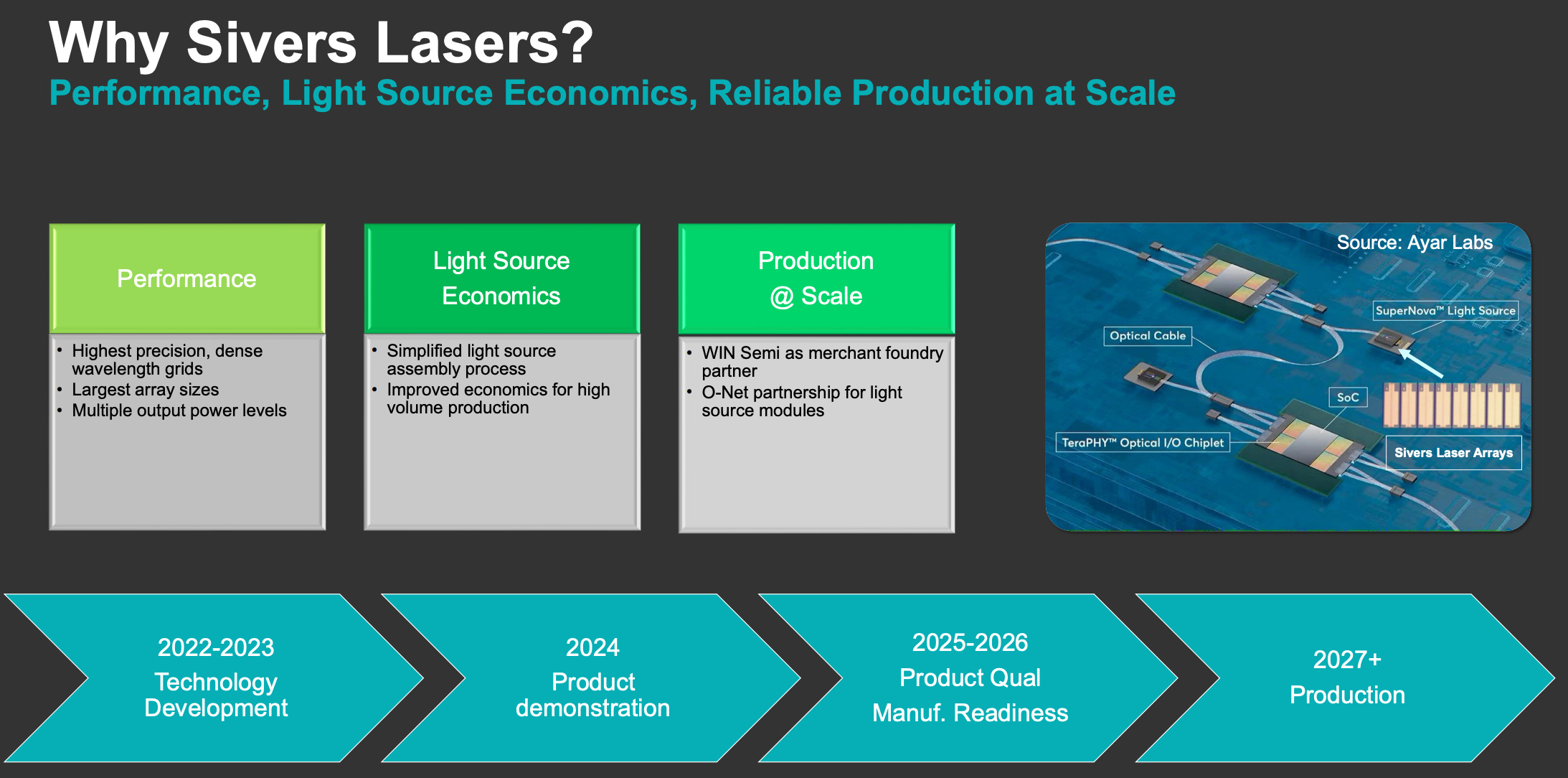
And there is a real ecosystem forming around it: today’s GlobalFoundries reference-design tie-up, plus prior collaborations with POET (optical interposer light engines), O-Net and Enablence (external light-source modules for the Chinese supply chain), Ayar Labs (laser arrays for the SuperNova light source), WIN Semiconductors (high-volume DFB production) and Jabil (a 1.6T pluggable module).
The bull case is that Sivers does not need to win everything, it just needs its lasers designed into one optical architecture that ends up scaling, and the operating leverage on a sub-scale component maker is enormous. That is a legitimate piece of optionality, and I will not pretend otherwise.
Why the hype - what retail sees, and is the product actually special
It is worth being honest about why this name has caught fire, because the story is genuinely seductive and not entirely without substance. Strip it down and retail sees five things at once:
