

Welcome to the 79th investment case and 40th AI & Technology idea on Crack The Market (and the most comprehensive SK Hynix investment case you will find online)! Join me as I dissect the flagship of the memory singularity, the number one supplier to Nvidia, a company that has led every HBM generation since it invented the category, that just delivered a 76% operating margin on W79.3tn of revenue, and that the market has repriced to 4 times forward earnings in the middle of the most violent AI drawdown of the cycle, along with the risks that come with the most operationally levered claim on AI capex that exists.
Twice a week, I will release deep dives into stocks and sectors that fit into the 6 themes that I see winning in the coming years and decades: AI & Technology, Electrification & Energy, Reshoring & Sovereignty, Healthcare & Longevity, China & Asia, Resilience & Quality.
Take advantage of this once in a generation opportunity to build long term wealth by investing in great stocks that will deliver returns for your portfolio for years to come.
After reading this article, you will understand why SK Hynix is the flagship asset of the memory singularity and why the market briefly priced it close to its all time trough, how a mix-timing quirk in the strongest quarter ever printed by a memory maker led to a >50% drawdown, and how the contracted floor thesis I built in the primer just got revealed. You will understand exactly how the company that invented HBM holds roughly half the market and has delivered every generation first, what each fab in the footprint does and why a quarter of the wafers still sit inside the China perimeter, and how the ADR wrapper manufactured a 30% premium that the deposit agreement itself is now unwinding. Most importantly, you will grasp why the stock trades at 4 times forward earnings and just 1.1 times 2028 book, with net cash on a trajectory to rival the market capitalisation, while paying nothing for several massive catalysts. You will also understand the risks and fears that led to the stock halving in a month this summer, and then recording the first limit-up session in its history while I was writing the conclusion.
On the 29th of July, SK Hynix printed the strongest quarter in its history, and the stock fell 10% on the day, at one point trading down nearly 20%.
Revenue of W79.3tn rose 51% sequentially and 257% year on year, a fifth consecutive all-time high and an eleventh straight quarter of year-on-year growth.
Operating profit of W60.5tn rose 557% year on year at a 76% operating margin, the highest in the company’s history and among the highest ever recorded by a manufacturer of anything.
Gross margin reached 83%, seventeen points above the prior all-time cycle peak of 66% set in 2018.
Net cash swelled to W69.4tn.
And the shares closed at W1,401,000, down 53% from the 25th of June record of W2,987,000, back where they traded in April.
These are numbers that simply do not happen together. A company does not print software margins on $55bn of quarterly hardware revenue and lose half its value in a month. Something in that combination is wrong, and this deep dive is about working out which half.
What truly matters for the investment case:
The first is that the miss was a mix story, not a demand story: Consensus wanted W84tn of revenue and W64tn of operating profit and got 6% less of each, because blended DRAM pricing rose 30% against expectations closer to 50%. What the market missed is that the gap is a feature of SK Hynix’s dominance: HBM prices are contracted flat for 2026 while conventional DRAM spiked underneath them, and high value-add shipments slipped into the second half, where HBM4 ramps and the mix reverses. Demand did not blink, customers are still asking for more memory than the company can make, and the guidance strengthened.
The second is that the contractual floor thesis just got its numbers: Around 10 long-term agreements are now concluded, including the key customers, on roughly five-year terms with deposits attached. This is the mechanism I described in the Memory Singularity primer, the de-commoditisation of the leading edge. SK Hynix owns more contracted, customer-specific, leading-edge capacity than anyone in the industry, and the market has just repriced it as if none of that were true.
The third is the price: Right after publishing its record earnings, the stock traded at 3.3x forward earnings, a tenth of a turn from the 3.2x where it bottomed at the end of 2019, the worst memory downcycle of the modern era, with Micron at a 31% market cap premium on half the HBM share and CXMT, the Chinese challenger with 8% of DRAM, valued within 36% of the HBM leader. That set of relative prices could not all be right at once, and two sessions later the market agreed violently: the stock fell to a new trough and then rose by its 30% daily limit, the first limit-up in its history, closing most of the Micron gap in a day. Even after that move it trades near 4x forward earnings, within a turn of the multiple the market awarded this company when it was losing money.
This is the deep dive I promised in the ADR piece and the Memory Basket. Since then, the Reckoning has taken the memory complex down with it, and as I wrote in the Reckoning update, the timing could not be better: the piece was researched into a stock that fell double digits on the best quarter in its history, and finalised as it snapped back with the first limit-up move the shares have ever recorded.


In this article I go through:
The drawdown you are buying into, layer by layer, and what the Q2 print actually said underneath the miss
What SK Hynix is, the forty-year history from Hyundai Electronics through near-death to HBM leadership, the footprint, and the highest AI purity in the industry
The investment case with the HBM franchise quantified, the LTA book, and why the flagship memory name now trades below the challenger
The innovation stack from HBM4 and HBM4E through iHBM, custom HBM, SOCAMM2, 321-layer NAND and the HBF option with SanDisk
The financials, the capex response, the shareholder return catalyst, the risks the bulls are underweighting, a full scenario framework, and my verdict
SK Hynix Investment Case
Table of content
The Drawdown You Are Buying Into
Before getting to the company, I want to address the environment, like I did at the start of my Samsung deep dive, because a 53% decline in twenty-four trading days needs to be understood properly before we call it an entry. The decline came in a few different waves, with only one that touched the earnings power, and only at the margin.

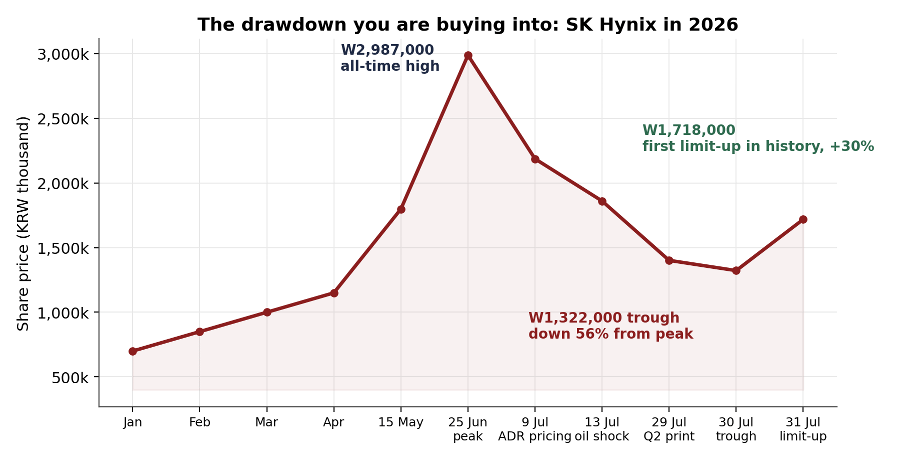
The 2026 path: from around W700,000 in January to W2,987,000 on the 25th of June, then four layers of selling in five weeks. Source: Crack The Market.
The first layer was the Reckoning itself:
In early July the most crowded factor in modern market history began de-risking mechanically, and Korea was the epicenter of the leverage: single-stock and index leveraged ETFs with Korean underlyings had grown to roughly $50bn of AUM, four times larger relative to market size than the equivalent products in the US, and they turned every down day into forced selling.
Roughly 1.2m leveraged retail accounts were margin-called through the episode, about one in thirty working-age adults in the country, and the KOSPI tripped circuit breakers nine times this year on its way to a decline of roughly 40% from the June peak, deeper than the COVID selloff.
SK Hynix, the largest and most crowded position in that market, was the epicenter of the epicenter.
That leverage is now roughly $17bn and the unwind is judged complete, which matters enormously for what comes next.

The second layer was the ADR listing aftermath:
The largest foreign listing in US history priced on the 10th of July at $26.5bn, seven times covered, and exactly as I argued in the ADR piece, the debut catalysed profit-taking in the Seoul line rather than fresh buying, amplified by the leveraged ETF machinery above.
The company celebrated a historic milestone but its home listing paid the price short term.
The third layer was macro:
The Hormuz re-escalation (as I had written about in March as an inevitability) and the oil spike hit the most export-levered market in Asia indiscriminately, Brent is up roughly 20% in July, and the Fed’s fifth consecutive hold this week was a close call with September now a live hike risk.
None of those sentences contain the words DRAM, NAND or HBM though.

The fourth layer, and the only fundamental one in my view, was the Q2 2026 earnings release:
Q2 revenue of W79.3tn came in 6% below the W84tn consensus and operating profit of W60.5tn came in 6% below the W64.2tn consensus, on blended DRAM pricing of 30% against expectations closer to 50%.
The stock fell 10% on the day, having been down nearly 20% intraday.
A 6% miss at the bottom line, driven by mix timing that management explicitly guided to reverse in the second half, subtracted roughly W100tn of market value from a company whose annualised run-rate operating profit is now around W240tn.
This piece argues that it is now time to take the other side of the argument, after a >50% drawdown in the purest AI memory name in the market.
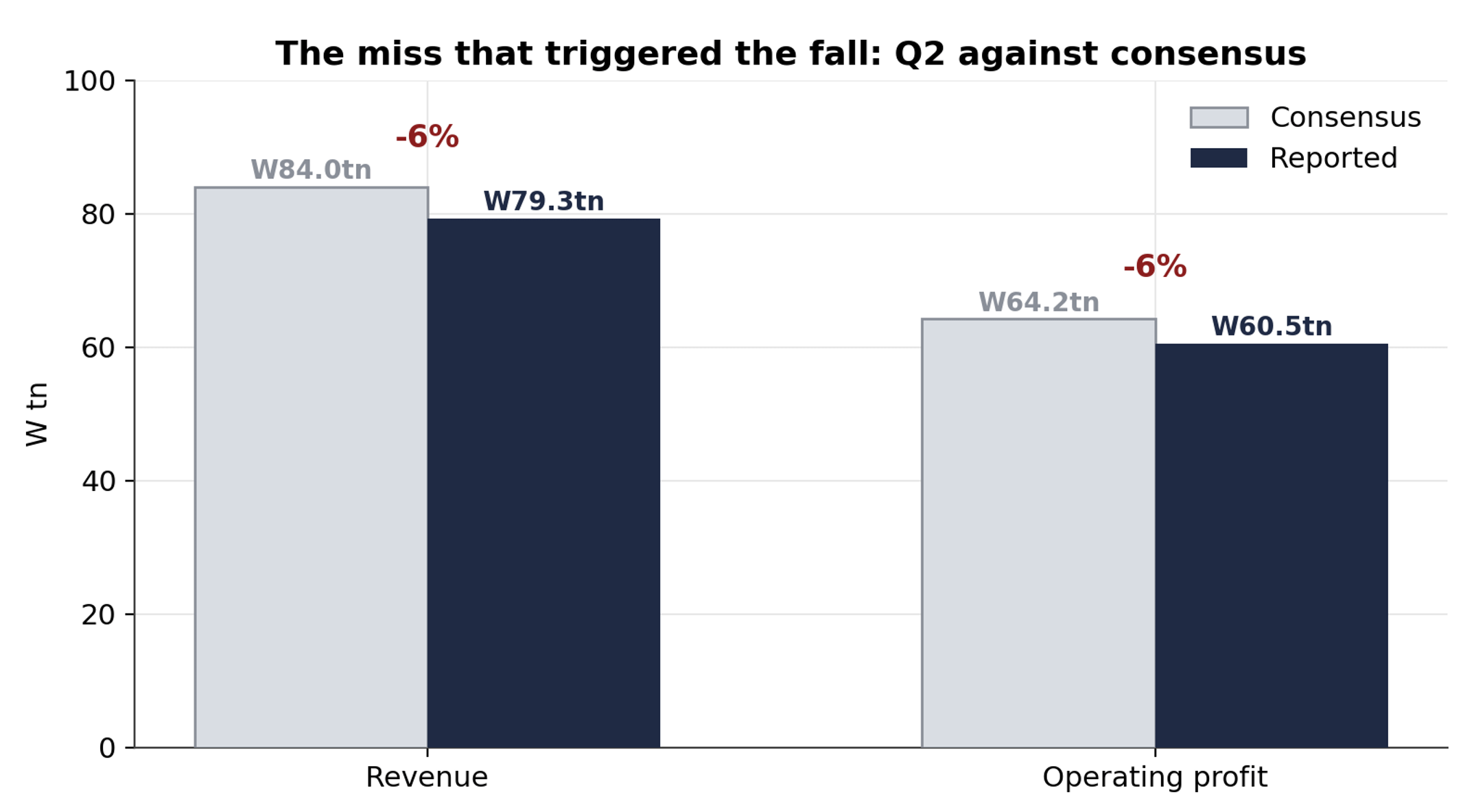
A 6% miss on each line, driven by blended DRAM ASP mix, met a 10% one-day decline in a stock already down 48%. Source: company filings, consensus estimates.
This is my read of this selloff: a mechanical leverage flush that is now spent, supply around a historic listing, an oil shock sold indiscriminately, and a mix-timing miss priced as a demand event. Memory contract prices did not fall. The long-term agreements multiplied. The customers are, in management’s words, still requesting more supply. What changed is the price, which improved by a whopping 53%.
The 31st of July: the violence runs both ways
On the 30th of July the shares fell a further 6% to W1,322,000, the true trough of this drawdown at 56% below the June peak.
That evening Microsoft and Amazon printed, the US semiconductor index rose 8.5% overnight, and on the 31st SK Hynix opened 28% higher and went on to hit its 30% daily limit at W1,718,000, the first limit-up session in the stock’s history, inside a KOSPI that rose 18% and retraced most of the week’s losses as a new leverage measure took effect.
The flow data showing the exact leverage unwind I mentioned in my Reckoning piece: foreigners bought a net W7.8tn of KOSPI stock in the session while retail sold a net W8.0tn, which is the leverage unwind ending in its mirror image, the margin-called selling the bottom to the institutions arriving for it.
One more detail that peaked my interest: the group chairman made his first-ever personal purchase of the shares on the 30th, W4.9bn at roughly W1.35m apiece, a day before the limit-up.
Whilst the 30% move is extremely impressive, it does not change the thesis:
The forward multiple moves from 3.3 to roughly 4 times, against the 3.2x where the stock bottomed in the 2019 trough. The market capitalisation moves to roughly $900bn, closing most of the Micron gap in a single session, which validates the anomaly argument and consumes part of the prize.
The base scenario upside compresses from the 80 to 90% I would have published on the 29th to roughly 45 to 55%. And the ADR premium compressed from 30% to roughly 15% at the Friday close of $143.70, closed the benign way, by Seoul rising rather than the wrapper falling.
A one-day round trip of this magnitude, trough to limit-up inside twenty-four hours, is the market structure section of this piece happening in real time, and it is why the sizing discipline in the conclusion is not a formality.
Business Description
SK Hynix (000660.KS, plus the new Nasdaq ADR line $SKHY) is one of only three at-scale DRAM manufacturers on the planet (with Samsung and Micron, both of which I covered recently), the number two memory maker overall.

Most importantly, it is the undisputed leader in the product that matters most to the AI era: it invented High Bandwidth Memory as a commercial category, it has been first to mass production in every generation since, and it supplies roughly half of all HBM bits consumed by the accelerators running the AI build.
The scale of what is happening to it is hard to overstate:
The company generated W97.1tn of revenue in 2025, itself a record year.
On the run-rate implied by the second quarter, it is now tracking toward roughly W335tn to W350tn of 2026 revenue, more than tripling in a single year, overwhelmingly on the price of memory.
Its operating margin, 41% a year ago, is 76% today.
Its balance sheet, W4.9tn of net debt five quarters ago, holds W69.4tn of net cash, 7% of its entire market cap.
SK Hynix’s history:
SK Hynix is the memory industry’s great survivor.
Its predecessor, Hyundai Electronics, built its first fab in Icheon in 1983, the same year as Samsung’s Tokyo Declaration, listed in Seoul in 1996, and swallowed the LG Group’s memory business in 1999 in a government-brokered consolidation of the Korean industry.
The 2001 DRAM crash nearly killed it: the company went through a creditor-led restructuring, debt-to-equity swaps, the divestment of everything non-core and a renaming to Hynix, and spent a decade effectively run by its banks while Samsung and Micron pulled ahead.
In 2012 the SK Group bought the creditors out, renamed it SK Hynix, and did the single most important thing in this story: it invested through the trough, including the counter-cyclical bet on a niche stacked-memory technology co-developed with AMD that nobody else wanted to fund. That technology was HBM, first productised in 2013 to 2015, and it is why the near-bankrupt also-ran of 2001 is the indispensable supplier of 2026.
Two more deals frame the modern company:
In 2018 it joined the consortium that carved Kioxia out of Toshiba, an investment it fully exited in June 2026, crystallising the W63.3tn gain that inflated this quarter’s net profit.
And between 2020 and 2025 it acquired Intel’s NAND business for $9bn in two phases, completed in March 2025 and operated as the US-based subsidiary Solidigm, which took it to a clear number two in NAND and, crucially, handed it the enterprise SSD franchise now riding the AI inference wave. A small foundry business, SK hynix system ic and SK keyfoundry, rounds out the group.
What it makes, and the purity point:
SK Hynix’s portfolio spans the full memory stack.
In DRAM: HBM3E and HBM4, server DDR5, the new SOCAMM2 low-power server modules, LPDDR5X and LPDDR6 mobile memory, graphics GDDR7 and CXL expansion modules.
In NAND, through both the Korean fabs and Solidigm: enterprise SSDs from high-performance TLC to 30TB-plus QLC, client SSDs, mobile storage and components.
In Q2, DRAM was 73% of revenue and NAND 27%, and the mix behind those numbers is the single most important fact about the company: roughly 70% of total revenue is AI memory, HBM, server DRAM and enterprise SSD sold into the data center, the highest AI purity of any memory maker and one of the highest of any large cap in the world.
When you buy SK Hynix you are not buying a diversified electronics group with an AI division, as with Samsung, you are buying the AI memory bill of materials with a small consumer tail attached.
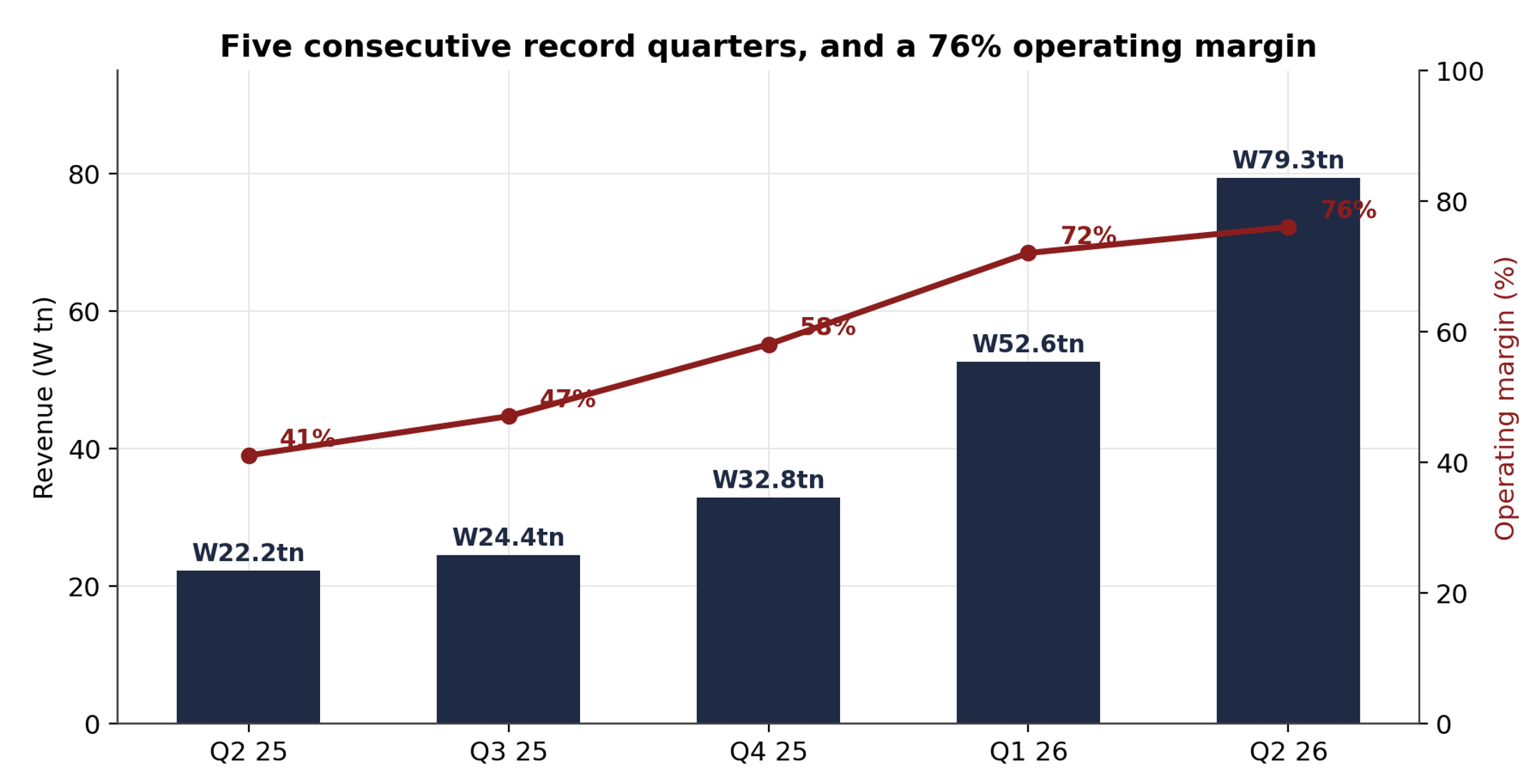
Five consecutive record quarters, margins that no longer look like hardware. Source: company filings.
The footprint, and where the money is going:
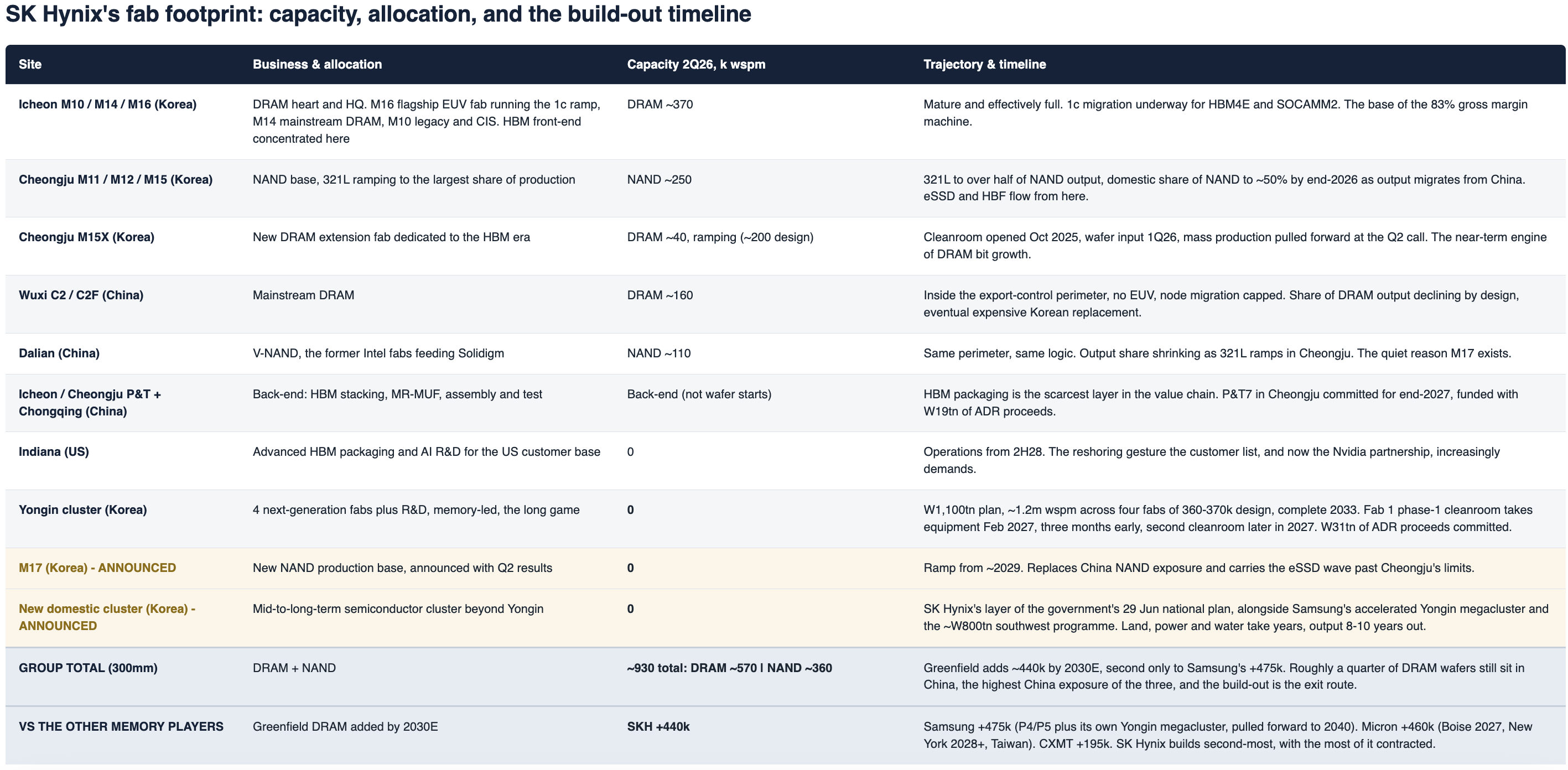
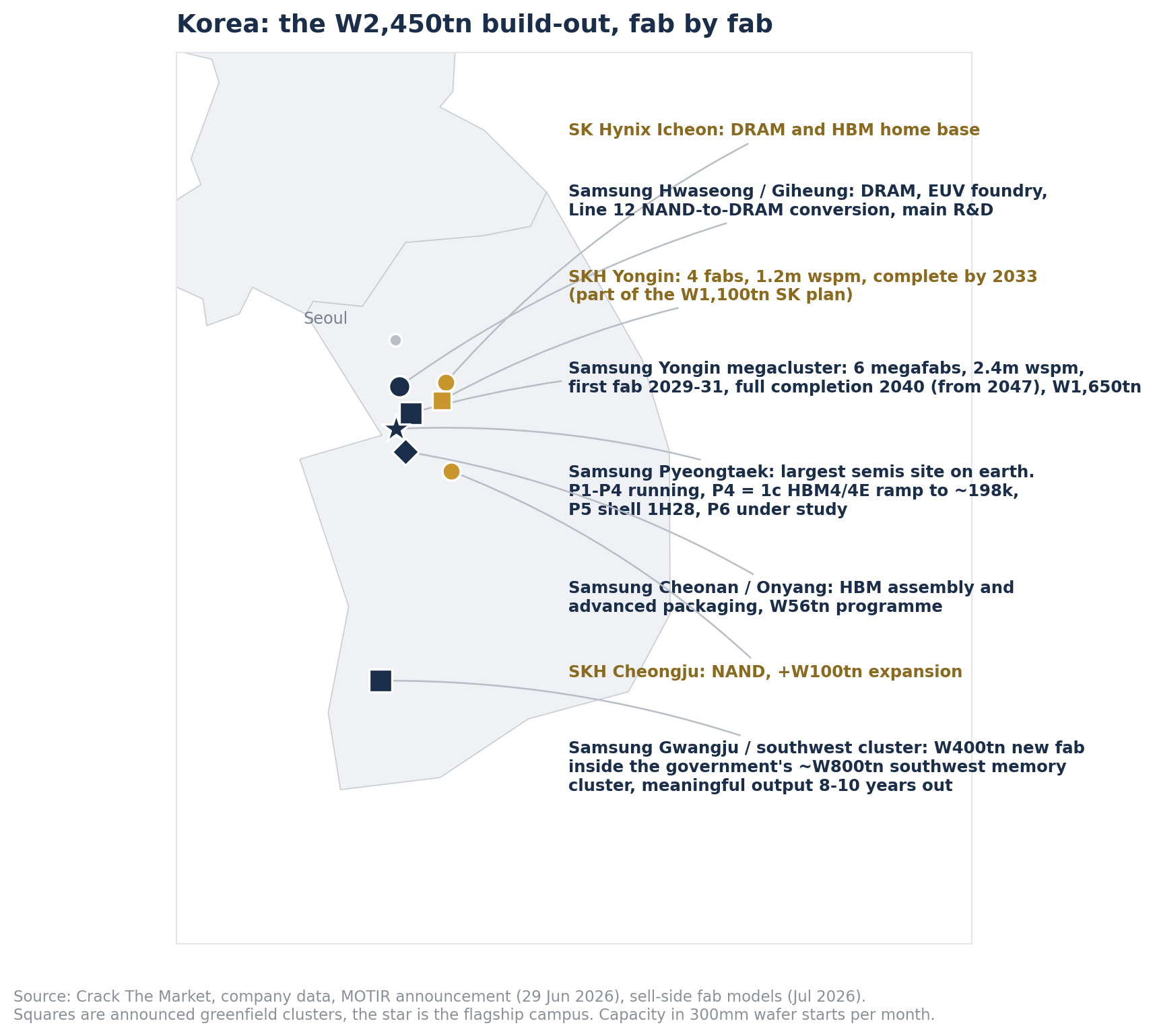
Icheon is the headquarters and DRAM heart, home of the M16 fab and the 1c ramp.
Cheongju carries NAND and, increasingly, the future: M15X is being pulled forward for HBM-era DRAM, the P&T7 advanced packaging complex is committed for end-2027, and M17, a new NAND production base, was announced this quarter.
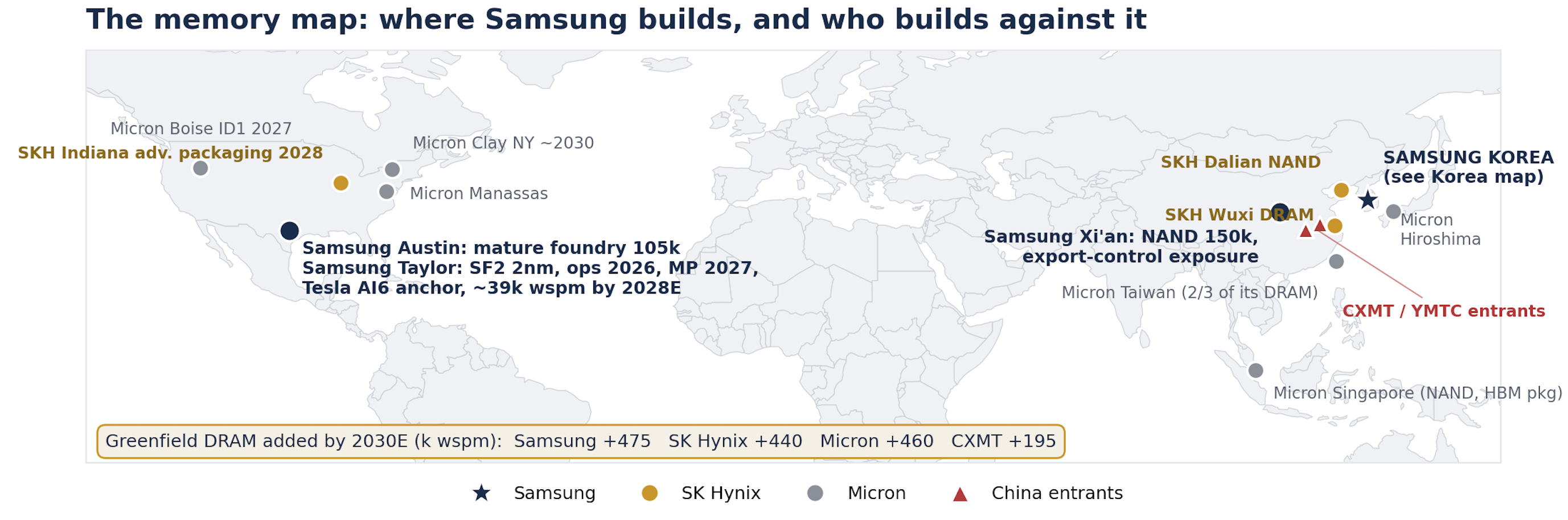
Yongin is the long game, a W1,100tn cluster that can eventually host four fabs of 360k to 370k wafer starts each, roughly 1.2m wafers a month when complete around 2033. The first cleanroom takes equipment in February 2027, three months ahead of schedule, funded in part by W31tn of the ADR proceeds, with later phases proceeding only if market conditions warrant. And Yongin no longer stands alone: the government’s national semiconductor plan of the 29th of June layers Samsung’s own Yongin megacluster, pulled forward seven years to 2040, and a new southwest cluster programme of roughly W800tn on top of it, with the further domestic cluster SK Hynix announced alongside these results as its layer of that plan. Korea has effectively committed to doubling its memory capacity over the coming decade, and every player is participating.
China is the caveat: the Wuxi campus produces a meaningful share of DRAM, Dalian houses the former Intel NAND fabs, and Chongqing handles packaging. That footprint sits inside the perimeter of export-control politics, and its eventual, expensive migration to Korean capacity is one of the quiet reasons Yongin exists.
Indiana brings advanced HBM packaging onshore for the US customer base from 2028, the reshoring gesture the customer list increasingly demands.
Ownership is the last structural fact to understand: SK Square owns 20.5% and must hold at least 20% under Korean holding company rules, which caps both future ADR expansion and any large primary issuance, the National Pension Service holds 7.5%, foreigners hold roughly half, and the free float is 78.7%.
