


On 21 May 2026, SpaceX filed its S-1. By the time you read this, the roadshow is either about to begin or already underway, with a target pricing date of 11 June and a Nasdaq listing on 12 June under the ticker $SPCX.
The numbers being floated, an offering of up to $80bn at a valuation north of $1.7tn, would make this the largest IPO in history by a factor of nearly three. The previous record, Saudi Aramco in 2019, raised $25.6bn. SpaceX is reaching for roughly the entire 2019 deal book of Aramco, Visa, Alibaba and Facebook combined.
There is a temptation, when something this consequential lands, to write the breathless piece. To frame it as the AI-and-Mars trade, fold in the Musk hagiography, sketch the bull case, and call it a deep dive. That piece will be written hundreds of times in the next three weeks. It is not this piece.
This is, instead, the piece that takes the S-1 at face value and asks what is actually inside the corporate wrapper that public investors are being asked to buy. SpaceX is no longer a rocket company. Following the February 2026 merger with xAI, the entity now contains at least four operationally distinct businesses:
A satellite broadband platform that is the fastest-growing telecom network in history.
A vertically integrated launch franchise that is mostly captive to that broadband platform.
An AI infrastructure business that lost $6.4bn last year and is on a far steeper trajectory in 2026.
A long-duration capital programme called Starship that is not yet a business at all.
These four businesses have wildly different margin profiles, growth rates, capital intensity, competitive dynamics, and time horizons. They share a holding company, a chief executive, and an internal allocation of capital that is opaque even to public investors. The valuation that the market is being asked to underwrite presumes that the four are worth significantly more bundled than apart. That assumption deserves more scrutiny than it has received.
Before any of that work begins, the single most important tension in the S-1 needs to be surfaced. Management argues that SpaceX addresses a total addressable market of $28tn. Of that, just $1.6tn, or 6%, comes from Connectivity, the segment that generates 61% of the company’s current revenue. $26.5tn, or 93%, comes from AI, the segment that generated 17% of revenue and 246% of consolidated operating losses in 2025. The number is not a typographical accident. It is the framing that justifies a 95x revenue multiple. The TAM math tells you that management is asking the market to value SpaceX not on what it currently sells, but on the AI and space economies it intends to address in some future state. Whether that framing holds determines whether the IPO is the entry point of a generation or the high-water mark of the AI capital cycle.
SpaceX is being sold as an AI-and-Mars story but is currently a satellite broadband company funding three loss-making adjacent businesses. That gap is the entire IPO.
Part I, this piece, deconstructs the four businesses one by one: the moats, the unit economics, the capital intensity, the competitive position, and the value-chain implications for each. By the end, you should understand exactly what is inside SPCX, where the cash comes from, where it goes, and what each segment would be worth as a standalone business.
Part II, will take the building blocks Part I assembles and answer the harder question: is the consolidated entity worth $1.7tn, and if not, what do you do with it.
Two notes on what to expect:
First, on what this is not: I am not going to spend pages rehashing the founding story of SpaceX or the history of Falcon 9. For this, I highly recommend reading “Liftoff” and “Reentry” by the great Eric Berger. I will also release a primer on the SpaceTech sector in the near future, which will come back on the economics of space, the trends shaping the sector and the public companies building this market.
Second, on conviction: I have followed this company (as well as the entire space ecosystem) for the better part of a decade, and I am a big fan of SpaceX and their incredible accomplishments. The Falcon programme is one of the most impressive industrial achievements of our time. Conviction in the company is not the same as conviction in the stock.
The Entity You Are Actually Buying
We start with the legal structure, because it is more complex than most pre-S-1 coverage suggests. Space Exploration Technologies Corp is a Texas-incorporated entity preparing to dual-list on Nasdaq and Nasdaq Texas. Public investors will buy Class A shares, each carrying one vote. Class B shares, held by Elon Musk and a small group of insiders, carry ten votes each. Holders of Class B shares are entitled, voting separately as a class, to elect 51% of the total authorised directors. Mr Musk himself can only be removed from the board, the CEO role, and the Chairmanship by a majority vote of the Class B common stock voting separately. SpaceX will be a controlled company under Nasdaq rules following the offering, which means it can rely on governance exemptions that ordinary listed companies cannot. Musk’s combined voting power is such that he will be able to determine the outcome of all matters requiring shareholder approval.
There is no time-based sunset on the dual-class structure. The Class B shares convert one-for-one into Class A only upon a transfer that does not qualify as a permitted transfer (permitted transfers include transfers to family members, certain trusts, and qualifying entities). Practically, Musk’s control persists until he either sells voluntarily or dies.
I will return to governance in Part II at length. For now, the only point worth making is that buying SPCX is not buying a typical public equity. It is buying a minority stake in a Musk-controlled vehicle that has the legal latitude to operate with substantially less minority-shareholder protection than is standard for a company of this scale. Whether that matters for the next three years depends on whether the businesses underneath the wrapper compound as advertised.
Underneath the legal structure sit the operational businesses, which the S-1 reports across three segments: Space, Connectivity, and AI. The segment cut is technically accurate but analytically incomplete, because the Space segment combines an external commercial launch franchise with the Starship development programme (which generated $3.0bn of R&D expense in 2025 and is not yet a commercial business), and the AI segment combines X’s advertising business with xAI’s frontier model development and the COLOSSUS compute infrastructure. To get to the right framework for valuation, you have to recut into four operational businesses.
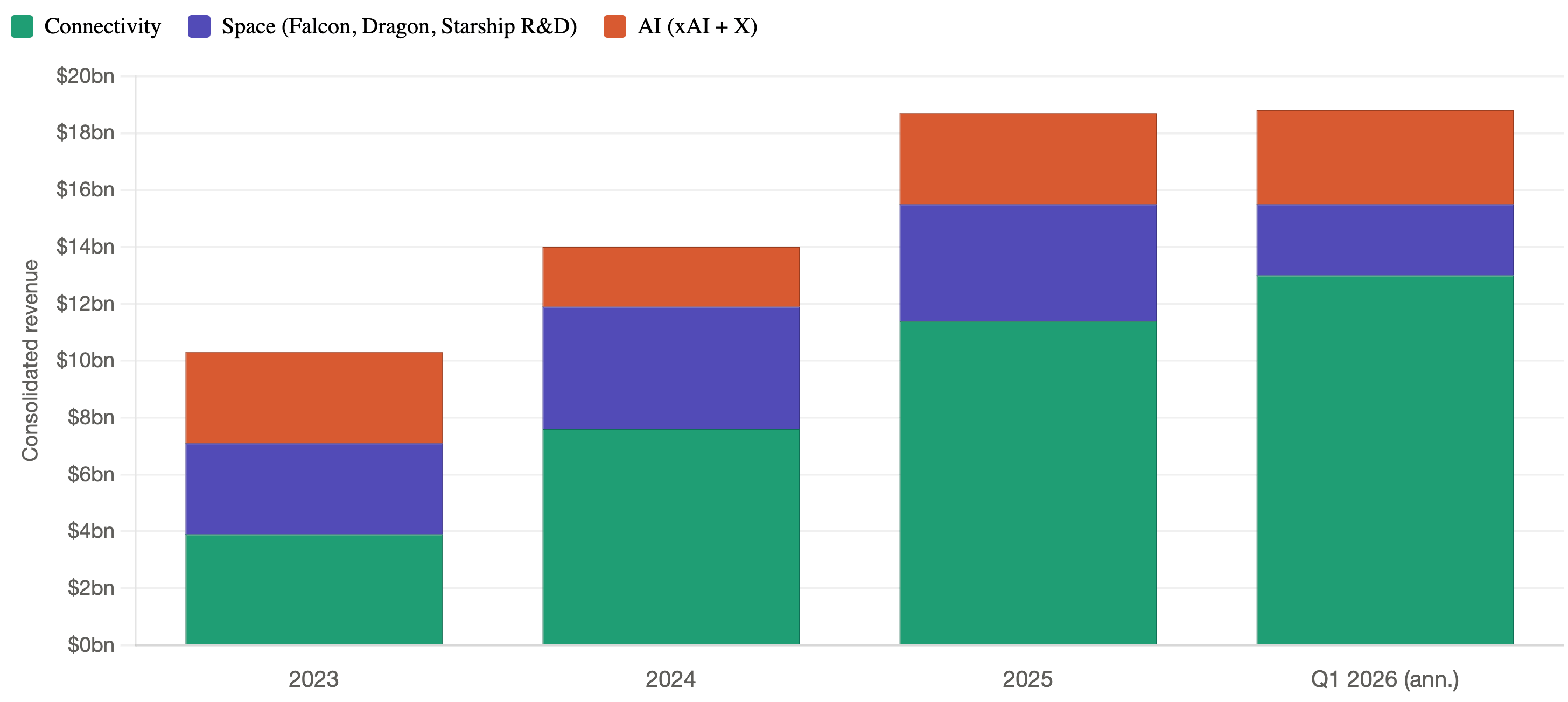
Figure 1. Connectivity has gone from 38% of revenue in 2023 to 61% in 2025. Source: SpaceX S-1, May 2026. AI segment includes retrospectively combined X and xAI under common-control accounting. Q1 2026 figures annualised. AI segment includes retrospectively combined X and xAI under common-control accounting. Q1 2026 figures annualised.
The four operational businesses are:
Starlink, the satellite broadband platform that generated $11.4bn of revenue in 2025 and accounts for the substantial majority of consolidated growth.
Launch Services, the external commercial launch franchise running on Falcon 9, Falcon Heavy, and Dragon with $4.1bn of Space segment revenue in 2025 against $3.0bn of Starship R&D.
xAI, the consolidated AI division comprising COLOSSUS compute, frontier model development, and X advertising, generating $3.2bn of revenue in 2025 against a $6.4bn operating loss.
Starship, which is not yet a business at all but a capex line consuming an estimated $5bn+ per year (including $3.0bn of R&D inside the Space segment) and carrying optionality on the future of orbital access.
Reported consolidated revenue of $18.7bn in 2025 (up from $14.0bn in 2024 and $10.4bn in 2023, on a retrospectively combined basis including X and xAI as common-control transactions). Reported operating loss of $2.6bn in 2025 (compared to $466m of operating income in 2024). Adjusted EBITDA of $6.6bn.
The Q1 2026 print materially worsens the trajectory: $4.7bn of revenue, $1.9bn operating loss, and a $4.3bn net loss. Adjusted EBITDA in Q1 2026 was $1.1bn, which on a four-quarter annualised basis is $4.5bn against the $6.6bn 2025 print. Capex rose to $10.1bn in Q1 2026 vs $20.7bn in FY25. The cash burn is accelerating into the IPO window, not stabilising.
The rest of this piece walks through each of the four pieces in turn. The reframing matters, because the consolidated numbers obscure what is happening at the segment level, and the segment level is where the valuation work actually has to be done.
Starlink - The Engine
If the IPO has a defensible anchor, it sits here. Starlink is the engine that funds everything else and the single business inside SPCX that an investor can value with anything approaching traditional methods. It deserves the most rigorous treatment in Part I, and the most space.
