

Welcome to the 65th investment case, 53rd Resilience & Quality, 40th Reshoring & Sovereignty, 21st Electrification & Energy idea on Crack the Market (and the most comprehensive CF Industries investment case you will find online)! Join me as I dissect the company that stands at the epicenter of two powerful structural forces: the most severe global energy crisis in modern history, which has sent nitrogen fertilizer prices to multi-year highs, and the rise of low-carbon ammonia as a foundational fuel for the future hydrogen economy.
Twice a week, I release deep dives into stocks and sectors that fit into the 6 themes that I see winning in the coming years and decades: AI & Technology, Electrification & Energy, Reshoring & Sovereignty, Healthcare & Longevity, China & Asia, Resilience & Quality.
Take advantage of this once in a generation opportunity to build long term wealth by investing in great stocks that will deliver returns for your portfolio for years to come.
After reading this article, you will understand why CF Industries is the dominant nitrogen and fertilizer company in North America, why the market treating it as a short-term cyclical trade are fundamentally misreading what has happened to the global nitrogen supply curve, why the Middle East energy crisis has created a structural earnings reset that has not yet been priced, and why the clean ammonia platform being built underneath the commodity business is worth far more than zero.
In this article I go through:
CF Industries’ business and how it dominates North American nitrogen production through the deepest distribution moat in the fertilizer industry, making it the single largest beneficiary of the current global energy dislocation.
Why the Geographic Arbitrage thesis is more durable and more powerful than the market currently believes, and what the EBITDA sensitivity actually implies at current spot pricing.
How the global nitrogen supply chain has been simultaneously disrupted across Qatar, Iran, Europe, and Russia, creating a structural deficit with no near-term relief valve.
How CF is executing the most ambitious low-carbon ammonia platform in the Western hemisphere and why this contracted, government-subsidized earnings stream deserves an infrastructure multiple, not a commodity one.
Why the capital return machine continues to compound per-share value independent of where nitrogen prices trade in any given quarter.

CF Industries Investment Case
Table of content
Business Description
CF Industries is the world’s largest producer of anhydrous ammonia and North America’s largest pure-play nitrogen manufacturer. The company converts cheap, stranded North American natural gas into ammonia, urea, UAN, and ammonium nitrate through the Haber-Bosch process, selling predominantly into agricultural end markets (fertilizer) and secondarily into industrial applications (DEF, emissions abatement, explosives, and increasingly low-carbon hydrogen for power generation and shipping). In a world where global nitrogen pricing is set by the most expensive marginal ton produced in Europe or Asia using LNG at $12 to $15 per MMBtu, CF produces from the lowest-cost geography on Earth, at a realized gas cost of $3.31 per MMBtu in 2025. Every dollar of spread between Henry Hub and TTF flows directly through CF’s income statement as gross margin.
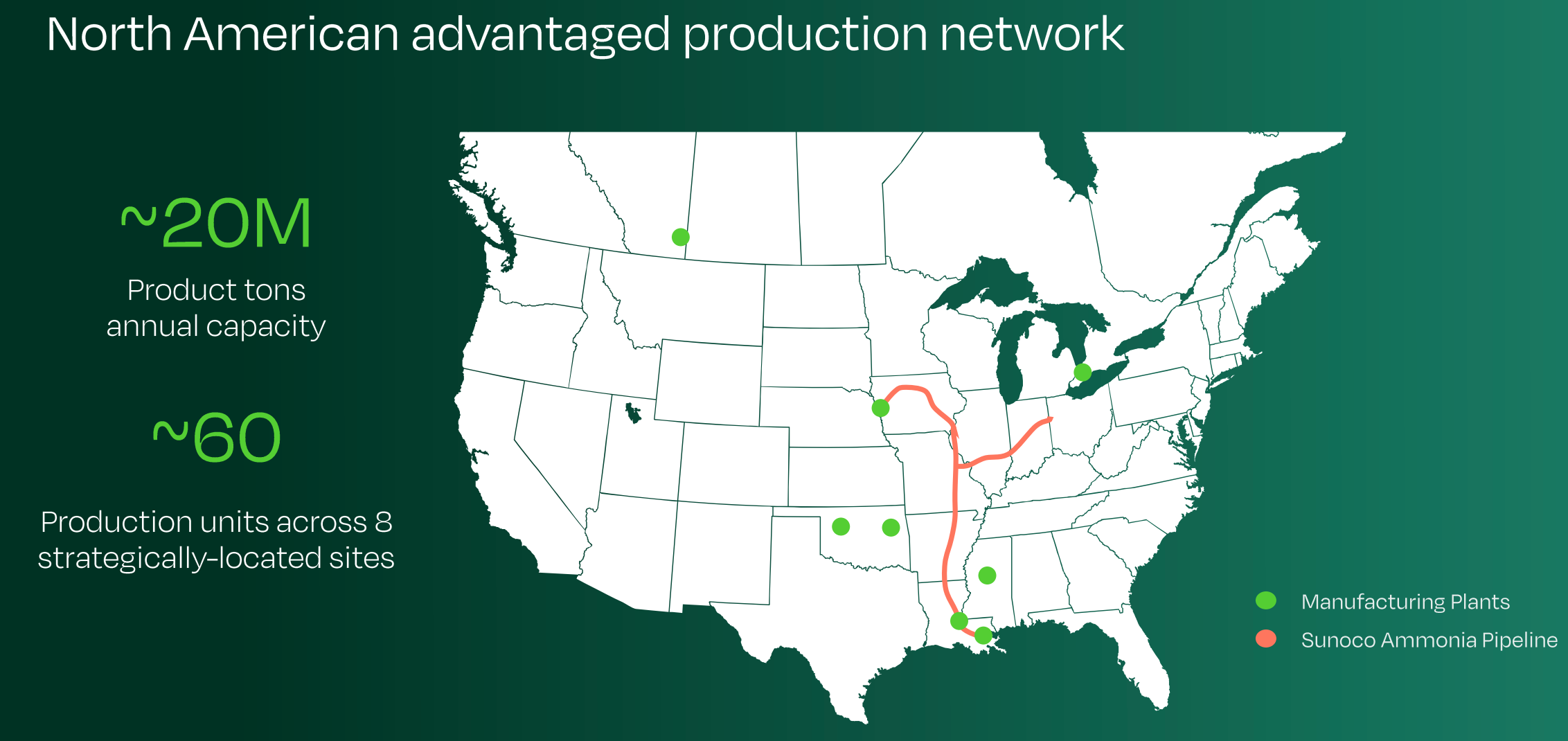
The company generated $7.08bn in net sales in 2025 on 19.1m product tons sold, producing $2.72bn of gross margin, $2.89bn of adjusted EBITDA, $1.46bn of net earnings, and $1.79bn of free cash flow. The business has returned $1.7bn to shareholders in 2025 alone ($1.34bn in buybacks reducing share count by approximately 10% year over year, plus $326m in dividends). Diluted EPS grew 33% from $6.74 in 2024 to $8.97 in 2025. The business operates eight manufacturing complexes in North America (six in the US, two in Canada) and one in the United Kingdom, which together control approximately 40% of North American ammonia capacity, 41% of granular urea capacity, 44% of UAN capacity, and 19% of ammonium nitrate capacity. A 50% interest in the PLNL joint venture in Trinidad provides 360,000 tons of additional ammonia capacity. Fewer than 3,000 employees run the entire operation, with among the lowest SG&A ratios in the fertilizer, chemical, materials, and industrial sectors.
Segment Overview:
Ammonia ($2.18bn in sales or 31% of total sales): The core output and chemical backbone of everything else CF sells. The company generated $2.18bn in ammonia revenue in 2025 on 4.6m tons sold, with ammonia gross margin percentage at 39.4%. Ammonia is 82% nitrogen by weight and is either sold directly to agricultural and industrial customers or upgraded on-site into the other three core products.
Granular Urea ($1.78bn in sales or 25% of total sales): Generated $1.78bn in revenue in 2025 on 4.1m tons at a 47.0% gross margin. Urea is 46% nitrogen by weight, is the most traded nitrogen product globally at approximately 50% of global nitrogen fertilizer consumption, and sets the global reference price that flows back to ammonia and UAN through well-defined conversion ratios (approximately 1.78 tons of ammonia equivalent per ton of urea).
UAN ($2.16bn in sales or 30% of total sales): Generated $2.16bn in revenue in 2025 on 6.9m tons at a 42.6% gross margin, up from 36.3% in 2024 on higher realized prices. UAN is a liquid fertilizer product with 28 to 32% nitrogen content, produced by combining urea and ammonium nitrate. UAN is the most significant revenue segment and where CF holds its largest market share position (44% of North American capacity).
Ammonium Nitrate ($0.42bn in sales or 6% of total sales): Generated $421m in revenue in 2025 on 1.3m tons at a 33.3% gross margin. AN is produced at Yazoo City, Mississippi, and Billingham in the UK, and serves both agricultural and commercial explosives markets. Yazoo City has been temporarily idled since November 2025 following an incident in the AN upgrade area, with production not expected to resume until the fourth quarter of 2026 at the earliest.
Other Segment ($0.54bn in sales or 7% of total sales): Generated $545m in revenue in 2025 on 2.1m tons sold. Includes diesel exhaust fluid (DEF), urea liquor, nitric acid, and aqua ammonia sold to industrial customers. DEF is used in diesel engine emissions systems and is a growing industrial end market with structural tailwinds from tightening global emissions regulations.
The Value Chain and Distribution Moat:
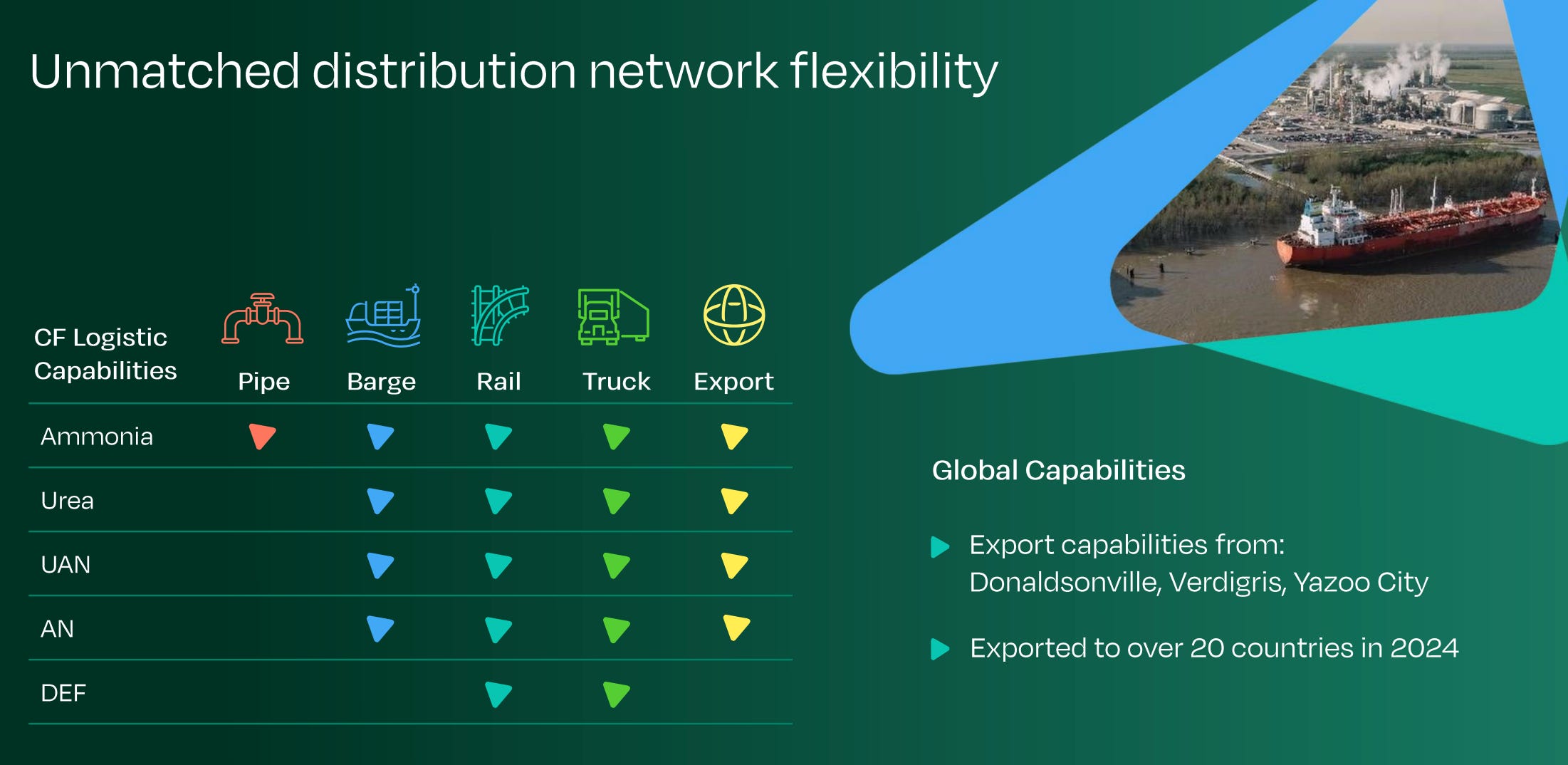
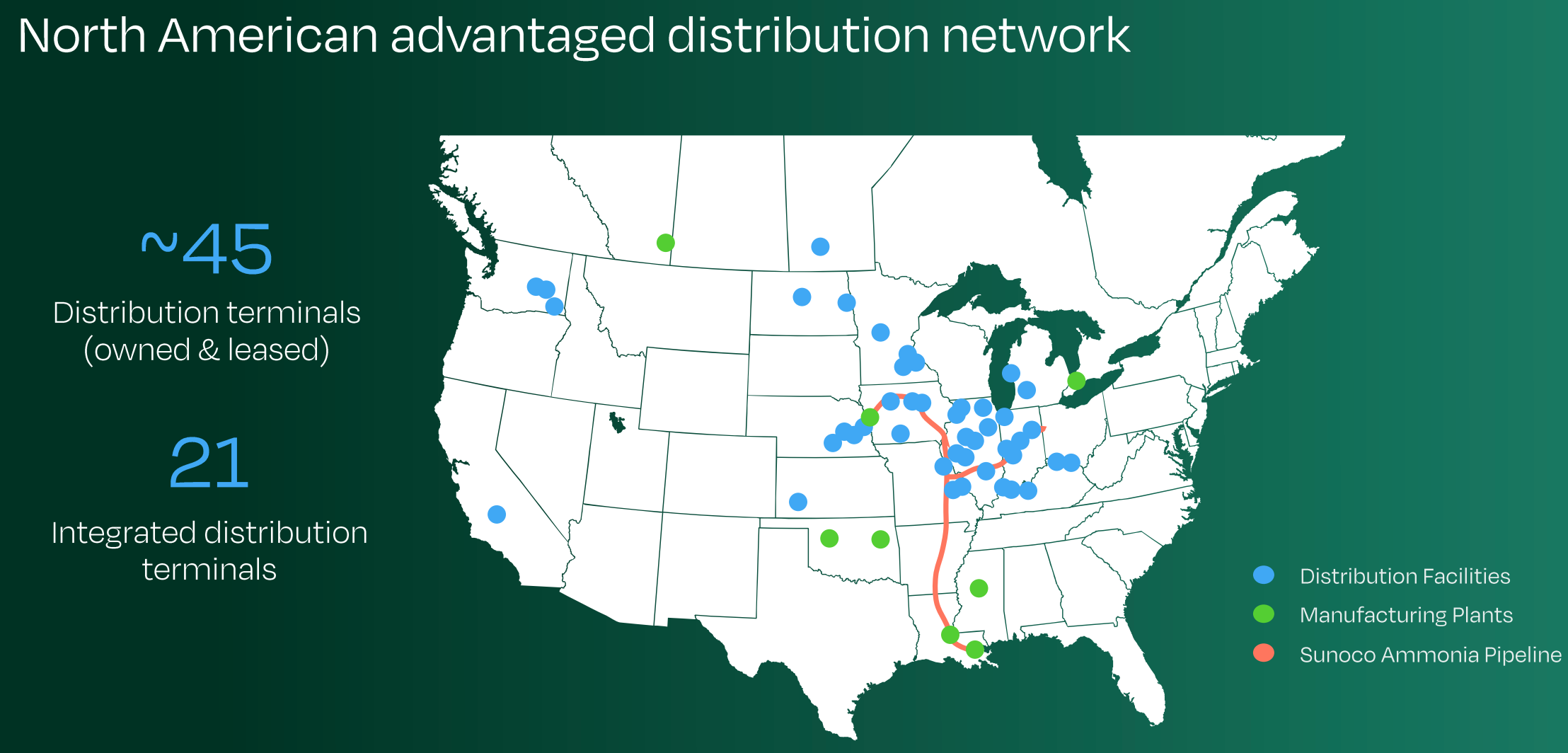
What distinguishes CF from almost every other commodity producer is the depth of its physical distribution network. Outside the manufacturing footprint itself, CF operates 39 in-market storage terminals across a 17-state region of the US, Canada, and the UK, plus an extensive owned and leased fleet that includes up to 13 tow boats and 42 river barges for Mississippi River transport. The Donaldsonville and Waggaman facilities are directly connected to the 2,000-mile Sunoco ammonia pipeline, which allows CF to move ammonia from the Gulf Coast to ten company-owned terminals and additional shipping points in the Midwestern corn belt, exactly where US agricultural demand is densest. Aggregate storage capacity across production facilities and terminals exceeds 2.8m tons.
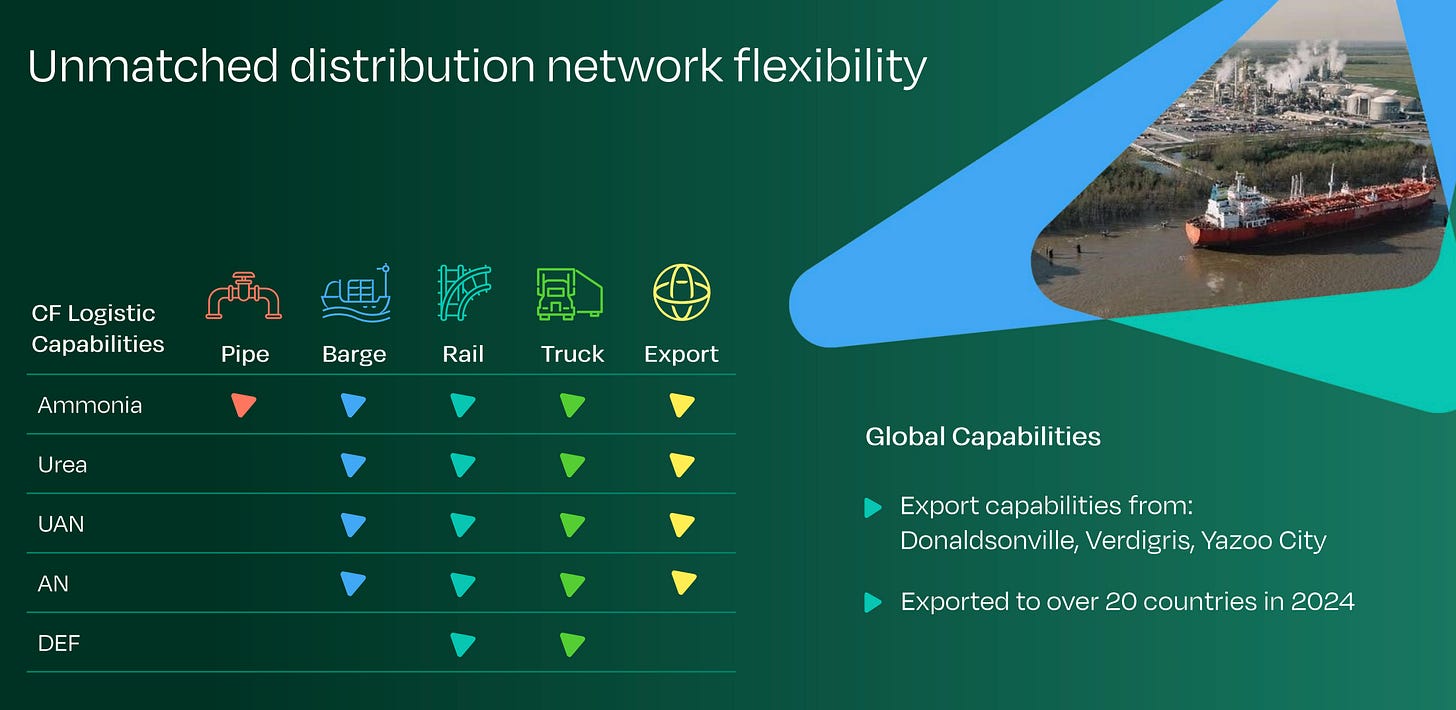
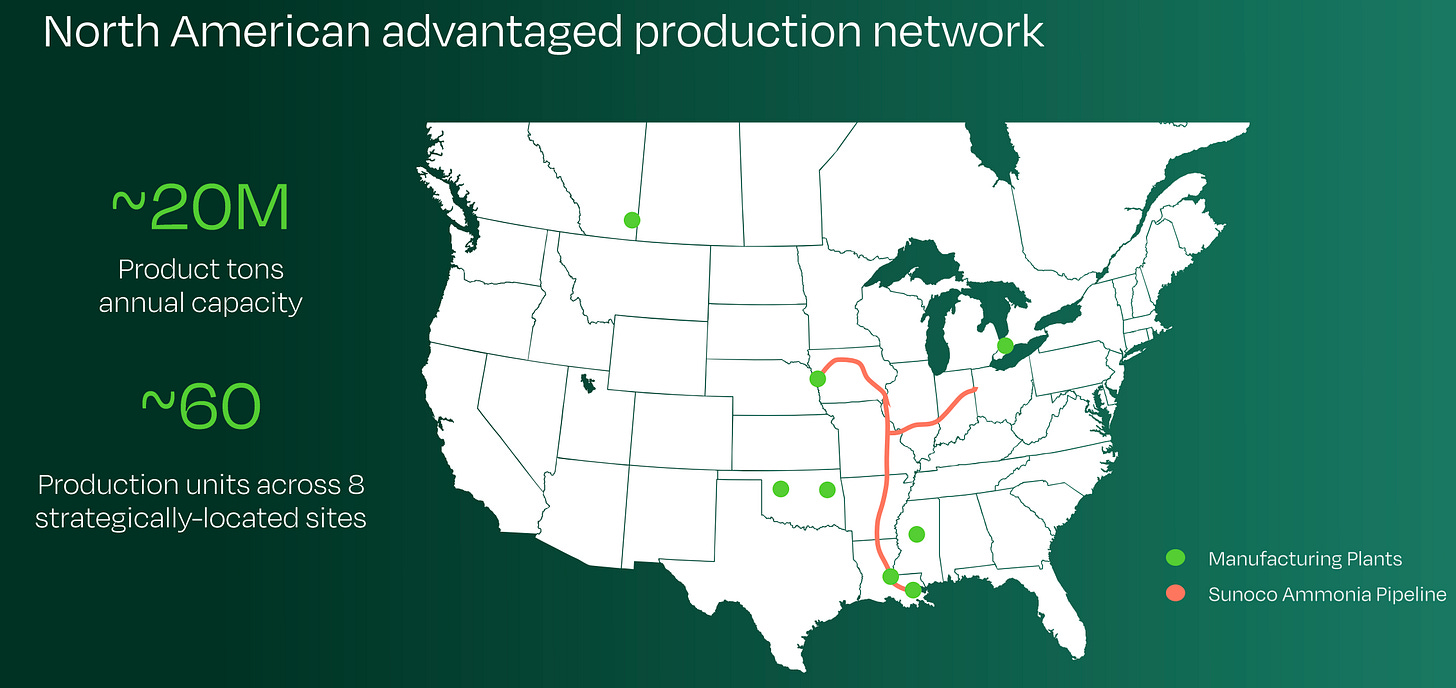
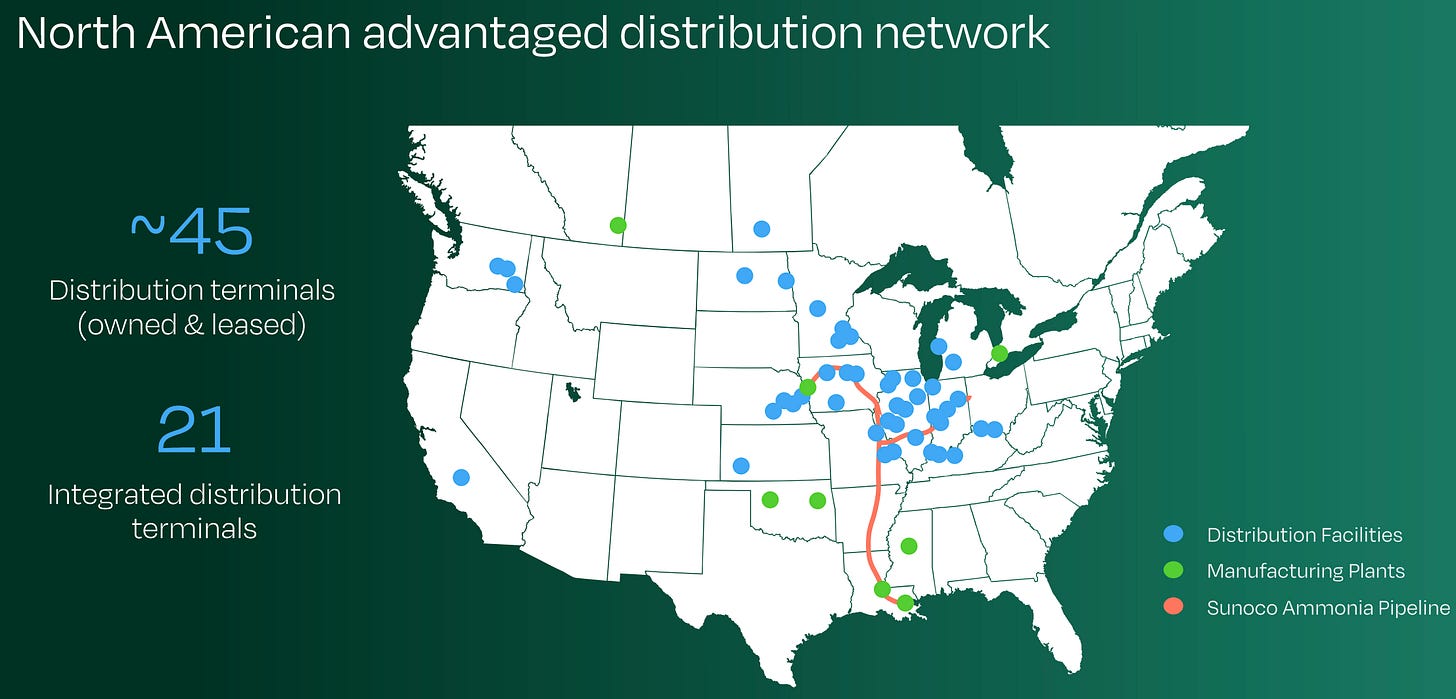
This network matters because nitrogen is expensive and dangerous to transport. Ammonia is highly regulated, must be stored under pressure or refrigeration, and cannot easily be moved by truck over long distances. A competitor looking to replicate CF’s Gulf Coast to Corn Belt supply chain would need to either invest billions of dollars in pipeline and terminal infrastructure or accept materially higher delivered costs. This is why the company consistently achieves the highest value net back in its industry, captures 10% higher capacity utilization than North American peers over the past five years (equivalent to operating an additional world-scale production facility valued at $3.5bn in capital), and wins the marginal bid into the import-dependent North American market whenever global prices dislocate.
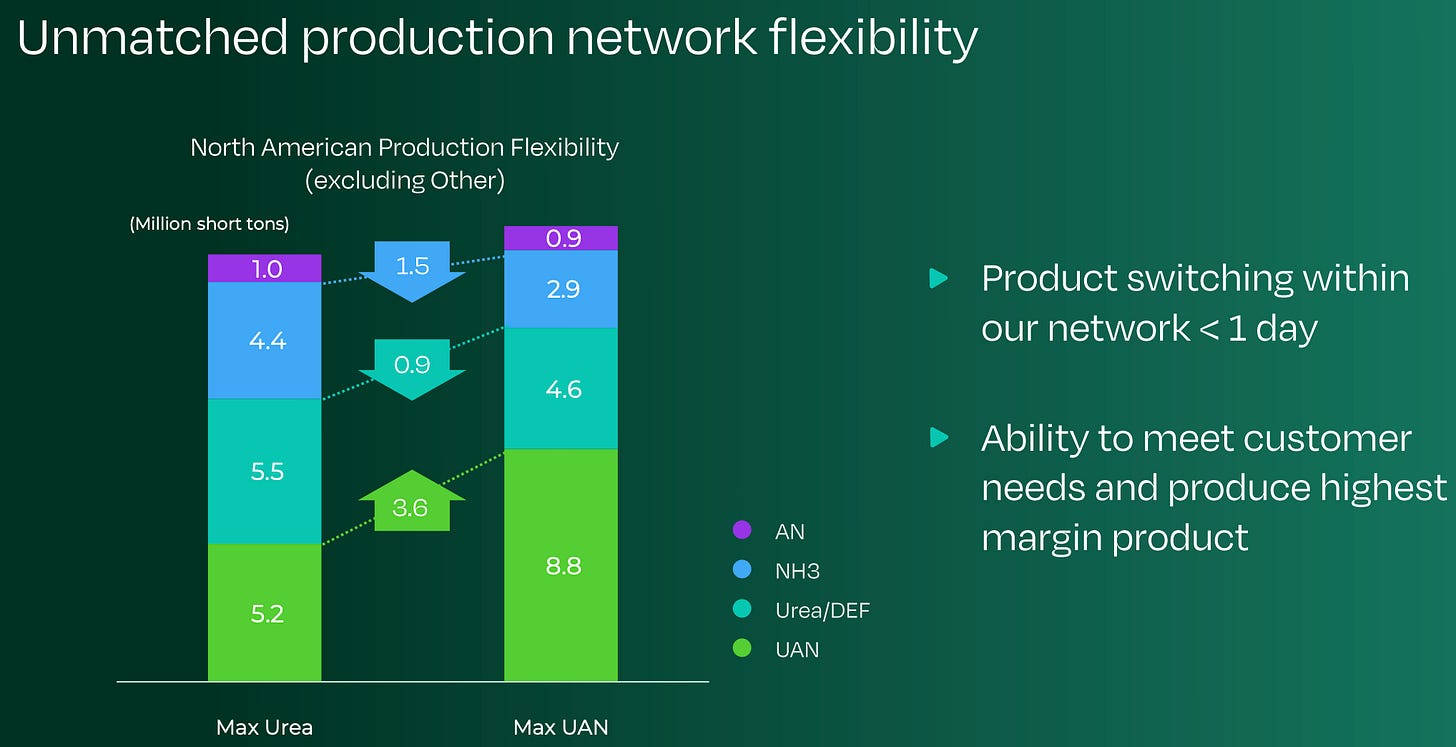
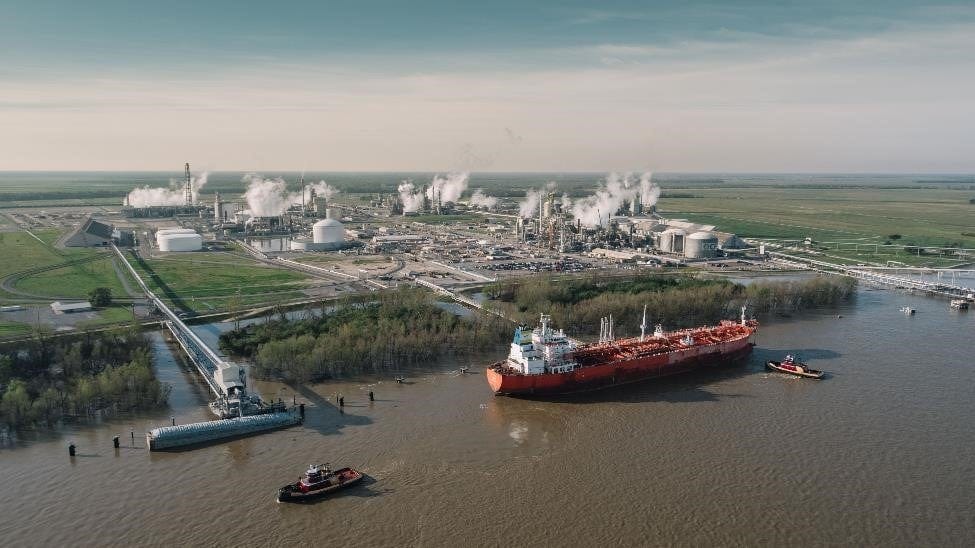
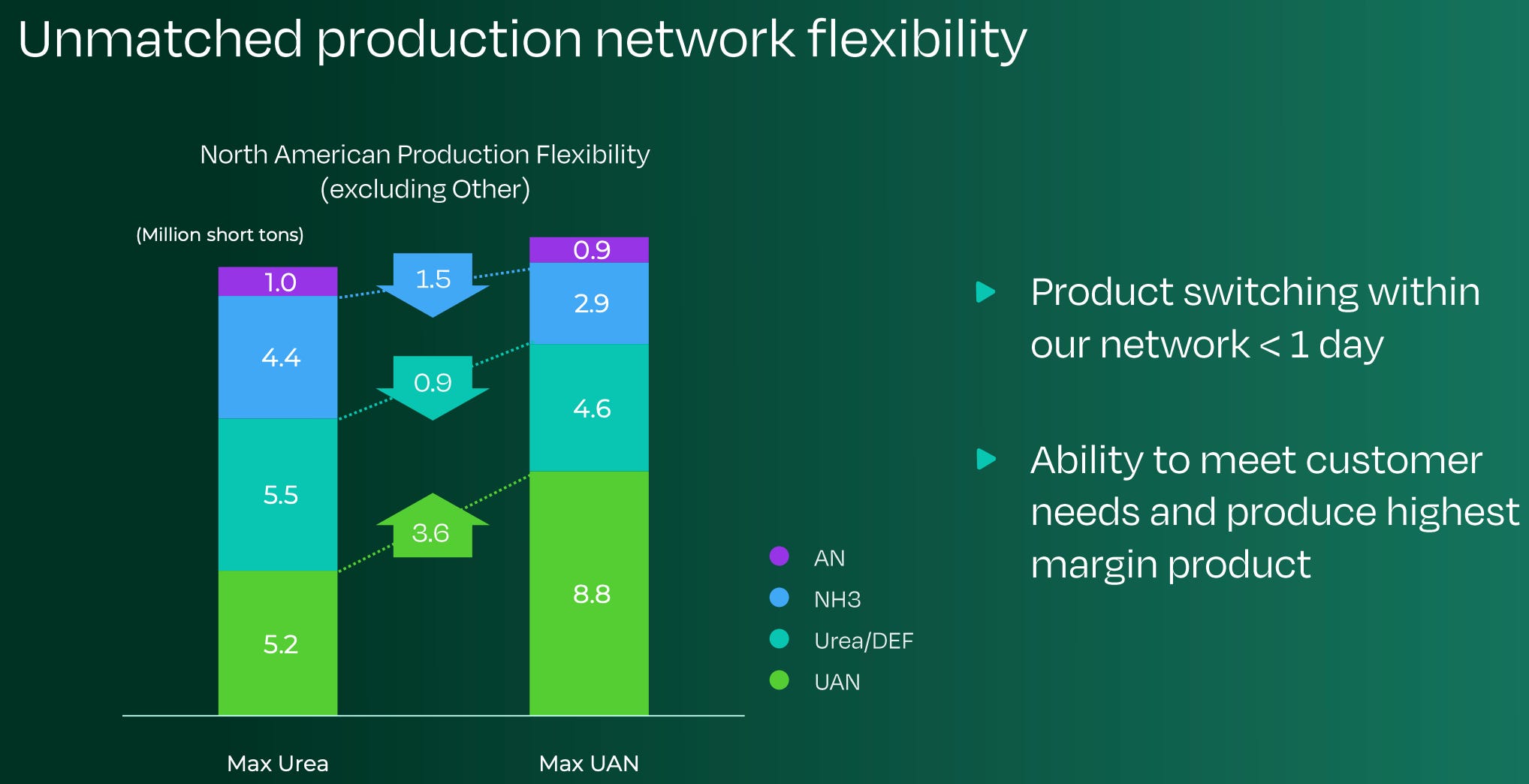
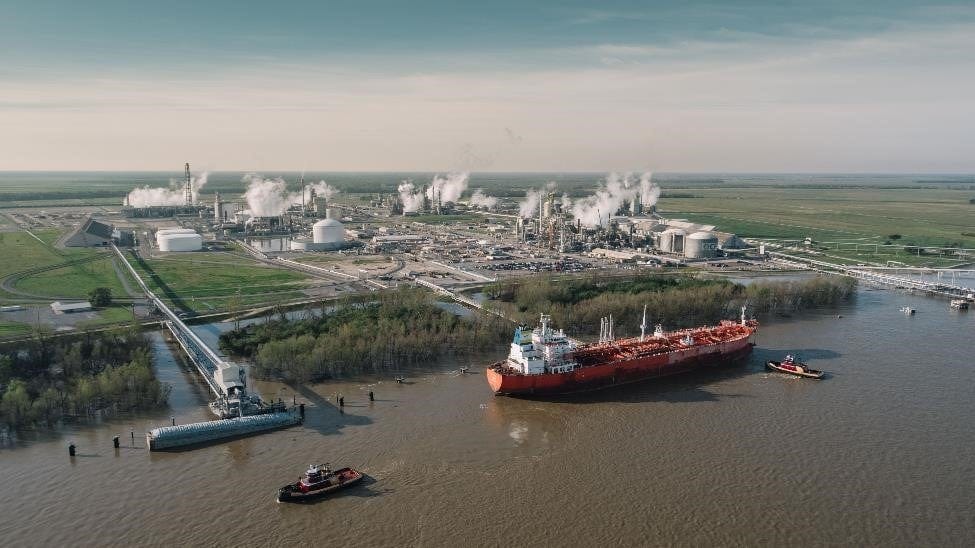
The Donaldsonville complex in Louisiana deserves specific attention. It is the world’s largest and most flexible ammonia production complex: six ammonia plants, five urea plants, four nitric acid plants, three UAN plants, and one DEF plant, all on the Mississippi River with deep-water docking, pipeline connectivity, and truck and rail loading. The facility alone has on-site storage for 139,000 tons of ammonia, 202,000 tons of UAN, and 130,000 tons of granular urea. Donaldsonville’s production mix can swing between 2.4m and 3.3m tons of granular urea annually and between 1.2m and 4.3m tons of UAN annually, giving CF unmatched product-mix optionality to respond to whichever nitrogen product is priced most attractively in any given quarter. This flexibility is a structural moat that pure urea or pure UAN producers elsewhere in the world simply do not have.
A Brief History of CF Industries:
1946: Founded as Central Farmers Fertilizer Company, owned by a group of regional agriculture cooperatives. Post-World War II America was undergoing a massive agricultural boom with unreliable localized supply chains. CF was a consortium of farmers that existed to ensure a guaranteed, reliable supply of crop nutrients. The entire company was built on supply reliability for the American farmer, a founding DNA that still defines the operational culture today.
1970: Renamed CF Industries. Operates for the next 35 years as a cooperative-owned nitrogen producer serving member farmers.
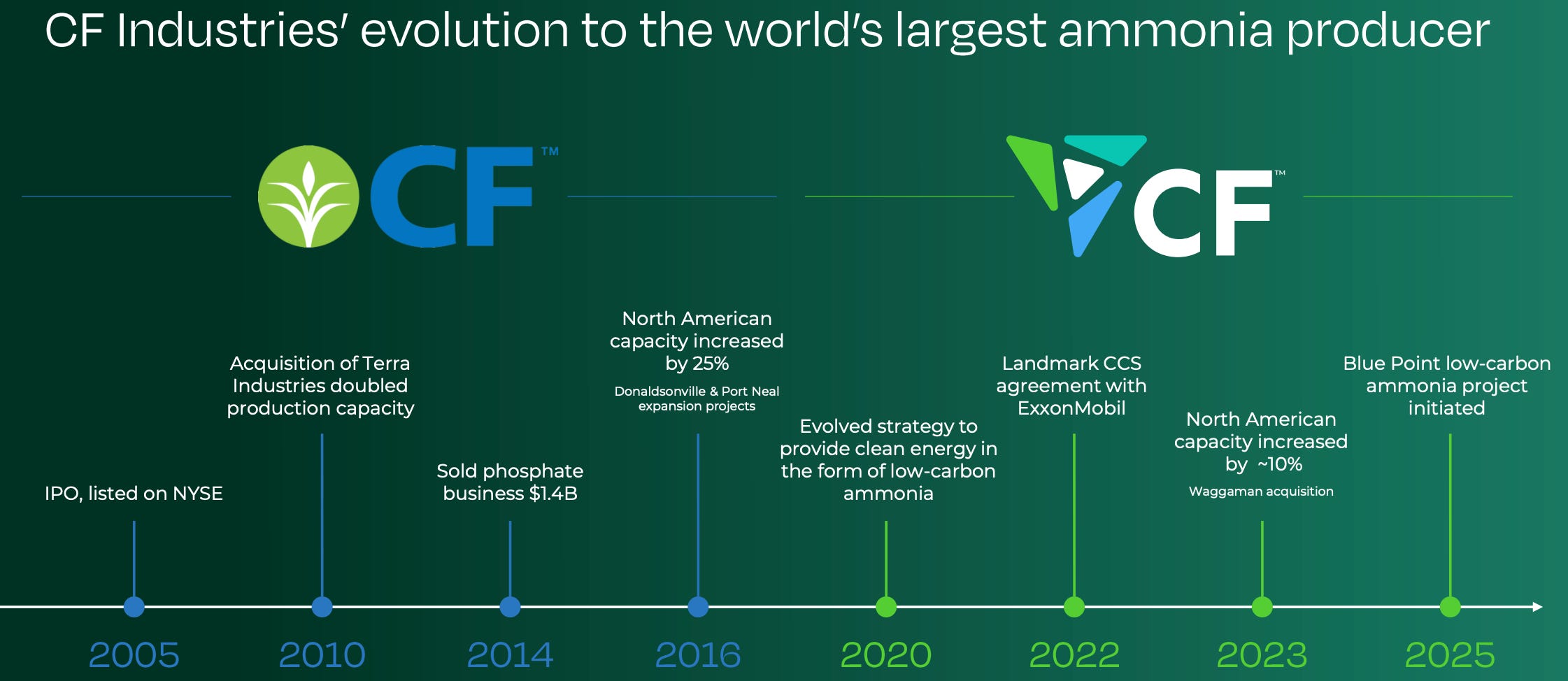
2005: IPO on the NYSE, transitioning from cooperative ownership to public company structure.
2010: Acquisition of Terra Industries doubles production capacity and establishes CF as the largest North American nitrogen producer.
2014: Sold the phosphate business for $1.4bn, transforming CF into a pure-play nitrogen company. The strategic focus on ammonia and nitrogen upgrades, rather than diversified fertilizer, has defined the company ever since.
2016: North American capacity increased by 25% through the Donaldsonville and Port Neal expansion projects, adding significant granular urea and UAN capacity exactly as the next cyclical downturn was beginning. CF absorbed the depressed earnings through 2018 but emerged with capacity that would prove extraordinarily valuable through the 2021 to 2025 supercycle.
2020: Board and management adopt a strategic evolution to leverage the company’s unique capabilities to accelerate the clean energy transition, formally pivoting the strategic vision from traditional nitrogen fertilizer producer to low-carbon ammonia producer for new applications in power generation, marine shipping, and hydrogen.
2022: Landmark CCS agreement signed with ExxonMobil for the transport and permanent geological sequestration of CO2 from the Donaldsonville complex, the first at-scale industrial CCS partnership in the nitrogen industry. Same year: CF is swimming in cash as global fertilizer prices hit all-time peak highs following the Ukraine war. Management shows legendary restraint, sitting on the cash rather than chasing overpriced peak-cycle M&A, a discipline that would be rewarded 18 months later.
2023: December acquisition of the Waggaman, Louisiana ammonia facility from Dyno Nobel for $1.675bn, adding 880,000 tons of ammonia capacity and expanding North American capacity by approximately 10%. The surgical nature of this deal, a state-of-the-art facility right in Louisiana that seamlessly integrates into the existing pipeline network, purchased at a highly reasonable valuation after the peak-cycle frenzy subsided, defines the CF capital allocation playbook.
2025: Formation of the Blue Point joint venture with JERA and Mitsui in April to construct a greenfield $3.7bn low-carbon ammonia production facility. Donaldsonville CCS completed in July. First commercial sales of low-carbon ammonia at a premium to traditional ammonia consumers in Europe and Africa.
January 2026: Chris Bohn becomes CEO, succeeding Tony Will after a 12-year CEO tenure. Bohn brings 16 years at CF across COO, CFO, and operations roles, the rare combination of financial engineering expertise for capital allocation and JV funding plus granular understanding of pressurized chemical reactor operations.
March 2026 onward: The Middle East energy crisis and global fertilizer shock. The physical destruction of Qatari LNG cryogenic trains creates a multi year structural reset of the global gas curve. Iran’s production collapses under geopolitical and gas availability curtailments. India mandates emergency domestic gas rationing, slashing allocations to its fertilizer plants to 70% of operational requirements, forcing the world’s largest urea importer into the spot market just as Middle Eastern seaborne supply vanishes. Approximately 20% of European ammonia capacity and 25% of European urea capacity is curtailed as TTF gas costs make production uneconomic. Russian nitrogen exports continue to be disrupted. Global nitrogen prices spike violently, and CF Industries, producing from Henry Hub at $3.50 per MMBtu while competitors are priced out at $15 per MMBtu, becomes the single largest beneficiary of the nitrogen supercycle in the Western world. This is the inflection point at which CF transitions from a cyclical trade into a structural long-term hold.


