

Welcome to the 69th investment case, 57th Resilience & Quality, 44th Reshoring & Sovereignty, 24th Electrification & Energy, 10th China, 33rd AI & Technology idea on Crack the Market (and the most comprehensive Vertiv investment case you will find online)! Join me as I dissect the purest listed vehicle for the AI infrastructure buildout, one of the cleanest industrial compounders in the world, a company sitting at the exact intersection where grid power meets the GPU, and arguably the single best way in public equities to play the decade long capex supercycle driven by AI compute, rising rack density, and the architectural shift to liquid cooling and 800V DC distribution.
Twice a week, I will release deep dives into stocks and sectors that fit into the 6 themes that I see winning in the coming years and decades: AI & Technology, Electrification & Energy, Reshoring & Sovereignty, Healthcare & Longevity, China & Asia, Resilience & Quality.
Take advantage of this once in a generation opportunity to build long term wealth by investing in great stocks that will deliver returns for your portfolio for years to come.
After reading this article, you will understand why this company is so special thanks to an unmatched integrated portfolio and a fast compounding services annuity that together produce a quality of earnings the market still underprices, what it does, why it is the only listed business that delivers both power and thermal infrastructure at hyperscale with one of the highest growth rates in the industrial complex, why its management team has executed one of the cleanest transformations in public markets, why it is at an inflection point as rack density escalates and the 800V DC architecture arrives, and why it remains one of the best businesses to own for the next decade.
In this article I go through:
Vertiv’s business and how it dominates the power and thermal infrastructure that sits between the silicon and the facility
How this company has become one of the cleanest compounders in the industrial world
How rack density escalation, the 800V DC transition, and the liquid cooling ramp xpands Vertiv's content per megawatt
Why its competitive position in integrated power and thermal keeps getting stronger
Why its three consecutive Investor Days of conservative guidance have all been left in the dust
Vertiv Investment Case
Table of content
Business Description
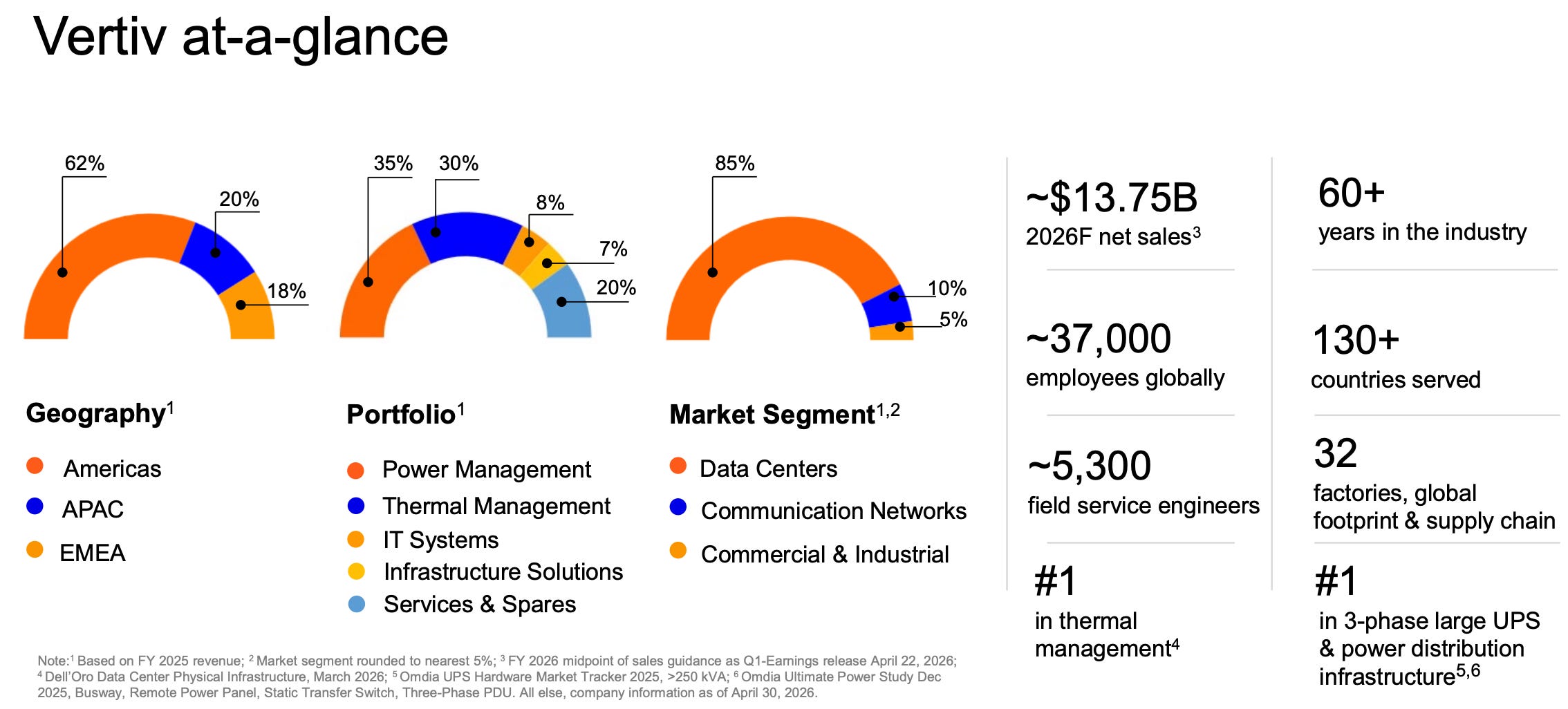
Vertiv Holdings ($VRT) designs, manufactures, and services the mission-critical electrical, thermal, and IT infrastructure that keeps data centers running. The business is the direct corporate descendant of Liebert Corporation, which invented the computer room air conditioner in 1965 and for six decades has specialized in the infrastructure that sits between the power grid and the compute rack. Today, Vertiv generates 85% of its revenue from data center end markets, with the balance split between communication networks (10%) and commercial and industrial applications (5%). On a portfolio basis the business splits into five functional categories:
Power Management (35% of revenues): UPS systems, power distribution, switchgear, busways, energy storage, microgrid integration.
Thermal Management (around 30% of revenues): chillers, CDUs, row and rack cooling, heat rejection).
IT Systems (8% of revenues): racks, integrated cabinets, monitoring).
Infrastructure Solutions (7% of revenues): prefabricated modular and turnkey solutions).
Services (around 30% of revenues): lifecycle services, maintenance contracts, field engineering, commissioning).
The geographic split is: 62% Americas, 20% APAC and 18% EMEA across 130+ countries, supported by approximately 37,000 employees (as of year-end 2025), of whom roughly 41% sit in manufacturing and 5,300 are field service engineers. The business operates 32 manufacturing sites globally and more than 320 field service centers, up from approximately 200 in 2022.
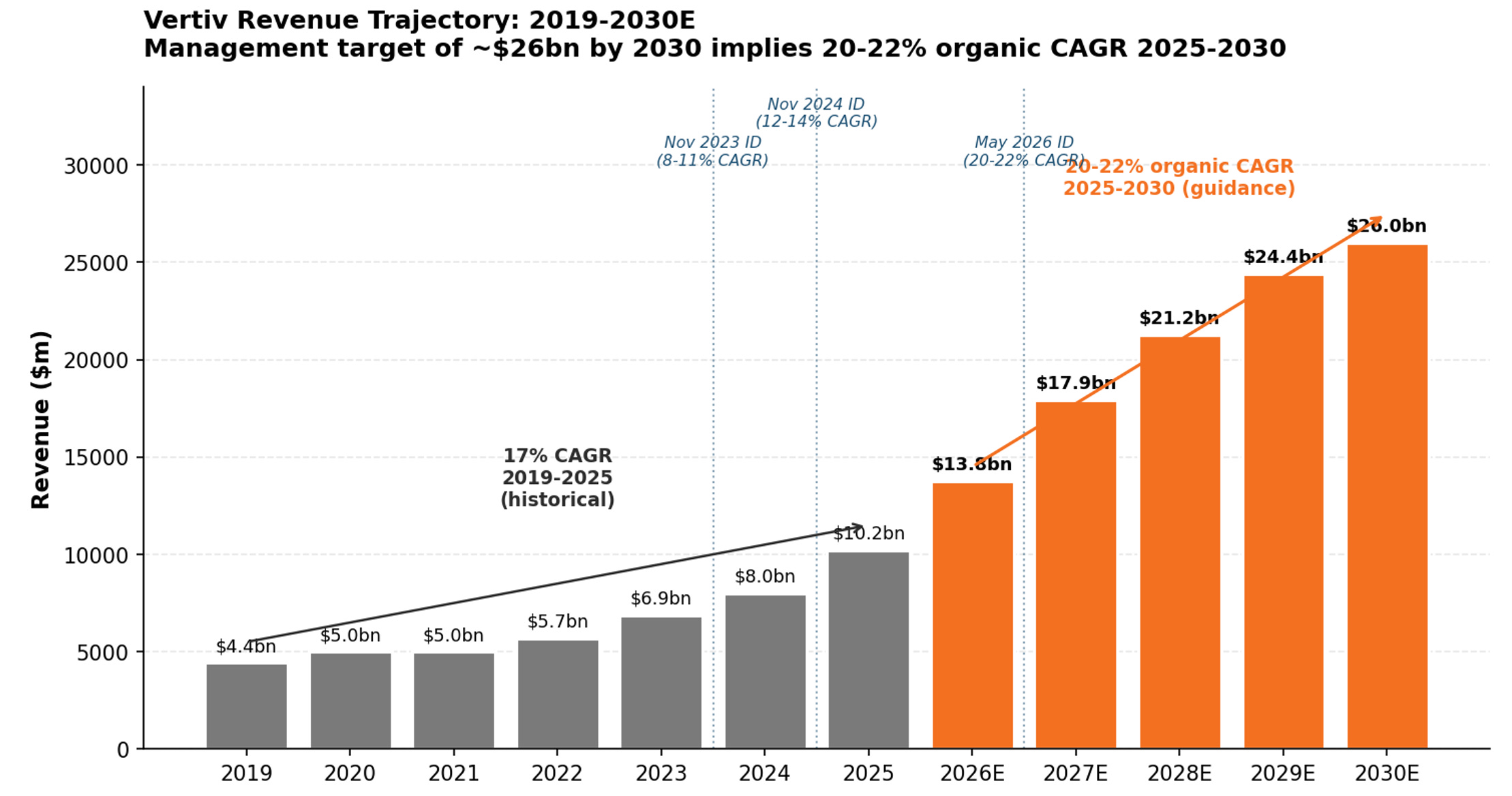
The company generated $10.2bn in revenues in 2025 vs $8.0bn in 2024, with 2026 guidance reaffirmed at the May 2026 Investor Day at $13.5-14.0bn (implying 32-37% organic growth). The new 2030 revenue target is approximately $26bn, anchored on a 20-22% organic CAGR over 2025-2030 against an underlying served-market growth assumption of 16-18%, with the residual 400bp of outgrowth attributable to share gains from solutions capability (services and prefabrication) and leading product positions. Adjusted operating profit margins have expanded from 7.6% in 2019 to 19.4% in 2024 and 20.8% in 1Q26, an 1,300+ basis point expansion since the SPAC listing. 2026 ajd operating profit margin guided to 22.8-23.8% and 2030 targeted at 27%+. Net debt-to-adjusted EBITDA has moved from 7.9x in 2019 to nearly net cash today. The market capitalization sits at approximately $120bn, and this is definitely an expensive company as the shares trade at 46x 2026 consensus EPS and 34x 2026 EV/EBITDA.
Vertiv Revenue Trajectory 2019-2030E
Segment Overview:
Thermal Management:
The largest and most strategically differentiated segment at around 35% of revenues. Thermal Management encompasses the full heat rejection chain from outdoor chillers through row- and rack-level cooling: chillers and outdoor heat rejection units, transformer and distribution cooling, row liquid manifolds, rack liquid manifolds, row coolant distribution units (CDUs), and rack-level liquid cooling.
Vertiv holds the #1 market share position in data center thermal management at approximately 20% (Dell’Oro and Omdia data), with Johnson Controls at 11%, Stulz at 7%, Trane at 6%, Schneider at 6%, Modine at 6%, Carrier at 5%, Daikin at 4%, and Munters at 4%.
The next-generation transition from 48V AC distribution to liquid-cooled, high-density rack architectures (Nvidia Blackwell 120kW/rack, Blackwell Ultra 180kW/rack, Rubin 600kW/rack, Rubin Ultra 1,000kW/rack) has doubled the addressable revenue per megawatt in this segment and made the thermal chain the critical enabling bottleneck of AI compute deployment.
The September 2024 acquisition of CoolTera added rack-level CDU capability, the 2025 acquisition of PurgeRite expanded fluid management and liquid cooling services.
The new CoolLoop Trim Cooler launched in 2026 combines dry-cooler efficiency with chiller backup for hot-climate operation and is positioned to capture share as liquid cooling penetration accelerates.
Vertiv has stated at the May 2026 Investor Day that the current data center mix is approximately 80% liquid / 20% air for high-density compute, transitioning toward 90-95% liquid / 5-10% air long-term as next-generation architectures deploy.
Liquid cooling within this segment is forecast to grow at approximately 60% CAGR from 2024 to 2028 versus 14% for air cooling.
Power Management:
Power Management at around 30% of revenues covers the full electrical chain from medium-voltage grid entry to the compute board. Products include power modules, MV/LV switchgear, three-phase UPS systems, energy storage and battery backup, static transfer switches, cooling units, medium-voltage busducts, DC power distribution, microgrid integration (battery storage and fuel cell integration), and energy power management systems.
Vertiv is the #1 market share vendor in power switching, distribution, and three-phase UPS for data center applications over 250kVA (per Omdia 2024 data), ahead of Schneider, Eaton, ABB, Legrand, Siemens, and Hubbell. In the broader electrical equipment category, Vertiv holds approximately 17% market share behind Schneider at 21% and ahead of Eaton at 16%, ABB at 9%, Legrand at 8% and Siemens at 7%.
The architectural transition from 48V AC to 800V DC distribution, driven by Nvidia’s Rubin Ultra and Meta/Microsoft/Google’s Mount Diablo initiative, is the single largest content-per-megawatt opportunity in the Power Management segment. Vertiv’s 800V DC portfolio is scheduled for commercial release in 2H 2026, aligned to Rubin Ultra volume deployments in 2027.
At the May 2026 Investor Day, Vertiv detailed two specific products central to this transition: the PowerDirect 5000 sidecar (up to 900kW per IT rack, with customer lab validation and testing currently underway, commercial launch expected in early 2027) and centralized DC power architectures using both established transformer and rectifier technology and emerging solid-state transformer technology.
Services:
Services represents around 30% of revenues (higher than the 20% referenced in the investor day breakdown of new equipment versus services and spare parts, because the Services segment as a standalone portfolio bucket includes commission work tied to equipment sales in addition to lifecycle services tied to the installed base). This is the most strategically important and the most underappreciated segment in my view. Approximately 5,700 field service engineers operate across 320+ service centers globally (up from 200 in 2022).
Services revenue grew 33% year-over-year in Q1 26, with field service headcount growing 25% in 2025 including PurgeRite. Service contracts are typically multi-year, cover electrical, thermal, and liquid cooling systems, and feature high attach rates because the cost of downtime in a high-density AI environment is, per management, in the hundreds of thousands of dollars per minute.
Liquid cooling failures are materially more costly than air failures, which increases the willingness of customers to sign full-coverage service agreements. The services franchise is the highest-margin and most recurring revenue stream in the business.
Critically, at the May 2026 Investor Day management disclosed that approximately 75% of 2025 services revenue is tied to recurring lifecycle sales rather than one-time commissioning work, and target services growth through 2030 is 20%+, broadly in line with the overall company growth rate, which means the services share of mix is expected to remain stable rather than dilute (despite the incredible growth rate).
The CFO articulated that “complexity and attach rates are correlated” and as data center architecture becomes increasingly complex, the services franchise is a structural advantage with no real peer.
The PurgeRite acquisition (2025) and Waylay/Great Lakes acquisitions (2025) bolted on fluid management, IT solutions, and additional services capability ahead of the liquid cooling installed base ramp.
Infrastructure Solutions and IT Systems:
The remaining 15% of revenues splits between Infrastructure Solutions (7% of revenues, prefabricated modular data center skids, containerized power and cooling solutions, microgrid integration projects, and the new OneCore platform) and IT Systems (8% of revenues, rack enclosures, cable management, integrated cabinet solutions, monitoring software).
Infrastructure Solutions is where the trend to offsite assembly is concentrated. Management commentary at a March 2026 industrials conference highlighted that modular and offsite assembly is becoming increasingly popular and necessary because of safety requirements and physical limitations at data center sites, driven by construction-side bottlenecks (safety, truckloads, skilled labor). Vertiv technicians perform the offsite assembly with HVAC and electrical skills integrated, and Vertiv prices the system including labor, which expands the revenue envelope per MW.
Management explicitly noted at the May 2026 event that Infrastructure Solutions revenue is materially larger than the reported segment number because of intracompany accounting allocations, converged solutions ship with power, thermal, and services bundled, with the revenue attributed to the underlying product segments rather than the converged offering itself.
This matters because OneCore is the central organizing concept of the long-term framework: a site-level converged infrastructure platform scalable from 10MW to 1GW that delivers up to 50% shorter deployment time, 30% smaller physical footprint, and 25% lower total cost of ownership measured in tokens per dollar.
IT Systems is small today but is the adjacent category where the EMS competition (Flex, Jabil, Foxconn) is most active and where the rack-level architectural changes driven by Nvidia have the highest design-in velocity.
The Value Chain and Competitive Position:
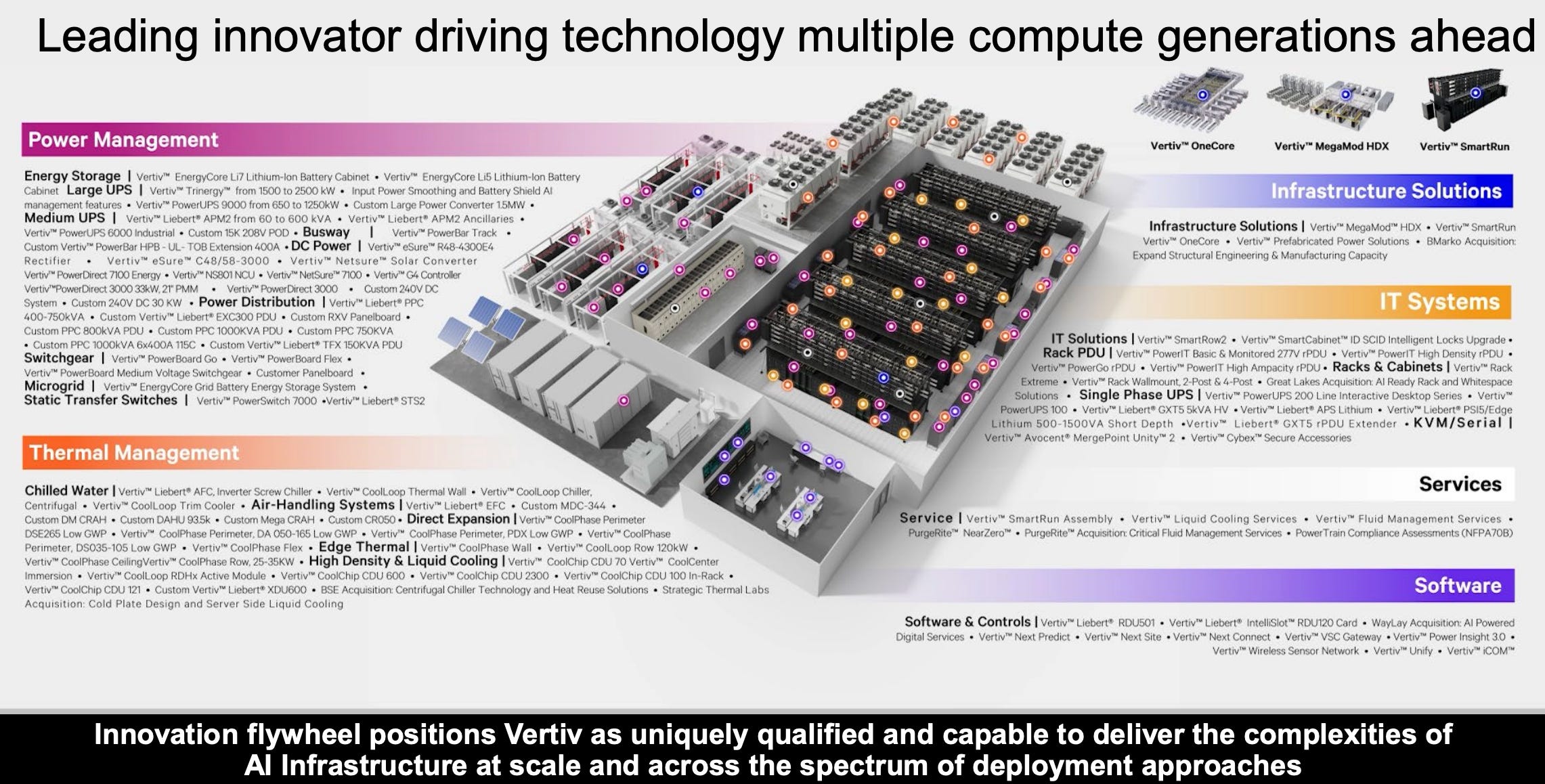
What distinguishes Vertiv from every other vendor in the data center physical infrastructure space is the vertical and horizontal breadth of its portfolio:
On the vertical axis, the company participates in every layer of the data center power and thermal chain, from the MV transformer at the utility entry down to the rack coolant manifold at the compute layer.
On the horizontal axis, the company combines electrical, thermal, IT, and services capabilities in a single design relationship with the end customer.
No other vendor offers this combination at Vertiv’s scale.
The competitive set fragments into three tiers:
The first tier is the power-only incumbents (many of which I have covered as part of my focus on the electrification megatrend): Schneider Electric, Eaton, ABB, Legrand, Siemens, and Hubbell. These companies have strong electrical capabilities but are structurally underpenetrated in thermal management, which has forced a recent wave of thermal M&A (as discussed previously).
The second tier is the thermal-only specialists: Johnson Controls, AAON, Stulz, Trane (Trane Technologies), Munters, Daikin, Carrier, and Modine. These are strong thermal companies but lack power management depth and do not have the integrated systems capability that hyperscalers increasingly demand. As the compute rack evolves and the boundary between power (DC distribution, sidecars, BBUs) and thermal (direct-to-chip liquid cooling, CDUs) blurs, thermal-only vendors are on the wrong side of the integration trend.
The third tier is the emerging electronic manufacturing services (EMS) competition: Flex (one which I wrote the most comprehensive deep dive available online and one of my favorite AI buildout pick), Jabil, and Foxconn. These players have scale in manufacturing and are cost-competitive in specific components or sub-assemblies, but they lack the portfolio breadth, the 60-year customer design relationships, the field service footprint, or the systems-level design capability that Vertiv has built. Management’s candid view is that Vertiv has lost competitive bids in the past (particularly on chillers in the US in the 2020-23 period when Vertiv was later to certain thermal products), that multi-sourcing is common, and that customers committed to buying programs during prior cycles. The competitive threat from EMS is real but contained by the depth of Vertiv’s portfolio.

The company’s strategic positioning is perhaps best summarized by a comment made recently by the management: Vertiv describes itself as “the tissue that connects the silicon to the facility.” The customer problem Vertiv solves is not “how do I cool a rack” or “how do I power a rack.” It is “how do I get from a 35kV grid connection to a 1,000kW Rubin Ultra compute board with zero downtime, zero failure modes I cannot predict, and a 12 to 18 month installation timeline that moves with Nvidia’s product cycle.” That problem requires someone who can co-design the entire infrastructure with the silicon vendor, commit to a roadmap 2-3 generations ahead, and service the installed base for decades. That is Vertiv’s positioning and it is the foundation of the +400bp of structural market outgrowth embedded in the new 2025-2030 framework..
A Brief History of Vertiv:
1965: Liebert Corporation founded in Columbus, Ohio. Invents the computer room air conditioner, the foundational product category that becomes data center thermal management. For the next twenty-two years Liebert operates as an independent specialist building mission-critical cooling for early mainframes and, later, enterprise server rooms.
1987: Emerson Electric acquires Liebert Corporation. Over the next decade, Emerson builds out the business by bolting on related power and thermal technologies, creating Emerson Network Power as a business unit focused on mission-critical power and cooling infrastructure.
2000: Emerson acquires ASCO and combines it with other power transfer switch businesses, consolidating the Emerson Network Power platform. The decade-plus of divestitures and adjacencies creates the integrated power, thermal, and services footprint that defines the business today.
2016: Private equity firm Platinum Equity acquires Emerson Network Power from Emerson Electric for approximately $4bn. The business is rebranded as Vertiv Holdings. Platinum invests in operational improvement, commercial sharpening, and global footprint optimization during a difficult four-year stewardship period that includes the pre-AI data center downcycle.
February 2020: Vertiv becomes a publicly listed company on the NYSE under ticker VRT through a merger with Goldman Sachs-sponsored SPAC GS Acquisition Holdings (GSAH), which was chaired by former Honeywell CEO Dave Cote. Cote transitions to become Executive Chairman of Vertiv, a role he still holds today. Initial trading valuation of approximately $5bn.
2020 to 2022: The business executes through the COVID-era supply chain disruption, the hyperscaler capex pullback of early 2022, and the initial emergence of generative AI as a demand catalyst. Revenue grows from $4.4bn in 2019 to $5.7bn in 2022. Pricing discipline lags, management acknowledges pricing was “not priced correctly” through 2022 and became a tailwind starting in 2023.
January 2023: Giordano Albertazzi, a Vertiv insider since 1998 who previously led EMEA and the Americas business, is named CEO. Albertazzi initiates a fundamental operational transformation: sharpening focus on pricing, operational excellence, backlog quality, and the emerging AI data center opportunity. CFO David Fallon joins the same year. The Emerson Operating System is installed more rigorously across the business under Albertazzi and the Cote-led board.
November 2023: First post-AI investor day. Management sets 2023-28 revenue CAGR target of 8-11% and adjusted OP margin target of 18-20% by 2028. Targets viewed as credible but conservative.
November 2024: Second investor day. Revenue CAGR target upgraded to 12-14% for 2024-29 (which it is already blowing past), adjusted OP margin target upgraded to 25% by 2029, FCF conversion target raised to 95-100% by 2029. The company is beginning to signal that the AI opportunity is materially larger than initially modeled.
October 2024: Launch of the initial liquid cooling CDU portfolio following internal investment and design collaboration with Nvidia. Management discloses that Vertiv has built internal testing labs and brings in customers to build racks together, an unusual level of co-development access.
October 2025: Vertiv announces its 800V DC portfolio will be commercially available in 2H 2026, aligned with Nvidia’s Rubin Ultra platform (scheduled for 2H 2027 release). The announcement validates Vertiv’s co-design partnership with Nvidia and its ability to track Nvidia’s roadmap on the power side.
December 2025: Acquisition of PurgeRite expands the services footprint in fluid management and liquid cooling maintenance. Multiple hyperscaler contract wins disclosed.
February 2026: Q4 25 results deliver a blowout. Revenue $2.88bn (+37% reported, +19% organic), adjusted EPS $1.36 (+32% organic growth), backlog $15.0bn (+109% year-over-year on $8.3bn as of 3Q25, with Q4 alone seeing $3.8bn of fresh orders), and FY26 revenue guidance initiated at $13.25-13.75bn. Stock rallies 24% on the print.
April 2026: Q1 26 results were again very impressive (reported April 23rd). Revenue $2.65bn (+30% reported, +25% organic), adjusted EPS $1.17 vs $1.01 consensus, Americas revenue +53% year-over-year with operating margin 27.0%. Management raises FY26 organic revenue growth guide to 34% ($13.5-14bn) and adjusted EPS to $6.30-6.40. Deferred revenue signals imply $6.5-8bn of orders in the quarter. Stock hits $305.
May 19-20, 2026: Third investor day at the Greenville, South Carolina infrastructure solutions facility. Management raises 2025-2030 organic revenue CAGR target to 20-22% (from 12-14%), 2030 adjusted operating margin target to 27%+ (from 25% by 2029), TAM to $75bn (from $62bn), content per MW to $3.25-3.75m (from $2.75-3.5m), and capital deployment capacity to $28bn through 2030 (from $16bn). Strategic Thermal Labs and BMarko Structures acquisitions added.
