
Token Economics: The Master Variable
The two curves that decide whether the AI supercycle can pay for itself, where the value accrues as intelligence commoditizes, and the signposts that tell you which case is winning

The question I have been circling
Every major piece I have published on this supercycle has been, in one way or another, a piece on the supply-side of the AI revolution.
The semiconductor primer mapped the chips
The equipment primer mapped the machines
The memory singularity mapped the most operationally levered claim on the buildout
The electrification work mapped the power
The Nvidia, Broadcom, ASML, TSMC and dozens of other AI company deep dives mapped the companies collecting the tolls on all of it.
The Great AI Reckoning then asked the question that sits underneath every one of those pieces, whether the AI trade can pay for itself, and deliberately left the question unanswered
The toll-booths piece argued that ASML and TSMC are where you wait while that question resolves, because their cash flows are the least speculative in the complex.


The last two deep dives ended with the same conclusion and promise, that the resolution to the AI monetization question runs through token economics, the master variable of the AI revolution.
A token is the unit of AI output, roughly three quarters of a word, and it is the atom of this entire economy.
This whole AI supercycle and revolution rests on this one question. The $250bn wafer fab equipment boom, the memory shortage, the trillion dollars of hyperscaler capex now visible on forward guidance, the gigawatts of contracted power, all of it clears through one question, what it costs to produce a token of intelligence and what someone will pay for the intelligence that token represents. Everything upstream, from the GPUs to the power, semicap monopolies, memory singularity and HBM ramp, rest on a single condition being true, that intelligence produced at scale can eventually be sold for more than it costs to produce.
The thesis of this piece in one sentence: the token is commoditizing and the AI trade can still pay for itself, because what services the capex is not the price of a token but the dollar pool of tokens, price times volume, and that pool is a race the volume side is currently winning, which relocates the value away from anyone selling undifferentiated tokens and toward the two ends of the stack that are paid on volume or on differentiation, the toll booths beneath and the frontier and application layers above.
Twice a week, I will release deep dives into stocks and sectors that fit into the 6 themes that I see winning in the coming years and decades: AI & Technology, Electrification & Energy, Reshoring & Sovereignty, Healthcare & Longevity, China & Asia, Resilience & Quality.
Take advantage of this once in a generation opportunity to build long term wealth by investing in great stocks that will deliver returns for your portfolio for years to come.
Table of content
The framework: two curves and a spread
The divergence: there is no such thing as the token price
Kimi K3: the whole thesis in one launch
Jevons versus commoditization
Where the value accrues if tokens commoditize
The capex arithmetic: can tokens service the AI capex
The biggest risks for token economics
What I am watching
Where this leaves the AI trade
The framework: two curves and a spread
Strip everything away and the economics of the entire AI supercycle reduce to two curves and the gap between them.
The first is the cost curve, what it costs to produce a token.
Its drivers are silicon, model efficiency and utilization, and it is collapsing on a per-unit basis at a rate faster than almost any technology in history.
Nvidia’s old generation, the H200-class system, produced a million tokens for $4.00 as a baseline and around $1.56 when tuned for throughput.
The current rack-scale generation produces the same million tokens for $0.10 to $0.50 depending on the demands of the workload, an incredible reduction in cost of up to 35x.
Vera Rubin, ramping from the third quarter of this year (as I have written about in my recent piece about AI compute), could deliver a further cost cut of 10x.
These are the hardware numbers, but we know through the rental market that the realized costs are higher, with current-generation GPUs renting at an average of $5.33 an hour and as much as $8.50 on demand.
My conclusion: The production floor for a token is heading toward pennies.

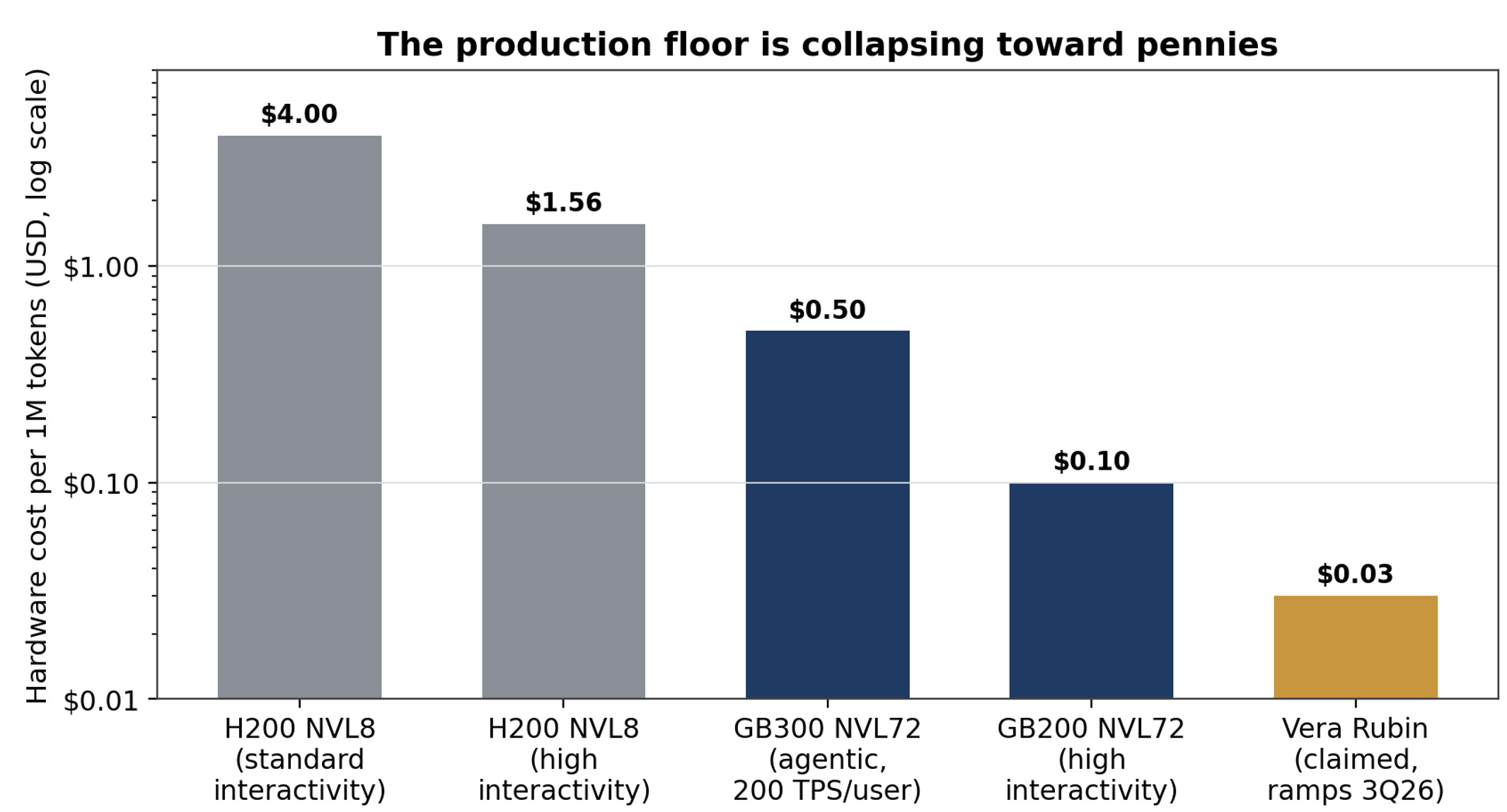
Hardware-level cost per million tokens by platform generation, at stated interactivity levels. Vendor benchmark data. Rental market rates imply a higher realized floor, but the same slope.
But it would be too simplistic to think that collapsing token costs are an inevitability. A few trends have been pushing in the other direction:
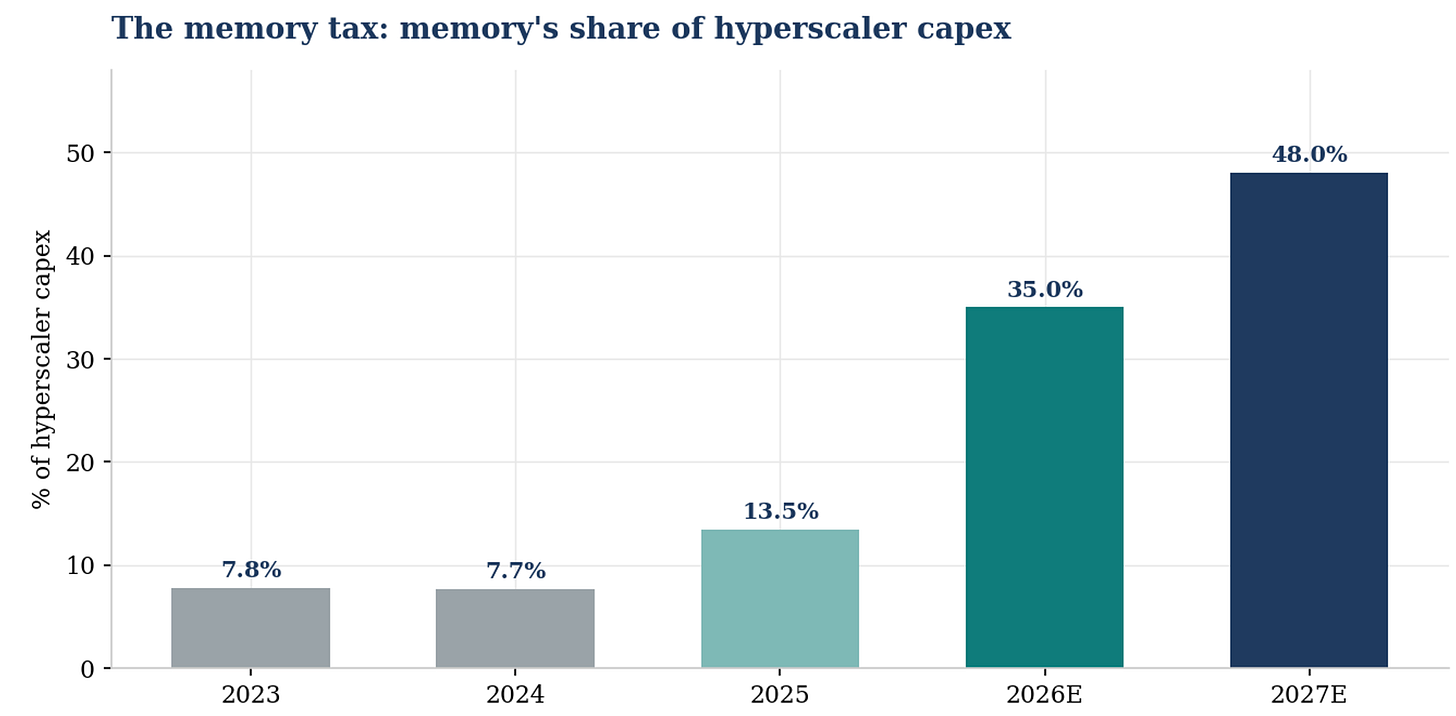
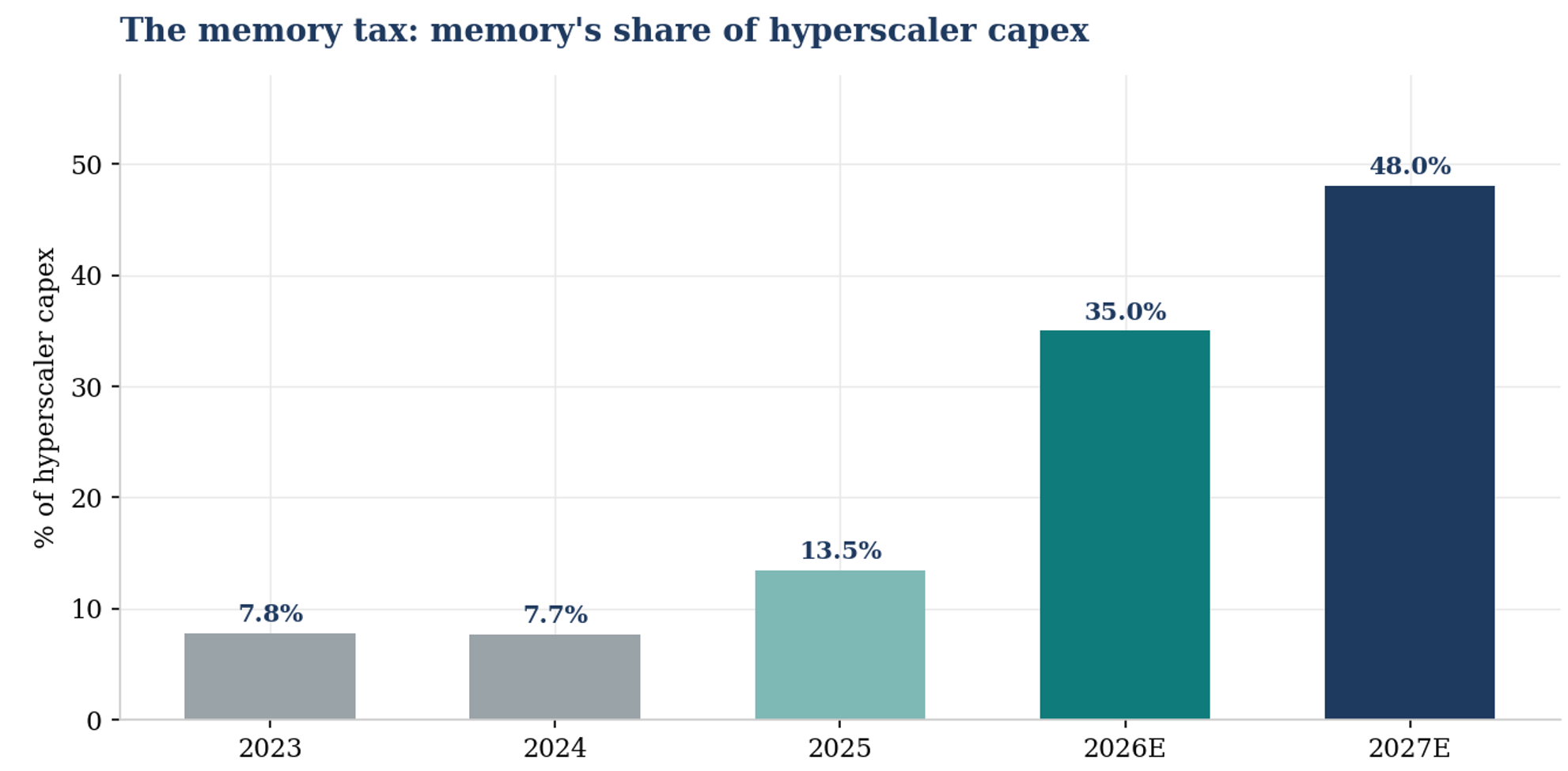
The first is the memory tax that I wrote about in my recent memory singularity primer. HBM content per accelerator is climbing fast, from 141GB toward roughly 1TB on the next flagship, with memory heading toward half of hyperscaler capex by 2027, a cost that is then reflected directly in the price of every token the data center produces.
The second is the reasoning tax. The highest-intelligence models use dramatically more tokens per answer through test-time compute, and a single agentic job now runs around 96,000 tokens before it returns an answer where a 2023 chat turn was a few hundred. This is something you have likely noticed if you have used the recent models from the leading AI models, with limits being quickly reached, even on paid tiers.
The third is power, the binding physical constraint of this AI buildout I have covered since my electricity primer (Electricity is the New Oil). As a reminder, dozens of GW of AI data centers are being built every year, contributing to more than half of the load growth and pushing electricity prices up everywhere. I will continue to cover the electrification and power value chain going forward, with my next piece likely to be on the companies powering the AI data centers.
What this means is that the token cost curve is really two curves, the cost per token, which is collapsing, and the cost per completed task at the frontier, which falls far more slowly because the token count per task is exploding.
The second is the price curve, what a buyer will pay for the intelligence a token represents.
Its drivers are the value of the task being performed, the intensity of competition at that capability level, and the availability of substitutes, including the buyer’s option to route the work to a cheaper model.
The data here is hard to overstate.
Independent research from Epoch finds that the price required to reach a fixed capability level has fallen between 9x and 900x per year depending on the task, just re-read these numbers, artificial intelligence is becoming cheap.
GPT-4-level capability that cost around $30 per million tokens in early 2023 sells for under a dollar today.
On the price curve, yesterday’s frontier will by definition become tomorrow’s commodity.
A useful framework to have is that the difference between the two curves is the gross margin of the AI industry, and the fight over that spread is the AI trade.
Below the model layer, so the AI infrastructure (compute, power, semis, equipement), everyone is paid out of the cost curve, meaning paid on volume regardless of the price the intelligence sells for.
The AI model layer and above must pay themselves from the spread between the two curves we talked about.
This means that when you own Nvidia, TSMC or ASML, you are long the volume of AI tokens.
When you own a lab (like OpenAI or Anthropic) or an AI application (like Cursor), you are long the AI spread itself.
In my view, understanding how different those two exposures are will put you way ahead of many investors.
The divergence: there is no such thing as the token price
In my AI Reckoning piece, I argued that commodity intelligence was collapsing in price while frontier intelligence was rising rapidly.
Anthropic maintained the price of its flagship Opus 4.8 model at $5 and $25 per million input and output tokens but most importantly, surprised the market with the price of its newest frontier model (Fable 5), twice as expensive as Opus, at $10 and $50.
OpenAI doubled its flagship API price.
But it’s not just about the model price. The true price of intelligence is dollars per completed task, and measured that way, the frontier has been repricing upward while the commodity tier collapses.
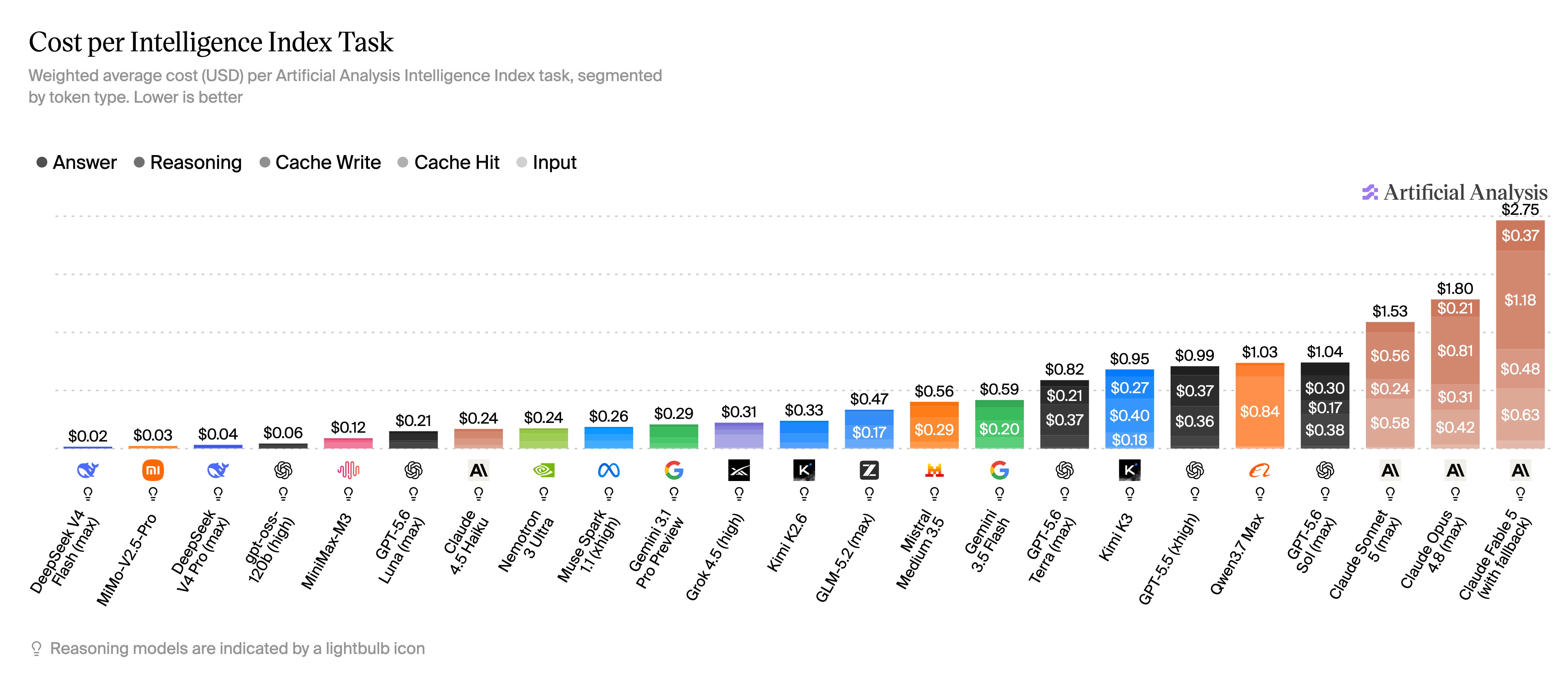
Cost per Intelligence Index Task, per Artificial Analysis as of 21st of July 2026.
You can see both curves at once in the consumption data:
The Silicon Data LLM Token Expenditure Index, a token expenditure index that tracks the blended cost of actually consumed paid traffic is up over 60% since December, including 23% in the second quarter. How is that possible? Because paid traffic is mostly frontier and agentic workloads whose effective price is rising as we have seen.
So why is it irrelevant to look at blended averages? Because at the same time as token expenditure is rising, the price of a fixed level of capability has collapsed.
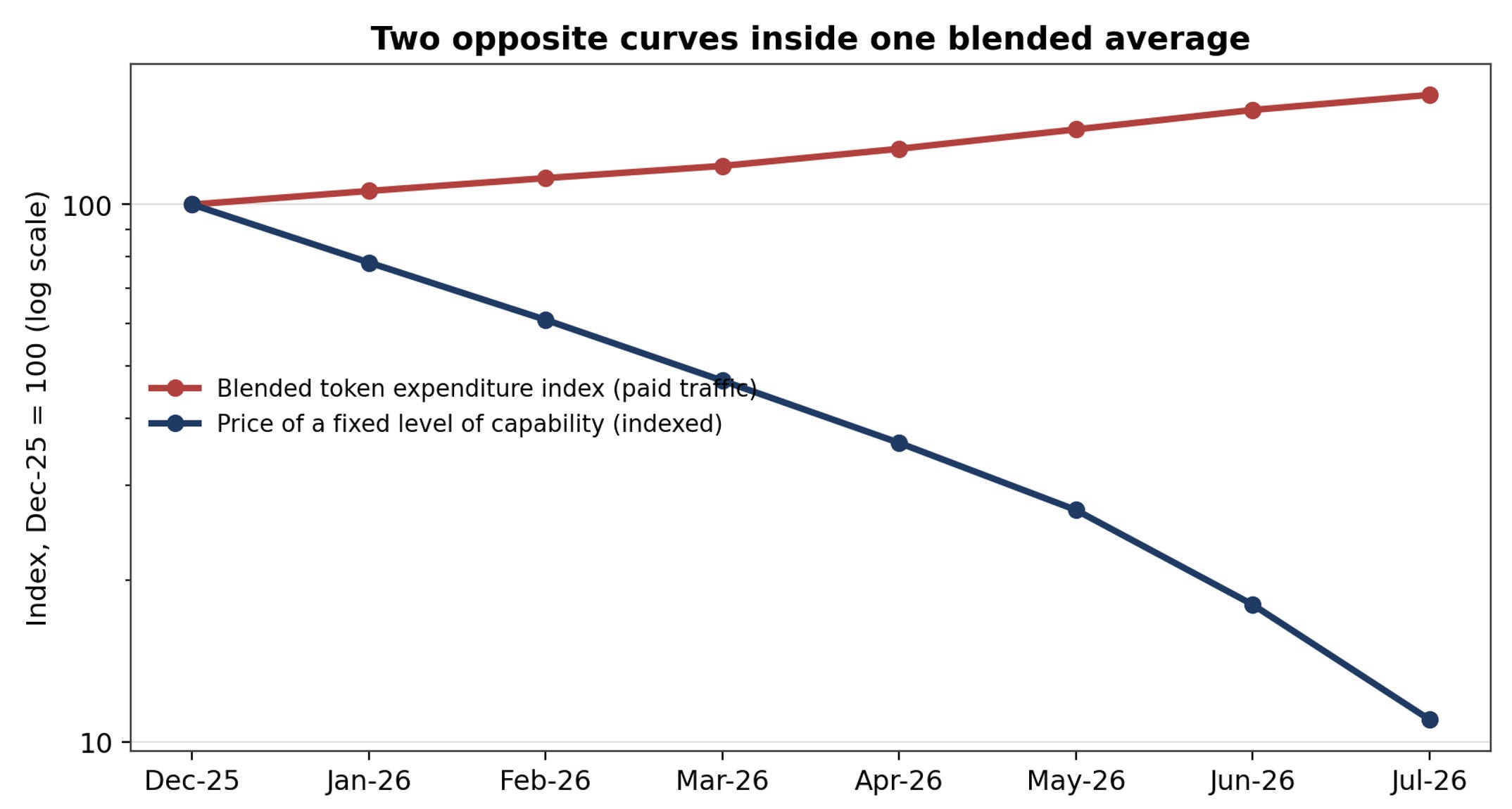
Two opposite curves inside one blended average. The expenditure index reflects what buyers actually pay across the paid traffic mix. The capability price line reflects the falling cost of a fixed level of intelligence. Illustrative monthly paths anchored to reported endpoints.
This bifurcation has evolved very rapidly in the last weeks:
Between the 8th and 16th of July, four frontier models launched in eight days, Grok 4.5, GPT-5.6, Muse Spark 1.1 and Kimi K3. Six labs now field a model above 50 on the Artificial Analysis Intelligence Index, up from two in early June, and the leader’s margin narrowed from four points to one.
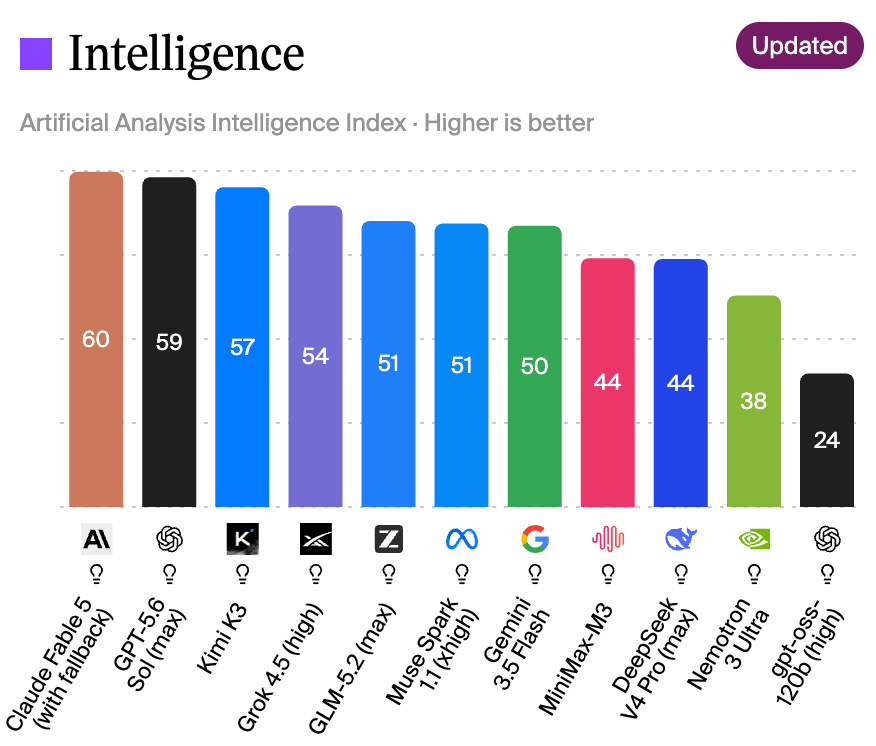
Intelligence comparison, per Artificial Analysis as of 21st of July 2026.
The cost ladder underneath is the part that should surprise you:
The leading model (Claude Fable 5) runs the full benchmark suite at $2.75 per task.
The second-ranked model (GPT-5.6 Sol) delivers one point less for $1.04.
Kimi K3, a Chinese open-weight model, delivers three points less for $0.95 on $3 and $15 per million token pricing.
Three more points down costs $0.31, and 51-point intelligence, frontier-class by any standard of six months ago, now costs $0.21 to $0.32 per task.
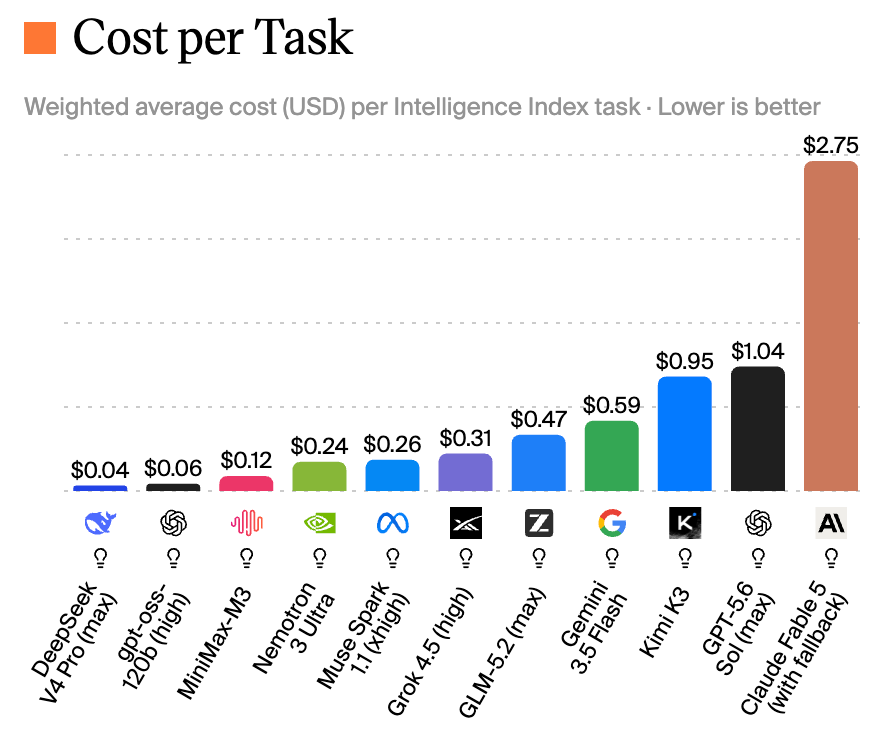
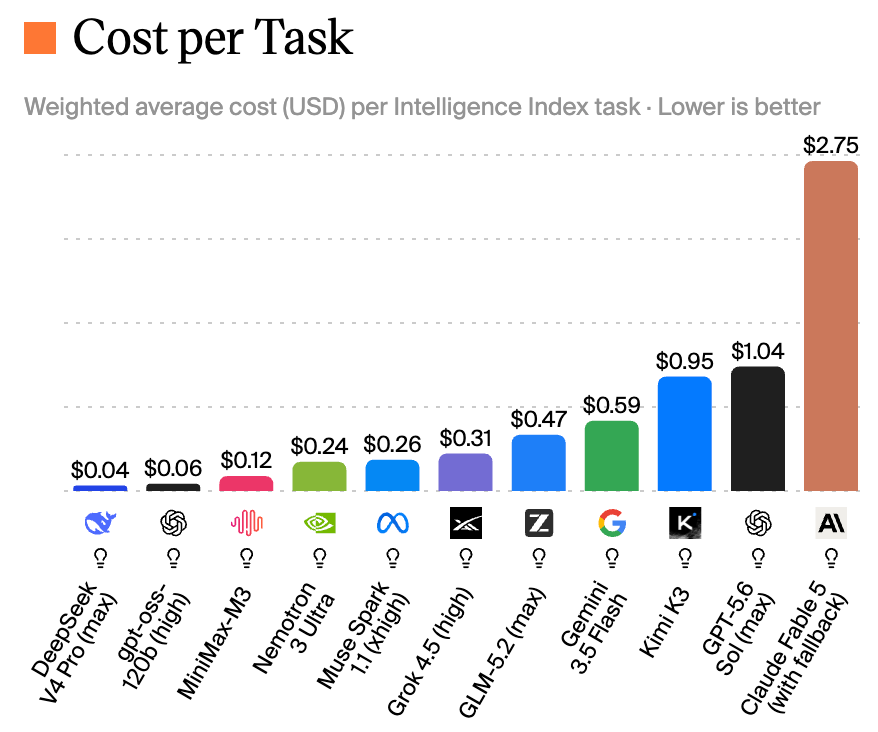
Cost per task comparison, per Artificial Analysis as of 21st of July 2026.
In the benchmark provider’s own words, near-frontier intelligence got two to three times cheaper in eight days.
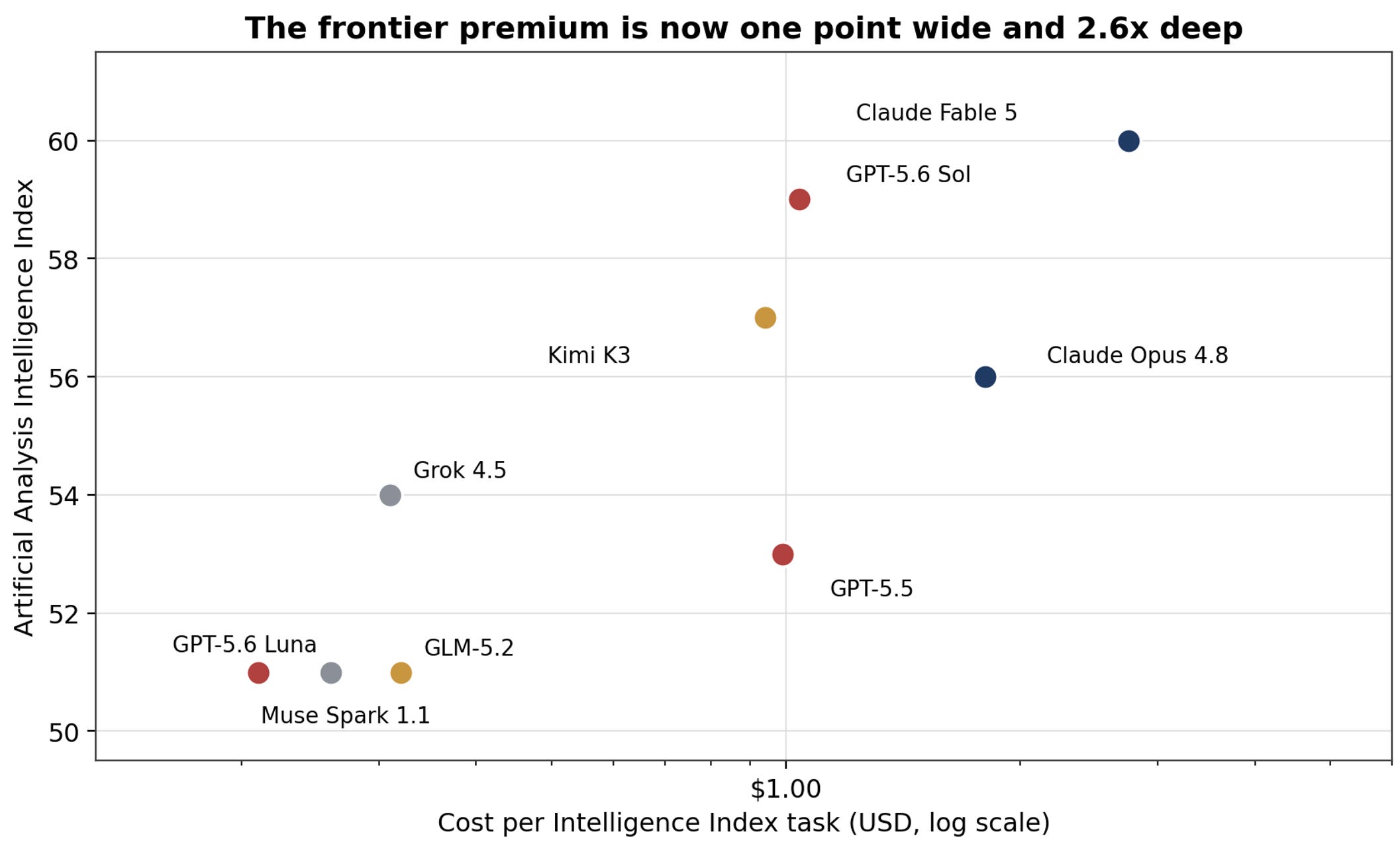
Intelligence versus cost per task across the current frontier, per Artificial Analysis as of the 21st of July 2026. Six labs above 50, four of them arriving since the 8th of July.
This confirms my Reckoning claims (commodity intelligence collapsing in price while frontier intelligence firming in price), but the second claim needs sharpening:
Frontier prices firmed, and the firming was immediately contested. The frontier premium is now approximately one point of measured intelligence wide and roughly 2.6x deep against the nearest challenger, stretching to more than 13x against the 51-point tier.
The half-life of frontier differentiation, the time it takes for a capability lead to be matched at a fraction of the price, has compressed to something like six weeks.
The pricing power question for the model layer is therefore very precise, can you hold a large multiple on a one-point lead, and I will answer it in the section on value accrual, because that answer is where the equity value of the entire model layer lives.
The other axis of the divergence is geographic:
Chinese open-weight models are priced at roughly 14% of US models on average, and their share of tokens routed through the main aggregation layer went from under 2% to 48% in twelve months while the US labs’ combined share fell from above 70% to around 20%.
The aggregator’s own research notes that small models are the ones most often self-hosted and therefore invisible to it, which means the real migration is further along than even these numbers show.
The commodity tier of the intelligence market has already moved to the low-cost producer, exactly as it did in solar or in batteries, and it happened in four quarters.
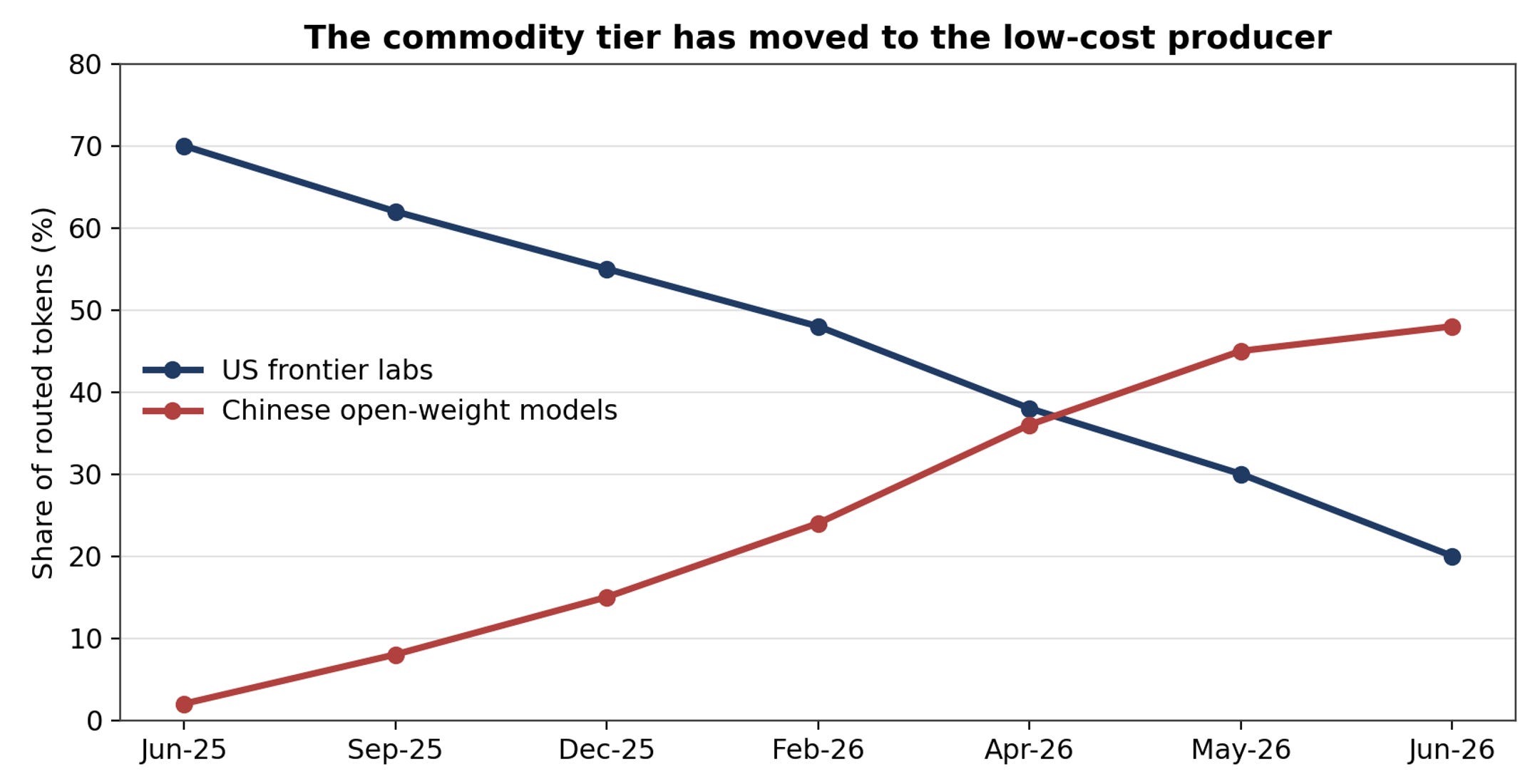
Share of routed tokens by origin, per OpenRouter data. Chinese open-weight models captured nearly all of the incremental growth over the past year. Interpolated monthly path between reported readings.
Kimi K3: the whole thesis in one launch
If you want the entire framework compressed into a single release, it arrived on the 16th of July:
Moonshot AI’s Kimi K3 is a 2.8 trillion parameter open-weight mixture-of-experts model with a million-token context window, the largest open-weight release in history, with the full weights file promised for public download by the 27th of July.
Within a day of launch it debuted at third on the Artificial Analysis Intelligence Index at 57, behind only the two US flagships, took the top spot on the Frontend Code Arena leaderboard above every Western flagship, and posted first or second place finishes across the agentic benchmarks that map to real work, terminal use, program synthesis, browsing and long-horizon knowledge tasks.
The six-week half-life of frontier differentiation I described above is, on this evidence, generous. K3 went from release to the podium in a day.
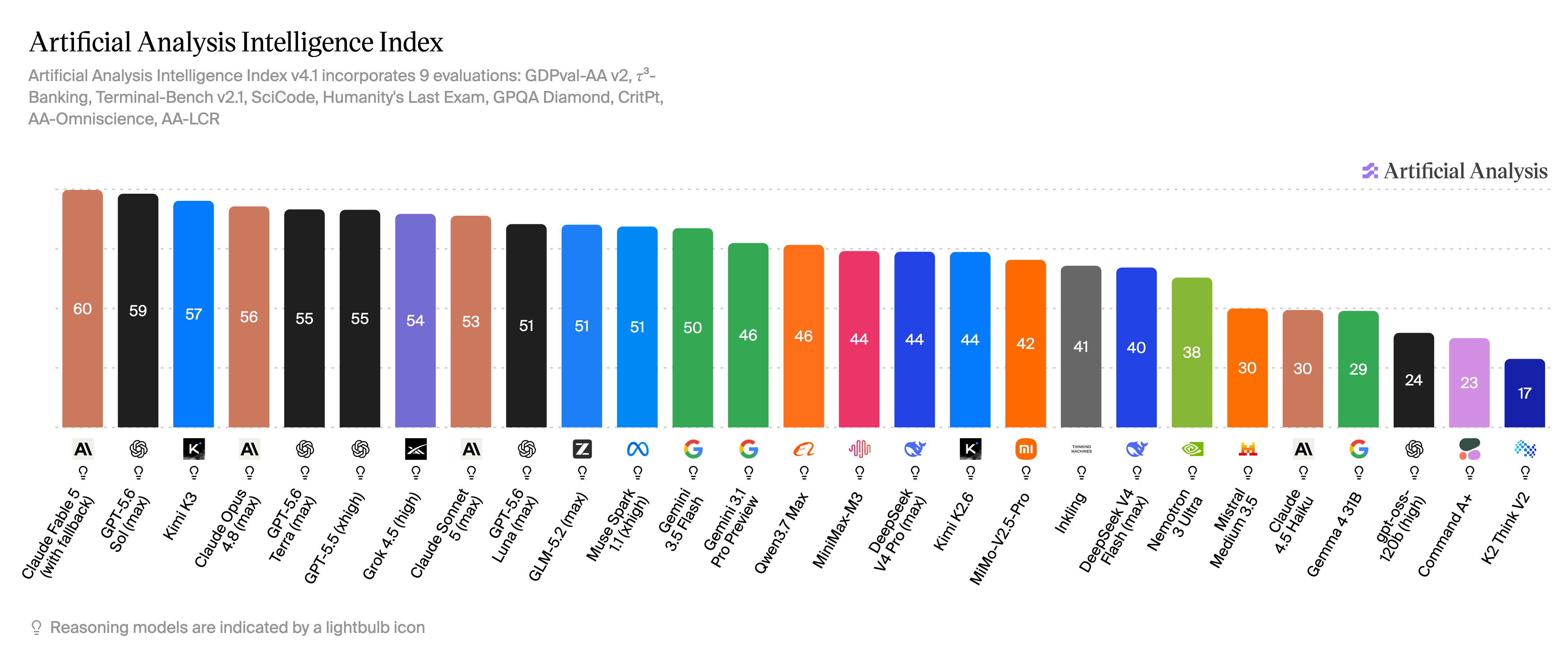
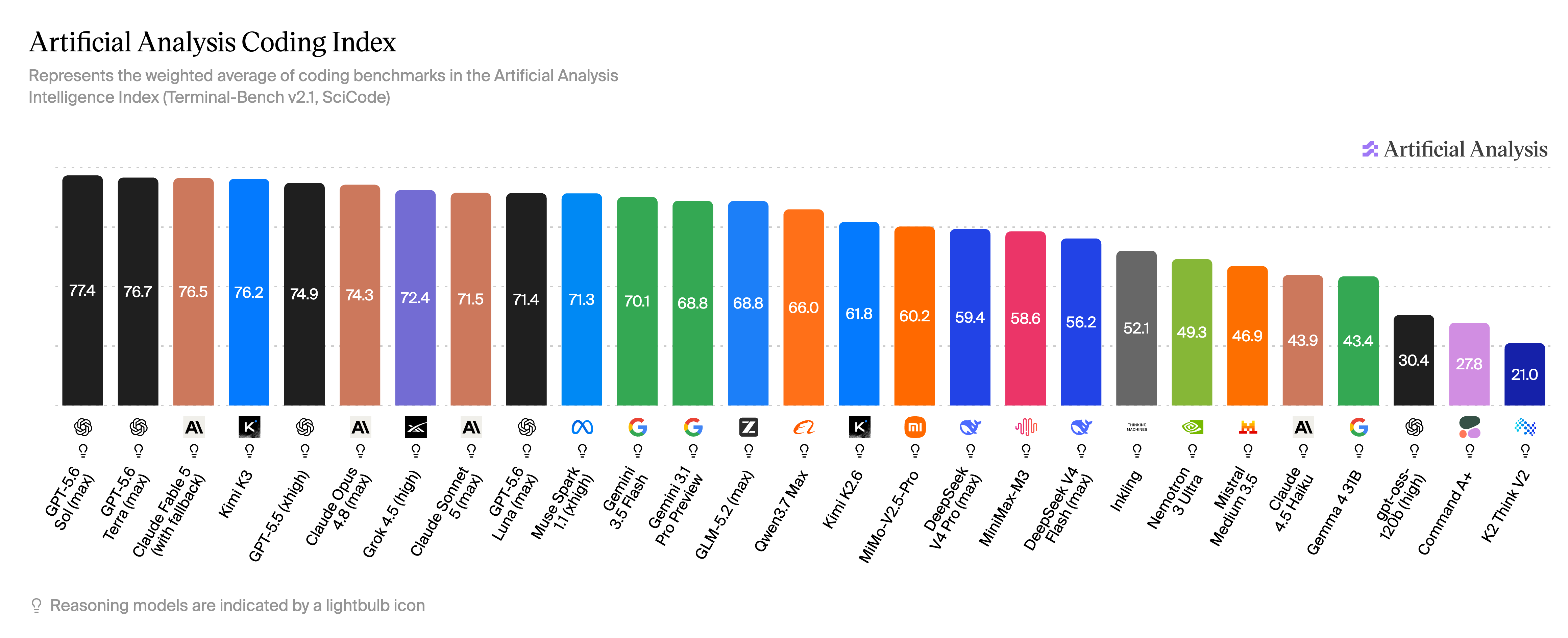
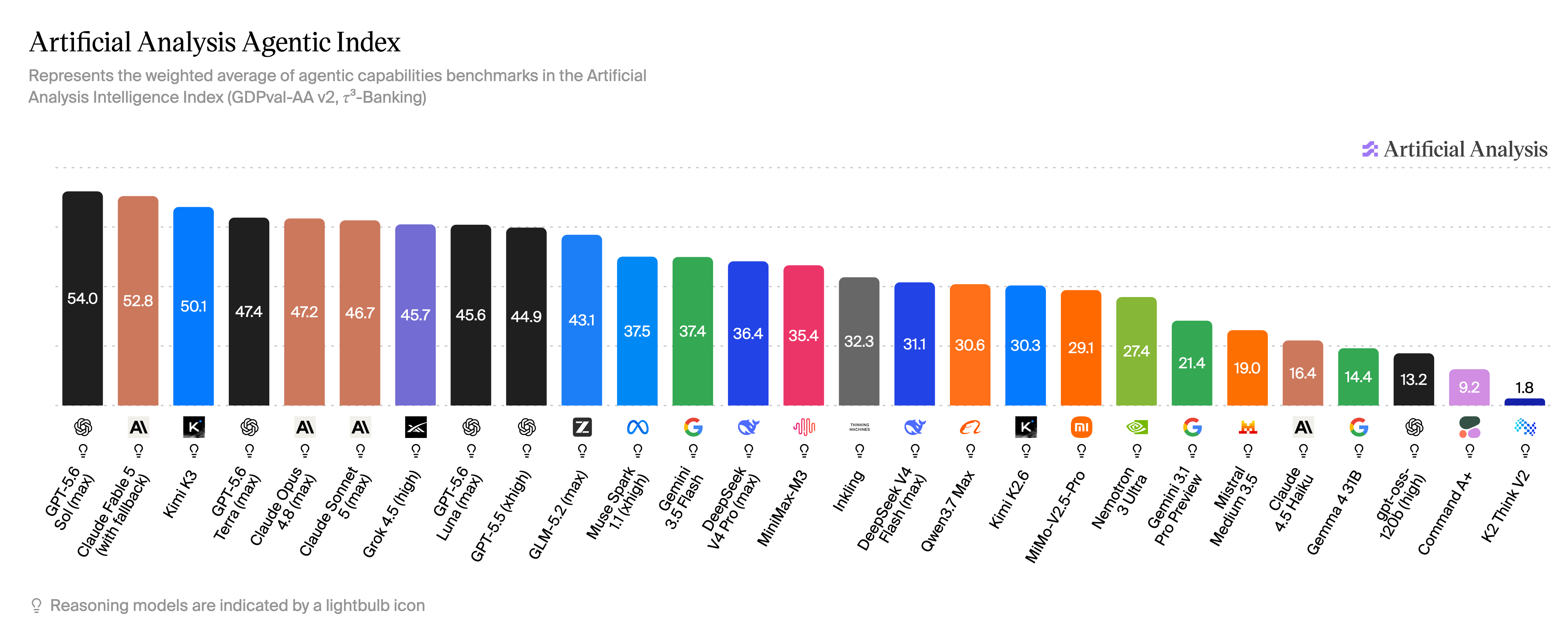
Kimi K3 (in blue) is at the frontier, per Artificial Analysis, as of the 21st of July 2026
But what I think is most interesting is not the benchmark but the price:
K3 launched at $3 and $15 per million input and output tokens, a 223% increase over its previous model, and the first significant price increase from a Chinese AI lab. This price increase is linked to rising hardware and operating costs, exactly the same that have affected Western models, like the memory tax.
That positions K3 on part with Western near-frontier models and above several others, Grok 4.5 at $2 and $6, GPT-5.6 Luna at $1 and $6, Muse Spark 1.1 at $1.25 and $4.25.
What does that tell us about the usual investor fears that Chinese models are equally powerful and cheaper and would therefore force price compression on the Western frontier?
K3 is equally powerful and priced in line with US AI models.
In my view, this kills the geographical argument that Chinese models are inherently cheaper and will undercut US ones.
The cost advantage that drove the market share gains for Chinese models above is narrowing as Chinese hardware and power costs rise.
The real bifurcation in AI models is the differentiation. The most competitive segment are logically around the cheapest Chinese models costing between $0.02 to $0.12. At the frontier, differentiation is being priced aggressively as we see with Claude which has the most expensive models but also dominates the token spend for most tasks.
This divergence is already having dramatic consequences in the market:
Inside China, Zhipu’s share price (a Chinese AI lab, which so far had the most powerful Chinese model GLM-5.2 and is now number 10 in the Artificial Analysis Intelligence ranking) fell 30% on the first day of Kimi K3 and is down 50% since its highs. This clearly proves my point that intelligence being commoditized will have as much of an impact on Chinese labs as on US ones.
At the political level, Beijing used the WAIC (World AI Conference) opening in Shanghai to be more vocal about its preference and support for open weight AI models, so you should not expect the release cadence of Chinese models to slow down.
At the AI infrastructure level, serving bigger and more powerful models makes the KV cache an important cost center and pushes cache offloading into the storage hierarchy, which is a direct read-across to the memory singularity thesis, the tax shows up wherever the tokens are produced. This further strengthens my conviction in the memory singularity thesis which I developed in my memory primer.
The weights of the Kimi K3 model will be released on the 27th of July. We will then see whether Western companies will actually run an open-weight Chinese frontier model at Western prices.
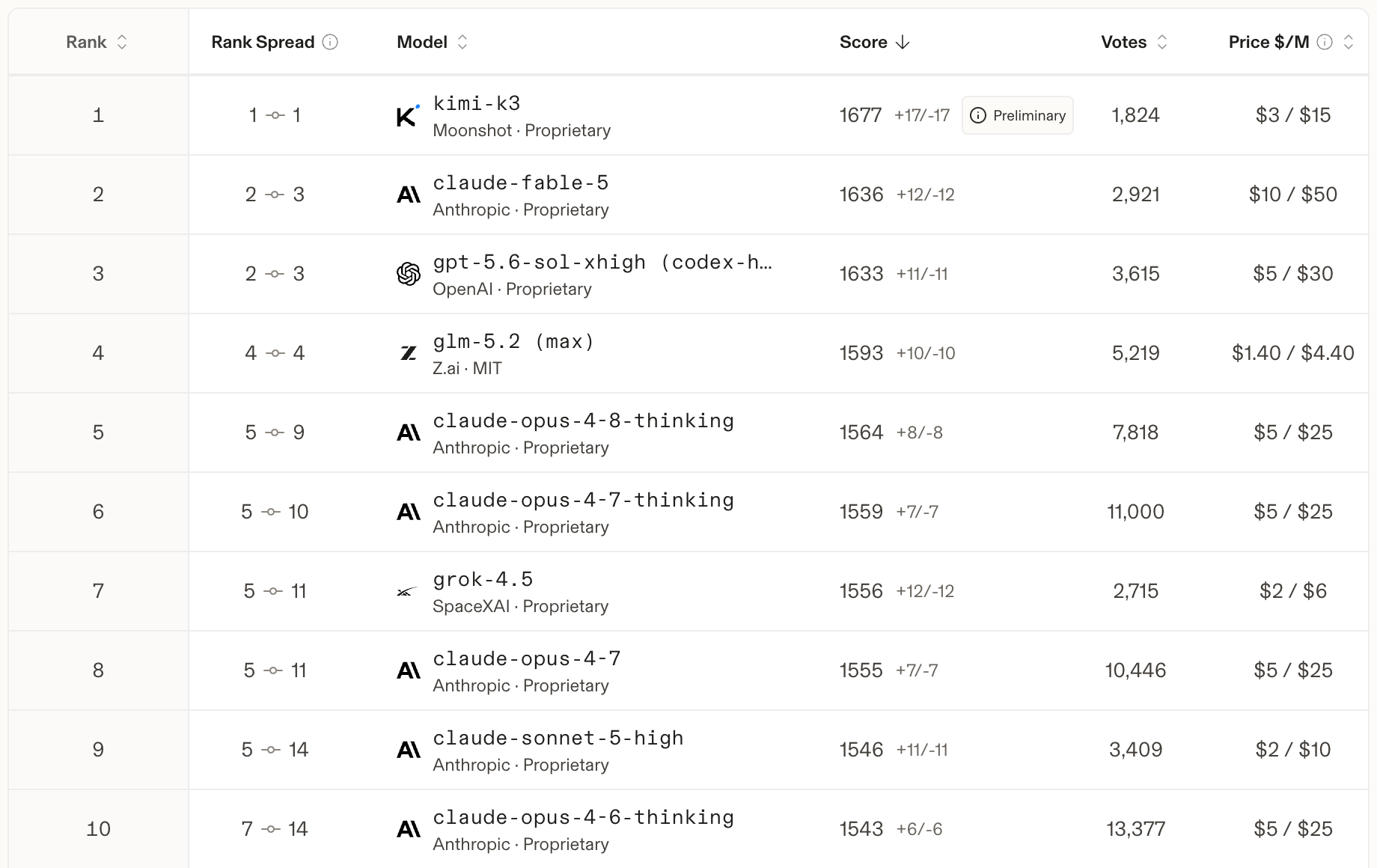
Frontend Code Arena leaderboard from Arena.ai showing Kimi K3 ranked first at 1,679 above Claude Fable 5 and GPT-5.6 Sol, 21st of July 2026.
Jevons versus commoditization
Here is the central tension of the whole trade, in my view:
The famous Jevons argument tells us that falling token prices expand the addressable market because of accelerated adoption. Cheaper intelligence unlocks possibilities and workstreams that were unavailable previously. Capex is therefore building capacity for demand that lower prices themselves will create, just as cheaper coal, cheaper compute and cheaper bandwidth each produced more total spending on coal, compute and bandwidth.
The commoditization argument tells us that the arms race is funding an output whose price is collapsing toward its marginal cost of production, that routing and open weights strip the pricing power from anyone selling tokens. If you ascribe to that view, the trillions of dollars of capex currently being spent are chasing a margin that will no longer exist by the time depreciation arrives.
What may surprise you is that I don’t view them as opposing views but as the two sides of the same phenomenon:
The falling token price that triggers that accelerates adoption of AI is what is causing the commoditization of AI sellers. Both are happening at once.
The real question is what happens to the aggregate dollar pool, price times volume, as the price falls, and that is an elasticity question.
Start with volume, because the scale of it is the most under-appreciated fact in the entire debate:
Google disclosed that it processed over 3.2 quadrillion tokens in May, up roughly sevenfold from 480 trillion a year earlier.
OpenRouter (the main routing platform) has seen a 15x increase in the number of tokens routed per week over twelve months (from 2.4 trillion to 36 trillion).
Harvey (an AI law company) also massively accelerated its AI use this year, taking its AI consumption from one trillion tokens in January to 12-13 trillion by May.
All of this highlights just how quickly AI is being adopted across the world.
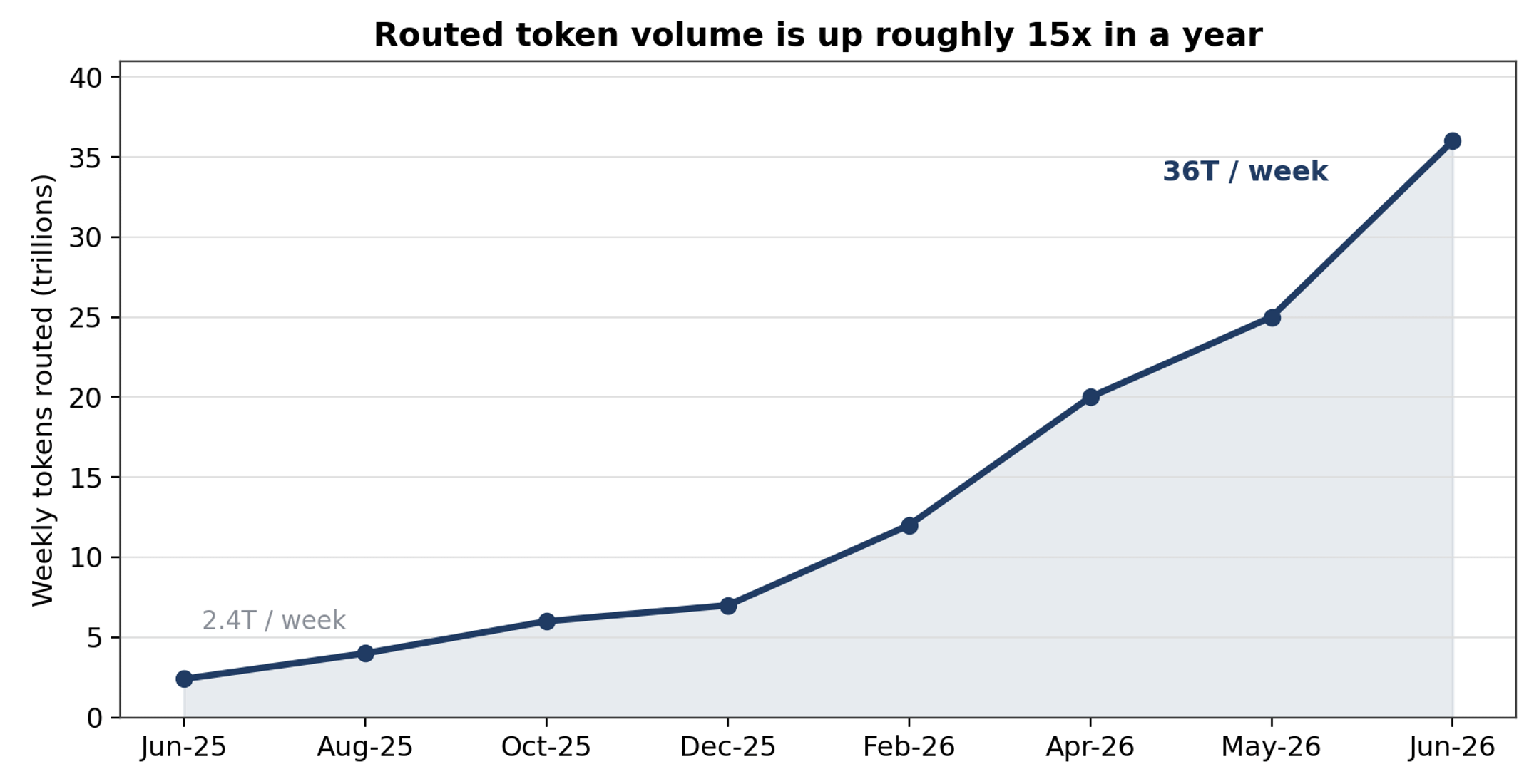
Weekly tokens routed through OpenRouter, approximately 15x in twelve months. Monthly path approximated between reported readings. Self-hosted volume is additive and invisible to any aggregator.
And something that you may not be surprised to read is that AI consumption is elastic:
On the 23rd of May, DeepSeek, the leading Chinese lab, permanently cut its flagship API price (on its DeepSeek V4-Pro model) by 75% to roughly $0.44 per million input tokens. It was followed a few days later by Xiaomi with a 99% cut to its own model, MiMo V2.5.
The data on OpenRouter shows that both of those models then saw a very strong increase in usage, becoming the fastest rising models globally.
This to me signals demand expansion.
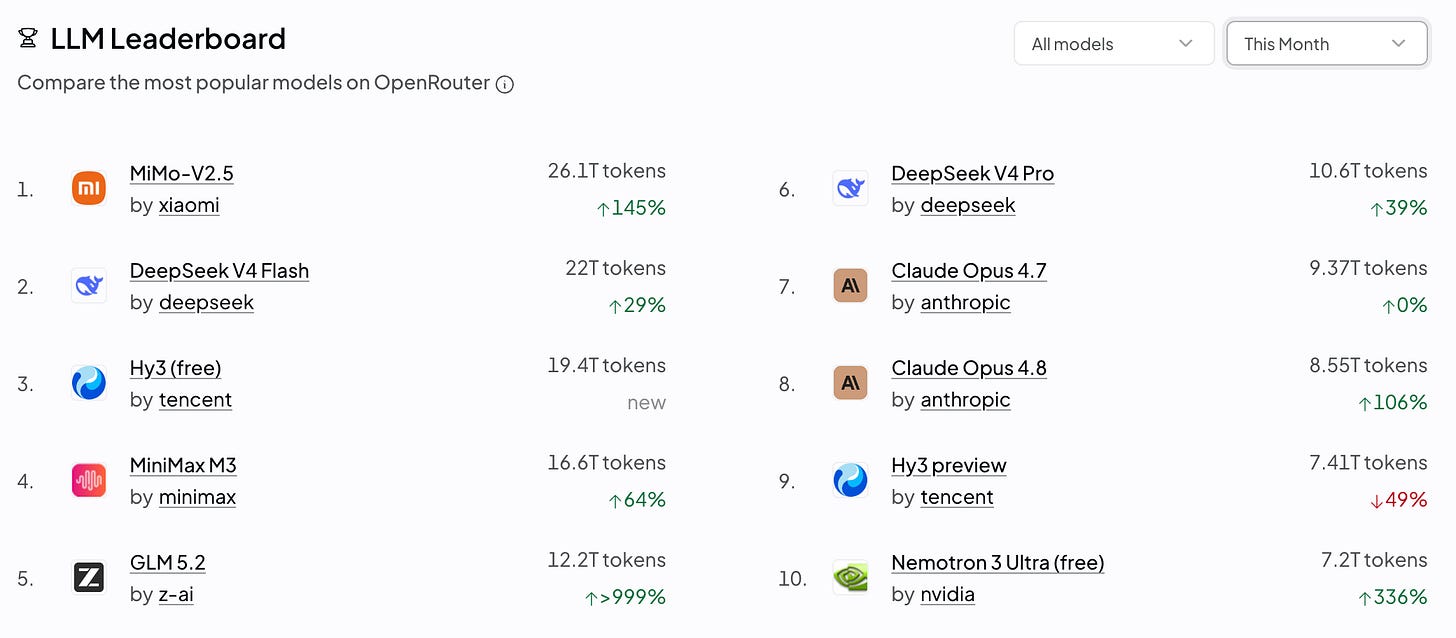
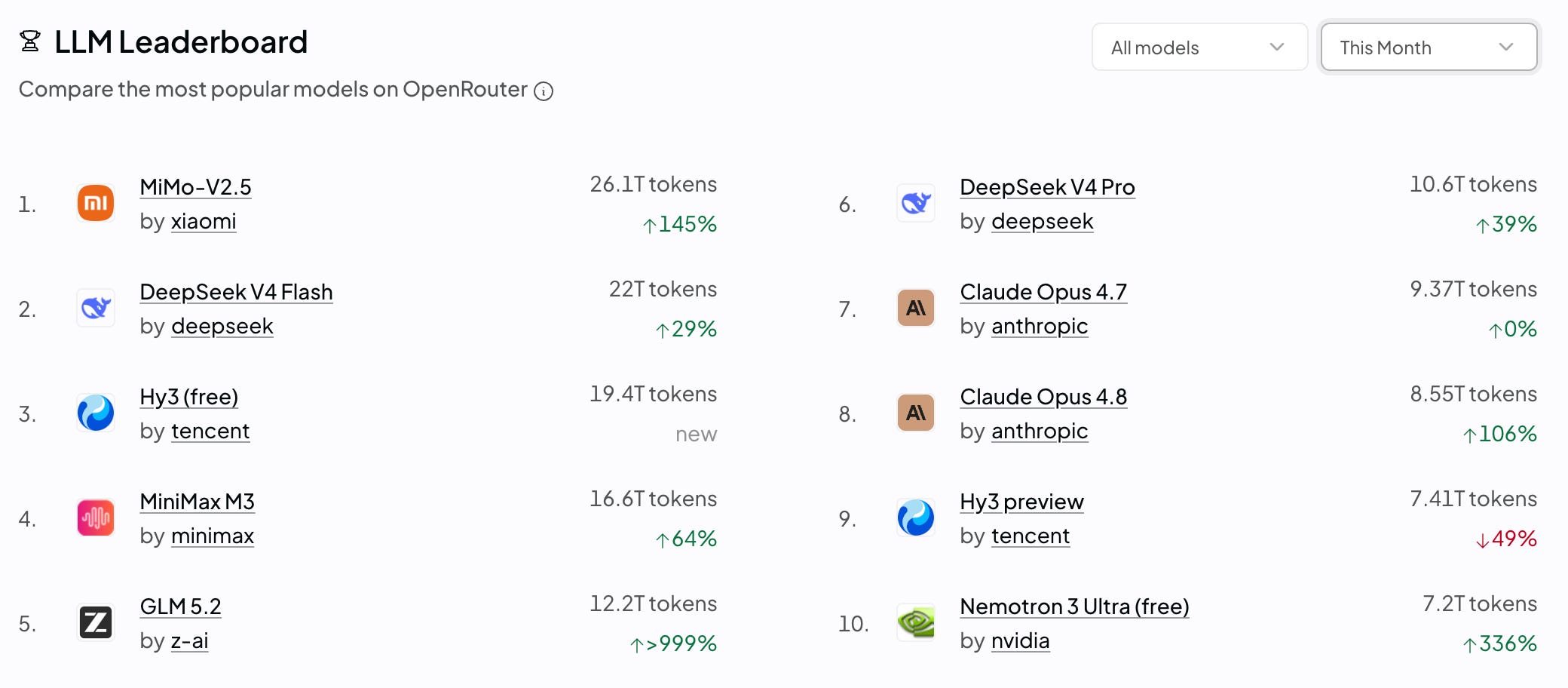
Change in popularity of LLM models on OpenRouter over the last month as of 21st of July 2026.
At the same time as this broad AI adoption wave, we have seen a fundamental shift in how enterprise approach AI usage.
We are shifting from tokenmaxxing to token optimization.
Everything that we have seen in the market recently points to some form of token optimization being put in place in the biggest corporations in the world:
Uber used up its full annual AI coding budget by April and decided to cap the AI usage to $1,500 per engineer per month.
Microsoft canceled most internal seats of Anthropic’s Claude Code roughly six months after rollout.
Coinbase cut its AI bill roughly in half without limiting its employees, thanks to routing and by lifting cache hit rates from 5% to 60%.
Tesla limited third-party AI tools to $200 per employee per week.
Two of the largest internet companies, Meta & Amazon, retired the internal consumption leaderboards they built during the tokenmaxxing era, one of them explicitly telling staff not to use AI for the sake of using AI.
This shows the industry is maturing and companies are learning how best to use AI. It doesn’t mean AI will be used less.
My conclusion: Token deflation is growing the AI market in aggregate but at the same time destroying the returns of undifferentiated AI labs. Total token volume and the total token dollar pool are both rising, the expenditure index up more than 60% since December is the proof, while the price of any given level of capability collapses underneath it. That is the classic pattern of a commoditizing input to a booming industry, and this cycle has run before, in DRAM, in bandwidth, in cloud compute. The pie grows. The undifferentiated middle gets crushed. The value migrates to the two ends of the stack. The mistake the bears make is treating falling prices as evidence of falling demand. The mistake the bulls make is assuming a growing pie feeds everyone who helped build it.
Where the value accrues if tokens commoditize
The toll booths and picks and shovels are paid on volume, which is why they carry the least speculative cash flows in the AI ecosystem.
The hyperscalers occupy the middle position, selling tokens wholesale while owning the three things tokens cannot commoditize, distribution, proprietary data and the enterprise relationship.
Their AI revenue is inflecting hard, Microsoft’s AI business run-rate is near $37bn growing above 120%, Alphabet’s cloud unit annualizing near $80bn growing above 60%.
Their exposure is not to the token price, it is the depreciation, and their strength, is that they fund the buildout from the strongest cash flows in corporate history rather than from the capital markets like AI labs.
The AI labs are where commoditization would bite the hardest.
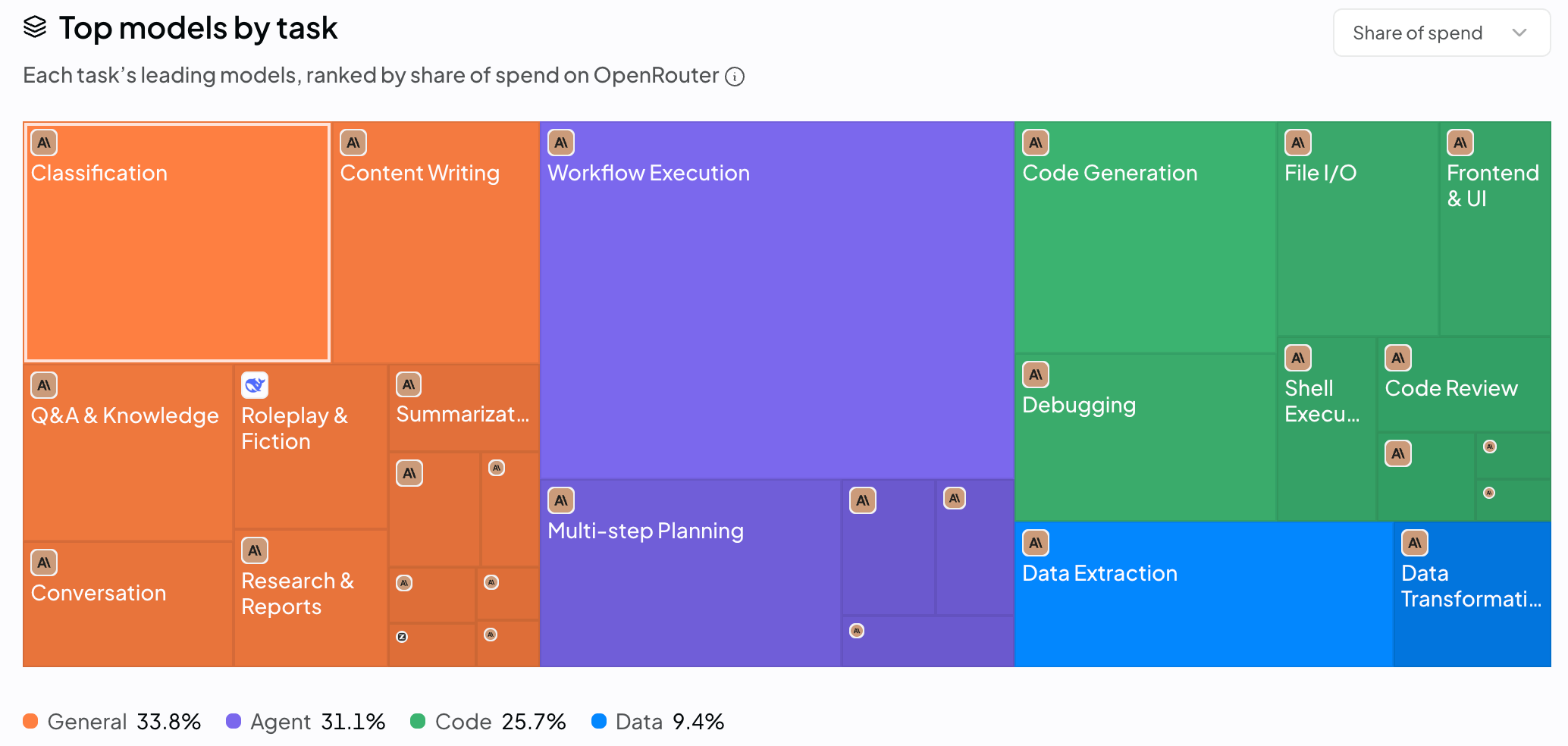
The evidence that frontier pricing power is real comes from the routing economics, the lab holding the top model (Anthropic) converts roughly 12% of routed token volume into roughly 46% of routed dollar share, and it passed its main rival, OpenAI in measured enterprise adoption this spring.
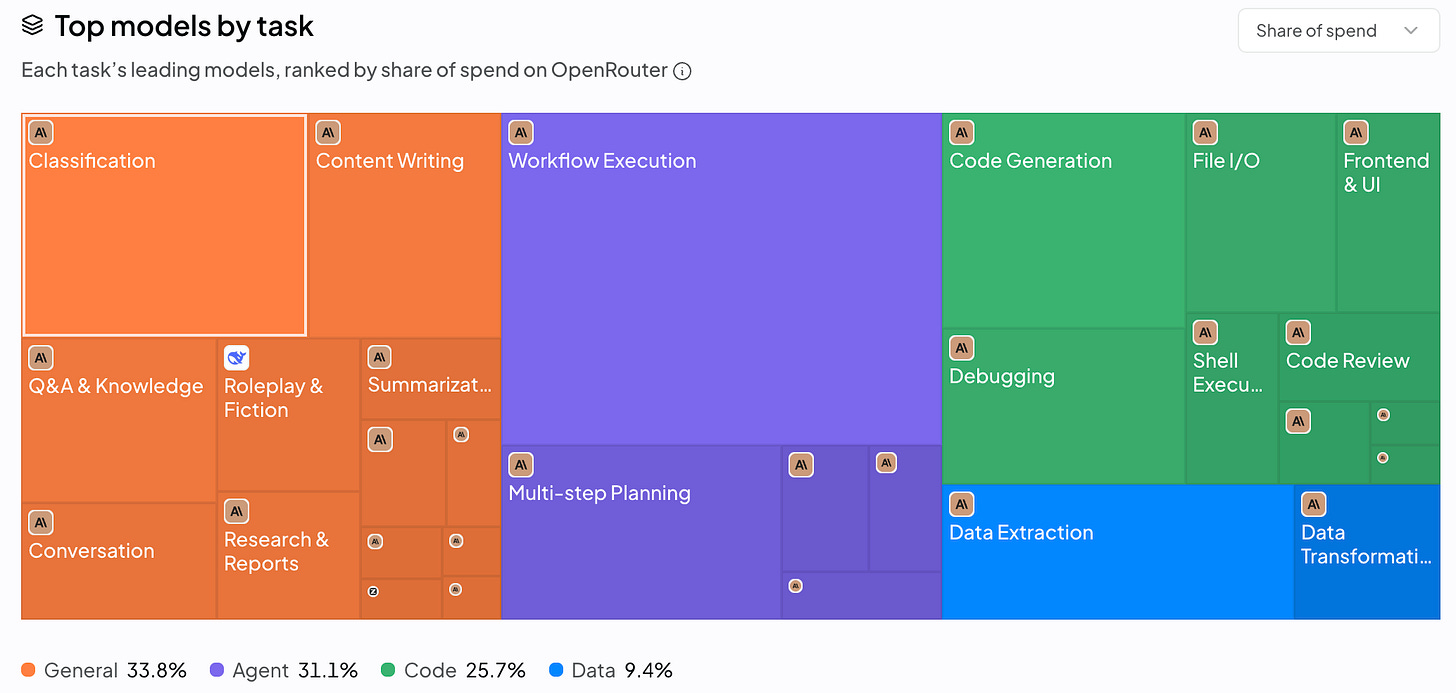
Share of AI spend by task, which is dominated by Anthropic, on OpenRouter as of 21st of July 2026.
At the task level, the frontier is frequently cheaper than the discount tier which is the deepest reason routing has not killed the frontier and will never.
The costly mistake of AI labs has been the flat consumer subscription, a $200 seat consuming up to $14,000 of compute at API-equivalent prices was the opposite of pricing the task, and the caps and tier restructuring now rolling through the industry are the model layer finally learning to charge for outcomes rather than seats.
The application layer (who owns the customer and the workflow) benefits from collapsing token prices with a structural margin tailwind.
Software captured the collapse of compute and bandwidth costs in exactly this way in prior cycles, and it is the mechanism behind the software mean-reversion setup I described in Software Armageddon, a sector priced as AI roadkill that is in fact the largest single buyer of a deflating input.
Alongside it, proprietary data and distribution appreciate mechanically, because when the model itself can be replicated in eight days, value migrates to whatever cannot be.

The capex arithmetic: can tokens service the AI capex
But can tokens pay for the AI capex?
As I have covered many times on this newsletter, AI spending has been skyrocketing in the last years.
Hyperscaler capex guidance for 2026 aggregates to roughly $700-750bn, up from around $443bn in 2025 and $256bn in 2024, with capital intensity running at 45 to 57% of revenue.
Depreciation for hyperscalers could compound 30-40% per year regardless of revenue growth.
The sector is expected to use massive amounts of debt (around $1.5tn) over the next few years to fund the AI buildout, on top of private-lab commitments, with OpenAI alone carrying close to $1.4tn of compute commitments.
Against this spending, we have the AI revenue pool. The challenge here is that nobody publishes a clean number for the global token dollar pool and most of the estimates that are out there conflate it with AI spending TAMs:
My own estimate sums disclosed and estimated hyperscaler AI revenue, with AI labs now having around $70bn of combined ARR (growing very rapidly), add to that AI-native applications and Chinese providers, and you get to a pool of roughly $150-200bn of annualized AI revenue in mid-2026.
Most of the research I read finds that current AI revenues is roughly in line with current depreciation at $120bn.
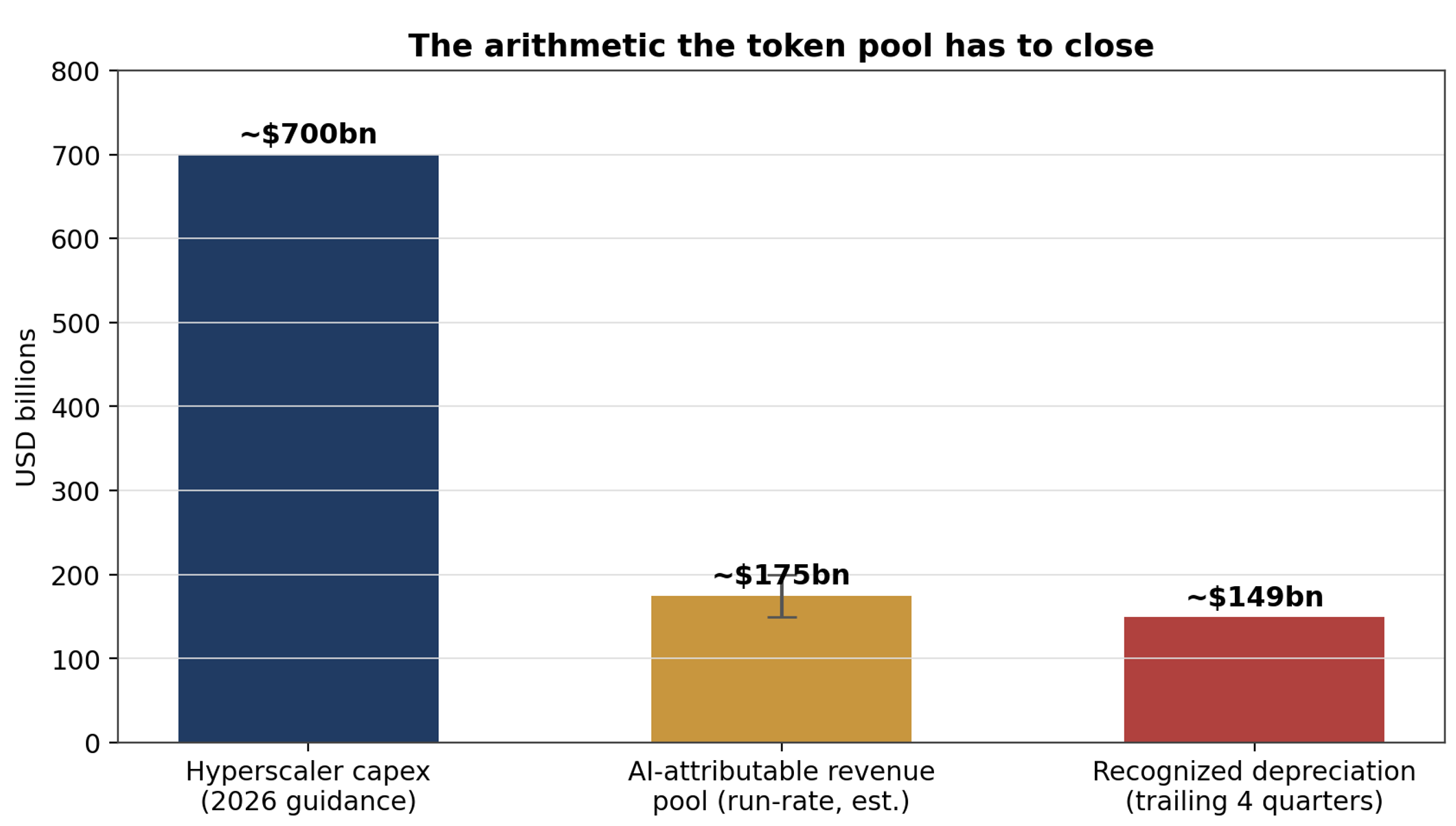
The 2026 arithmetic. Capex guidance aggregate versus my estimate of the annualized AI-attributable revenue pool and the trailing recognized depreciation of the four US hyperscalers.
Looking at the chart above and you see that we cannot compare current AI capex to AI revenue.
AI revenue must double every 18 to 24 months for the AI buildout to earn its cost of capital, on the order of $170bn or more of incremental AI revenue at run-rate by 2028, estimating that we require a mid-20s return on our AI spend.
Though this is a demanding hurdle, it is currently being met. As we discussed before, the expenditure index is up more than 60% in seven months, the largest AI platforms inside hyperscalers are growing at unheard rates of 60-120%, AI lab revenues are rising at triple digits, and token volume is up 7x to 15x year over year.
The bull case is not that the tokens pay for the capex today. It is that the growth rate of the AI revenue pool exceeds the growth rate of the depreciation, and today it does, by a wide margin.
So what would make this fail?
Frontier premium collapses, so the blended realized price per task falls faster than volume grows and the expenditure index starts to decline.
Optimization and mix shift together limit the dollar-pool growth below the 30 to 40% growth rate of hyperscaler depreciation.
Private AI labs, which fund a large share of the marginal compute demand (OpenAI and Anthropic have further increased their spending commitments this week) from external capital rather than revenue, lose access to that capital.
The biggest risks for token economics
The biggest and most convincing risk to the current token economics trajectory is that the token dollar pool grows, but that it accrues to the players that are not spending the most capex (like Chinese labs). Think of Chinese open weight models that serve tokens at 14% of US prices, increasingly using domestic silicon, so tokens would multiply while both the dollars per token and the leading-edge wafer content per token fall.
Optimization or an extreme focus on optimization could pressure token growth. Unclear ROI remains the single most-cited AI adoption hurdle, and only around 8% of enterprises run agents in production at scale (most agents remain in R&D).
The depreciation wave, meanwhile, arrives on schedule whatever revenue does, hyperscaler free cash flow conversion grinds toward 20%, a CFO changes his mind, and a board-level capex rationalization at two or three hyperscalers in the same quarter flows straight through the order books on which the entire toll-booth thesis rests.
In that world, the 2027 earnings the complex is priced on are revised down 30 to 50% at the same moment the multiple compresses, which is the mechanism that turns a consolidation into a full on correction.
Nothing in the last month of earnings supports that world, both toll booths raised guidance into the teeth of the selloff, but the bear case does not need this quarter’s earnings. It needs 2027’s, and 2027’s earnings are a bet on the growth rate of a revenue pool that is still barely a quarter the size of the capex line.
The most rapidly emerging risk that I see is that pricing power in the AI ecosystem breaks:
The frontier lead (still held by Anthropic) is now one point and roughly six weeks. Just sit with this for a second, the pace of innovation in AI is truly breathtaking.
If frontier pricing power breaks (would you pay $90/month to Anthropic if a new lab came out tomorrow with a similar model for a few dollars?), the pool keeps growing but its margin structure collapses to commodity economics all the way up the stack.
Because the AI labs cannot fund their training commitments from a commodity gross margin, the circular financing structures now deeply embedded in the value chain breaks and the marginal buyer of 2027 compute disappears.
Put another way, the entire complex is banking on the leading AI lab’s ability to maintain its lead.
I do not think that lead breaks but I think we need a certain level of humility given how quickly things change in this AI age.
What I am watching
The blended token expenditure index is the single most important statistic to watch to measure the adoption of AI, because it is price times mix across actually consumed paid traffic
Frontier rates and effective pricing. The next flagship model launches from OpenAI and Anthropic either increase prices or at least hold them steady or start getting under pressure due to the affordability of the models. Watch effective dollars per completed task.
Whether Anthropic can maintain its frontier lead. Look at Artificial Analysis’ benchmarks and whether Anthropic maintains its lead, expands it or whether the frontier gets consistently challenged.
Routed token mix and the self-hosting shadow. Monitor the Chinese share of routed volume, the US labs’ dollar share against their token share, and any evidence on the scale of self-hosted open-weight inference, which is the part of the market every aggregator undercounts.
Hyperscaler AI revenue against depreciation, every quarter. The one ratio that matters is whether disclosed AI revenue growth stays above the 30 to 40% compounding of the D&A line. The quarter that this ratio inverts is the quarter the capital-allocation conversation starts.
Tokens-processed disclosures, the closest thing we have to a volume census, to see whether the 7x annual pace is holding, accelerating or bending.
The optimization race, especially amongst the most sophisticated and AI native enterprises. Renewal shocks, spend caps, license cancellations.
AI lab funding and the circular deals, where a fracture would appear first, including the IPO filings that are coming and will eventually make the financials of the AI labs public and quarterly, a very useful source for AI investors.
Where this leaves the AI trade
The AI revolution and buildout will continue as long as the token dollar pool grows faster than the depreciation line, which is currently the case at twice the rate.
What could break this buildout is not cheap AI tokens (which grow the AI market) but a collapse in frontier differentiation or an AI capex slowdown.
Everything in the AI value chain is a derivative of two cost curves and the AI spread:
The AI infrastructure layer gets paid no matter the token price.
The AI adopters and the application layer are the next leg of the AI trade as they benefit from deflating token price through margin expansion.
AI labs, despite their massive valuations, are a concentrated bet on converting a small slice of the token volume pool into a big slice of the total token dollar pool.
Everything else in this AI value chain is, one way or another, a derivative of two curves and the spread between them.
Disclaimer: The information provided on this Substack is for general informational and educational purposes only, and should not be construed as investment advice. Nothing produced here should be considered a recommendation to buy or sell any particular security.
Excellent one.